Top places to stay in Milan, Italy.
Milan cultivated a tradition of refined hospitality through centuries of Lombard commerce, Renaissance patronage, and textile craftsmanship, with the rise of Italian fashion, international finance, and industrial innovation establishing the city as a European capital of luxury and design. Founded as the ancient settlement of Mediolanum, the city became an important center of the Roman Empire under Emperor Maximian in the late third century, establishing an enduring concentration of political authority and commercial activity in the Po Valley. During the medieval period, Milan's expanding mercantile economy supported powerful banking families, manufacturing guilds, and trading institutions whose wealth contributed to the development of substantial urban residences. The Visconti and Sforza dynasties subsequently transformed Milan into a major Renaissance court, commissioning palaces, churches, and civic institutions that established architectural traditions of enclosed courtyards, grand staircases, and richly decorated interiors. Under Spanish and Austrian administration, aristocratic families continued to develop substantial residences throughout the historic center, creating a legacy of palazzi that subsequently influenced the architectural character of prestigious urban accommodation. The opening of the Teatro alla Scala in 1778 strengthened Milan's position as an international cultural destination, attracting aristocratic patrons, musicians, and affluent travelers whose visits contributed to the development of sophisticated hospitality around the city's ceremonial center. Following Italian unification in 1861, Milan's accelerating industrial economy and expanding railway connections transformed the city into a major destination for commercial travelers, financiers, and international visitors. The opening of the Galleria Vittorio Emanuele II in 1867, designed by Giuseppe Mengoni, established a grand commercial environment connecting Piazza del Duomo with Piazza della Scala, concentrating prestigious shops, restaurants, and hospitality establishments beneath its celebrated iron-and-glass vaults. The Grand Hotel et de Milan, established in 1863, became an important institution of nineteenth-century European travel, acquiring particular cultural significance through its association with composer Giuseppe Verdi, who maintained a residence there during his final decades. The opening of Milano Centrale in 1931, designed by Ulisse Stacchini, reinforced the city's position within the European railway network and encouraged the development of substantial hotels along the grand avenues connecting the station with the commercial center. Milan's postwar economic expansion introduced a new generation of international business hotels as manufacturing, banking, publishing, and industrial design established the city as Italy's principal economic capital. The emergence of Milan Fashion Week and the international prominence of Salone del Mobile strengthened demand for sophisticated accommodation serving designers, fashion executives, collectors, and commercial delegations. The opening of the Four Seasons Hotel Milano in 1993 within a restored fifteenth-century convent demonstrated the potential of adapting historically significant architecture for contemporary luxury hospitality. The redevelopment of Porta Nuova and the completion of major projects associated with Expo 2015 subsequently accelerated investment in architecturally ambitious hotels, establishing a hospitality landscape that connects Milan's Renaissance inheritance with its international leadership in fashion, design, and contemporary urban development.
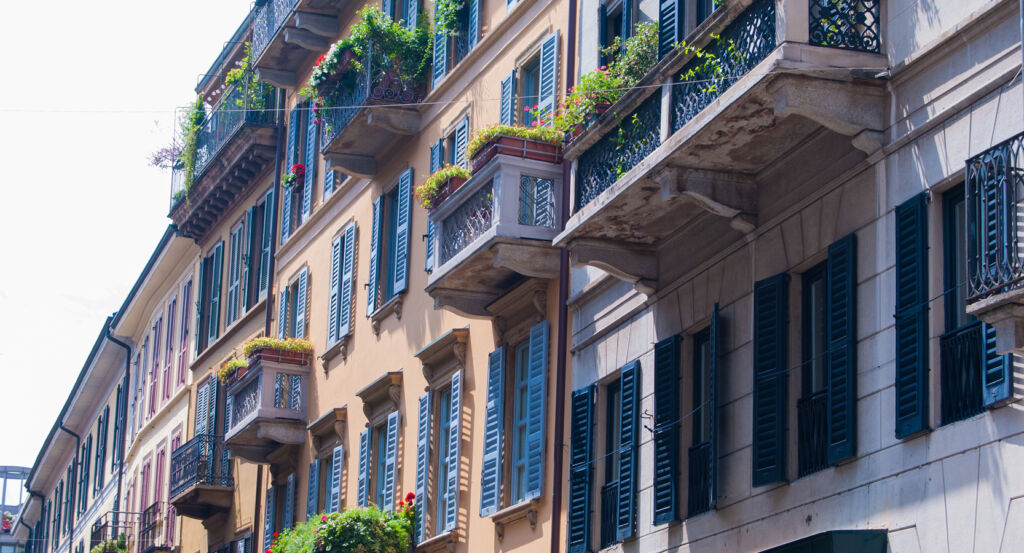
Milan's accommodation geography follows the historic concentration of political and religious institutions around the Duomo, the development of aristocratic residential districts surrounding the medieval center, and the expansion of commercial and architectural activity along the city's principal boulevards. The Centro Storico occupies the most prestigious position within this landscape, where luxury hotels stand near Piazza del Duomo, the Galleria Vittorio Emanuele II, and the grand civic buildings that define Milan's ceremonial center. The surrounding streets combine neoclassical façades, nineteenth-century commercial palaces, and substantial historic residences, establishing an accommodation environment closely connected to the city's principal cultural and retail institutions. The neighboring Quadrilatero della Moda, bounded by Via Montenapoleone, Via della Spiga, Via Alessandro Manzoni, and Corso Venezia, developed into one of Europe's most concentrated luxury fashion districts, with prestigious hotels occupying restored palazzi and discreet properties among the flagship boutiques of international fashion houses. Via Alessandro Manzoni contributes a particularly distinguished architectural setting through its concentration of historic residences, formal courtyards, and grand nineteenth-century buildings associated with Milanese aristocratic and commercial society. The Brera district developed around the historic artistic institutions of the Accademia di Belle Arti and Pinacoteca di Brera, retaining narrow streets, intimate courtyards, and residential palazzi that provide distinctive settings for boutique hotels and sophisticated urban retreats. Its accommodation character reflects the neighborhood's relationship with galleries, antique dealers, design studios, and longstanding cultural institutions. The adjoining district surrounding Via Solferino and Corso Garibaldi combines historic residential architecture with contemporary commercial development, connecting Brera's established urban fabric to the modern towers of Porta Nuova. The transformation of Porta Nuova introduced an entirely different architectural environment through the construction of glass-clad office towers, landscaped public spaces, and substantial mixed-use developments surrounding Piazza Gae Aulenti. The Unicredit Tower, designed by César Pelli, and Stefano Boeri's Bosco Verticale established internationally recognizable landmarks within a district increasingly associated with contemporary business hospitality and design-oriented accommodation. Farther east, the Porta Venezia district retains an exceptional concentration of late nineteenth- and early twentieth-century residential architecture, including elaborate Liberty-style buildings distinguished by floral ornament, decorative ironwork, sculptural façades, and sophisticated apartment interiors. Its proximity to Corso Buenos Aires and the landscaped avenues surrounding the Giardini Pubblici Indro Montanelli supports a varied accommodation landscape incorporating historic hotels and contemporary boutique properties. The area surrounding Milano Centrale developed through the expansion of railway infrastructure and twentieth-century commercial activity, with substantial hotels occupying prominent positions along Piazza Duca d'Aosta, Via Vittor Pisani, and the adjoining business corridors. South of the historic center, the Navigli district preserves the urban character of Milan's canal network, where former warehouses, artisan workshops, and residential buildings surround the Naviglio Grande and Naviglio Pavese. The adjoining Tortona district developed from an industrial landscape of factories and manufacturing premises into a center of contemporary design, fashion showrooms, and creative studios, supporting distinctive accommodations within adapted commercial and industrial buildings. Porta Romana combines historic residential streets with contemporary redevelopment, including the transformation of former railway and industrial land into new mixed-use districts. The southern neighborhoods retain a more intimate architectural character through enclosed courtyards, traditional Milanese residential buildings, and neighborhood commercial streets. Milan's accommodation landscape extends from aristocratic palazzi and grand commercial hotels to intimate artistic-quarter retreats, Liberty-style residences, contemporary business properties, and design-oriented accommodations integrated into former industrial neighborhoods. Foresyte may earn a commission when you book.
Foresyte Travel's top five choices.
5. Armani Hotel
Armani Hotel Milano occupies the 1937 rationalist building designed by Enrico A. Griffini on Via Alessandro Manzoni, placing Giorgio Armani's hospitality project inside the Quadrilatero della Moda where his fashion empire established its international identity. Armani personally directed the hotel's design according to his philosophy of eliminating unnecessary ornament, carrying the restrained materials, geometric forms and controlled proportions associated with his fashion work into architecture and interiors. The hotel forms part of Armani/Manzoni 31, the company's broader complex devoted to fashion, furnishings, dining and hospitality within the historic building. Its 2011 opening made Milan the second location in Armani's hotel partnership with Emaar Properties after Dubai, transforming the designer's home city into a permanent architectural expression of the brand he founded there in 1975.
4. Park Hyatt Milan
Park Hyatt Milan occupies a nineteenth-century palazzo directly beside the Galleria Vittorio Emanuele II, positioning the hotel inside the grand urban composition linking Piazza del Duomo with Teatro alla Scala. Architect Ed Tuttle transformed the building around a central cupola-covered courtyard, using travertine, Venetian stucco and classical proportions to establish a contemporary interior grounded in Italian architectural materials. The property opened in 2003 as Park Hyatt's first hotel in Italy, inserting the brand into the historic commercial center created during Milan's post-unification transformation. Its relationship with the Galleria gives the hotel unusual urban significance, connecting contemporary hospitality directly with Giuseppe Mengoni's great nineteenth-century passage and the civic axis at the center of Milan.
3. Mandarin Oriental, Milan
Mandarin Oriental, Milan occupies four interconnected eighteenth-century buildings on Via Andegari, a short distance from Teatro alla Scala within the historic center of the city. Antonio Citterio Patricia Viel transformed the ensemble for its 2015 opening, organizing the hotel around traditional Milanese courtyards and combining residential proportions with furniture, lighting and materials rooted in twentieth-century Italian design. The project marked Mandarin Oriental's entrance into Italy and placed the Asian hospitality group inside a city whose modern international reputation was shaped substantially by architecture, industrial design and fashion. Chef Antonio Guida subsequently gave the property independent gastronomic importance through Seta, whose two MICHELIN stars established the restaurant among Milan's highest-ranked dining institutions.
2. Bulgari Hotel Milano
Bulgari Hotel Milano became Bulgari's first hotel in 2004, establishing the hospitality model that the Roman jewelry house subsequently expanded to destinations across Europe, Asia and the Americas. Antonio Citterio Patricia Viel transformed an eighteenth-century Milanese palazzo on Via Privata Fratelli Gabba, pairing dark Zimbabwe granite, teak, oak and Italian stone with a restrained architectural language derived from Bulgari's approach to materials and craftsmanship. The property adjoins a 4,000-square-meter private garden containing mature trees and botanical remnants associated with Milan's former Brera horticultural grounds, creating an unusually substantial landscape within the dense historic center. Its success turned Milan into the origin point of Bulgari's international hotel business and established Citterio's architectural direction as a defining component of the hospitality brand.
1. Four Seasons Hotel Milano
Four Seasons Hotel Milano occupies a former fifteenth-century convent established by the Humiliati within Milan's Quadrilatero della Moda, preserving one of the district's oldest surviving architectural layers beneath its later hospitality use. The complex passed through secular ownership after the suppression of the religious order and accumulated centuries of alterations before Four Seasons commissioned architect Paolo Portoghesi to transform the property into a hotel in the 1990s. Portoghesi organized the restoration around the surviving cloister, exposed original columns, vaulted spaces and fragments of fresco decoration, allowing the convent's physical structure to govern the modern plan. The 1993 opening marked Four Seasons' first property in continental Europe, making the Milan hotel both an adaptive reuse of a Renaissance religious complex and a consequential step in the company's international expansion.
Where your story begins.
Foresyte Travel reveals places that feel extraordinary long before you arrive.
Enjoy editorial crafted for luxury travelers.
Foresyte may earn a commission when you book.