Top places to stay in Mexico.
Cancún's began with an ambitious national tourism initiative that transformed a sparsely populated stretch of the Yucatán Peninsula into an international hotel center. For centuries, the surrounding coastline formed part of the Maya world, whose communities maintained maritime trading routes connecting settlements along the Caribbean with inland ceremonial and commercial centers. During the colonial period, the northeastern peninsula remained relatively isolated from Mexico's principal urban economies, and fishing communities occupied scattered coastal settlements. Modern Cancún emerged from a federal strategy to diversify tourism beyond established destinations such as Acapulco. In 1969, Mexican planners selected the barrier island and adjoining mainland for a purpose-built resort, attracted by its beaches, turquoise waters, and potential for international aviation connections. The project became a flagship undertaking of the National Fund for Tourism Development, FONATUR, which coordinated infrastructure, land planning, and private investment. Construction began in 1970, establishing a hotel corridor on the island and a residential city on the mainland to accommodate the growing workforce. The Playa Blanca Hotel welcomed guests in 1974, joining the first generation of properties that introduced Cancún to international travelers. The opening of Cancún International Airport that year provided the essential connection between the emerging resort and major North American markets. During the 1980s, substantial beachfront hotels expanded along the island's eastern shore, and international hospitality companies established a strong presence. Hurricane Gilbert caused extensive damage in 1988, prompting reconstruction and improvements to coastal infrastructure. The development of all-inclusive accommodation subsequently reshaped the destination's commercial identity, combining lodging, dining, entertainment, and recreation within integrated beachfront properties. Hurricane Wilma devastated sections of the resort corridor in 2005, leading to major renovations and extensive beach restoration. The opening of the Moon Palace resort complex south of the principal hotel zone contributed to the expansion of large-scale luxury hospitality along the Riviera Maya corridor. More recently, sophisticated adults-only properties, design-oriented resorts, and elevated wellness offerings have diversified the market. Cancún's hotel industry represents one of Latin America's most consequential examples of planned tourism development, combining the economic ambitions of modern Mexico with the extraordinary natural appeal of the Caribbean coast.
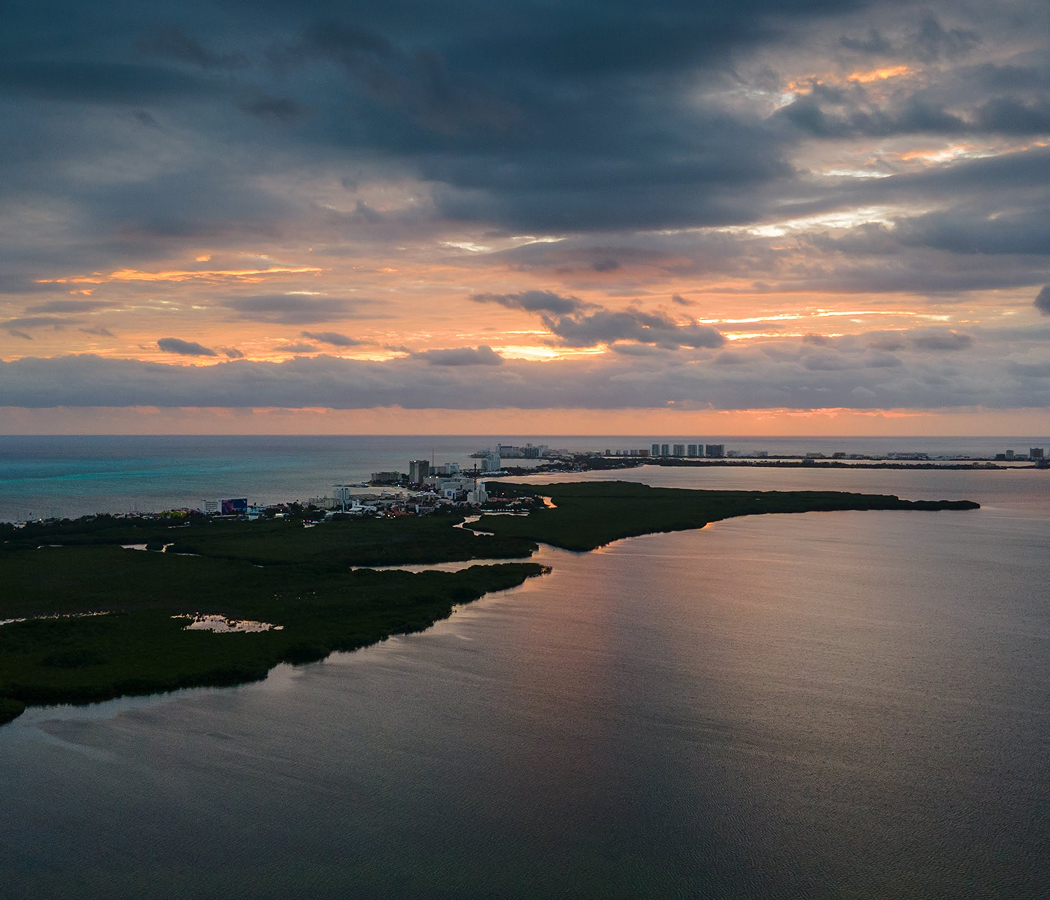
Cancún occupies a distinctive coastal landscape where a narrow barrier island separates the Caribbean Sea from the sheltered waters of Nichupté Lagoon, creating two contrasting waterfront environments within its principal resort district. The Hotel Zone follows the elongated island along Boulevard Kukulcán, with substantial beachfront properties arranged beside broad stretches of pale sand and luminous turquoise water. At its northern end, the shoreline curves around calmer bays near Playa Caracol and Playa Tortugas, where hotels occupy compact waterfront sites with convenient access to marinas, ferry terminals, and recreational facilities. The surrounding waters are generally more sheltered, creating attractive conditions for swimming and boating. Farther east, Punta Cancún forms the island's principal entertainment center, with substantial resorts, shopping complexes, restaurants, and nightlife venues concentrated near the prominent headland. Contemporary hotel towers overlook the surrounding Caribbean, and pedestrian routes connect the district's commercial attractions. Southward, the eastern beachfront extends through a succession of substantial luxury properties facing open water. Playa Chac Mool and Playa Marlin provide broad sandy settings, with hotels emphasizing expansive terraces, landscaped swimming pools, and direct access to the shoreline. The architecture combines contemporary high-rise buildings with low-rise resort wings organized around tropical gardens and open-air public spaces. Near La Isla, substantial shopping and dining facilities overlook Nichupté Lagoon, introducing a quieter waterside atmosphere through boardwalks, terraces, and sunset views. Farther south, Playa Delfines occupies one of the coast's most dramatic open-beach settings, with extensive sand dunes and uninterrupted Caribbean panoramas. Resorts along this stretch emphasize spacious grounds, ocean-facing accommodation, and a more secluded environment. Near Punta Nizuc, the island narrows toward a sheltered southern headland, where exclusive luxury properties occupy substantial landscaped sites overlooking reefs, mangroves, and protected coastal waters. The surrounding natural environment provides an intimate alternative to the busier northern hotel corridor. Across the lagoon, Downtown Cancún offers an entirely different accommodation landscape through contemporary business hotels, smaller independent properties, and established residential neighborhoods. Avenida Tulum and the surrounding commercial streets provide convenient access to restaurants, markets, and transportation connections. The Puerto Cancún district occupies a developing waterfront setting near the northern entrance to the Hotel Zone, with luxury residences, marina facilities, and contemporary hotels integrated into a sophisticated mixed-use environment. North of the city, Costa Mujeres and Playa Mujeres extend along a quieter mainland coastline facing Isla Mujeres, where extensive resort properties occupy broad beachfront sites amid tropical vegetation. Luxury accommodation emphasizes spacious grounds, private beach facilities, and a more secluded atmosphere. Across Cancún, lodging ranges from lively high-rise beachfront hotels and integrated all-inclusive resorts to intimate urban boutiques and exclusive coastal retreats, with the Caribbean shoreline and lagoon system shaping the destination's exceptional accommodation geography. Foresyte may earn a commission when you book.
Foresyte Travel's top five choices.
5. Grand Velas Riviera Maya
Grand Velas Riviera Maya opened in 2008 along the Caribbean coast north of Playa del Carmen as a major project of the Mexican-owned Velas Resorts group. The Vela family built the company from Eduardo Vela Ruiz's early hospitality investments into a portfolio distinguished by large-scale Mexican resort development. Architects Ricardo Elias and Elias Elias organized Grand Velas across distinct coastal, mangrove, and jungle environments, using the Riviera Maya landscape to determine the physical character of different sections of the property. Its arrival formed part of the extraordinary expansion that transformed the coastline south of Cancún into an internationally important resort corridor during the late twentieth and early twenty-first centuries. Grand Velas represents the rise of a Mexican family-controlled hospitality company within the large-scale resort economy that reshaped the Riviera Maya.
4. Le Blanc Spa Resort Cancún
Le Blanc Spa Resort Cancún occupies the Caribbean shoreline of the Hotel Zone, the narrow barrier island whose planned development transformed Cancún from a sparsely inhabited coast into an international resort city. Mexico's tourism agency selected the Cancún area for development 1970, using infrastructure investment and purpose-built hotels to establish a new economic center on the Yucatán Peninsula. Palace Resorts created Le Blanc as its adults-only luxury concept, placing a Mexican hospitality company within the destination produced by that national tourism initiative. A substantial transformation completed in 2019 reworked the property through contemporary interiors and a restrained architectural palette centered on the surrounding Caribbean light. Le Blanc represents the continuing reinvention of Cancún's original Hotel Zone as locally founded hospitality groups move established beachfront sites into increasingly specialized segments.
3. Kempinski Hotel Cancún
Kempinski Hotel Cancún occupies a prominent Caribbean beachfront site within the southern portion of Cancún's Hotel Zone, a district created through one of Mexico's most ambitious twentieth-century tourism programs. The property opened in 1993 as The Ritz-Carlton, Cancún, becoming an important early international luxury hotel during the destination's rapid expansion beyond its formative resort developments. Its architecture adopted formal courtyards, arcades, stonework, and classical proportions that gave the property a deliberately residential character within Cancún's increasingly dense beachfront corridor. Kempinski assumed management in 2022, bringing the European hospitality company descended from Berthold Kempinski's nineteenth-century enterprise into the building after nearly three decades under Ritz-Carlton. The hotel's successive international affiliations trace the maturation of Cancún from a state-planned tourism project into one of the Caribbean region's most established resort markets.
2. Waldorf Astoria Riviera Maya
Waldorf Astoria Riviera Maya opened in 2022 on the Caribbean coast south of Cancún International Airport, extending Hilton's historic luxury brand into the rapidly developing coastal territory beyond the Hotel Zone. SB Architects designed the resort as a sequence of low-rise structures embedded within mangrove vegetation, with architecture organized around water, shaded passageways, courtyards, and broad relationships with the sea. HBA San Francisco developed interiors using stone, timber, woven materials, and references to regional craft traditions across the Yucatán Peninsula. The property forms part of the continuing southward expansion of greater Cancún's resort geography toward the Riviera Maya, a process that has created extensive hospitality development along formerly sparsely built coastline. Waldorf Astoria represents the newest generation of international resort investment reshaping the Caribbean edge of Quintana Roo.
1. NIZUC Resort & Spa
NIZUC Resort & Spa occupies Punta Nizuc at the southern end of Cancún's Hotel Zone, where the Caribbean Sea meets the protected waters bordering the Nichupté Lagoon system. The site previously contained a Mexican presidential retreat before developer Grupo Brisas transformed the coastal property into NIZUC, which opened in 2013. Architect Alejandro Escudero designed a low-rise composition of stone, timber, water courts, gardens, and pavilions distributed across the peninsula, using horizontal forms to preserve the visual dominance of sea and sky. Interior designer Sam Robin extended the architectural program through natural materials and restrained spaces shaped around the tropical setting. NIZUC converts a former state retreat on one of Cancún's most geographically distinctive sites into a contemporary expression of Mexican-developed coastal hospitality.
Where your story begins.
Foresyte Travel reveals places that feel extraordinary long before you arrive.
Enjoy editorial crafted for luxury travelers.
Foresyte may earn a commission when you book.