
Why Terasa U Zlaté Studně matters.
Terasa U Zlaté Studně is a distinguished Czech fine-dining restaurant where Malá Strana's Renaissance heritage meets Lukáš Hlaváček's internationally developed cooking, the hospitality traditions of Golden Well Hotel and one of Prague's most remarkable panoramic dining settings.
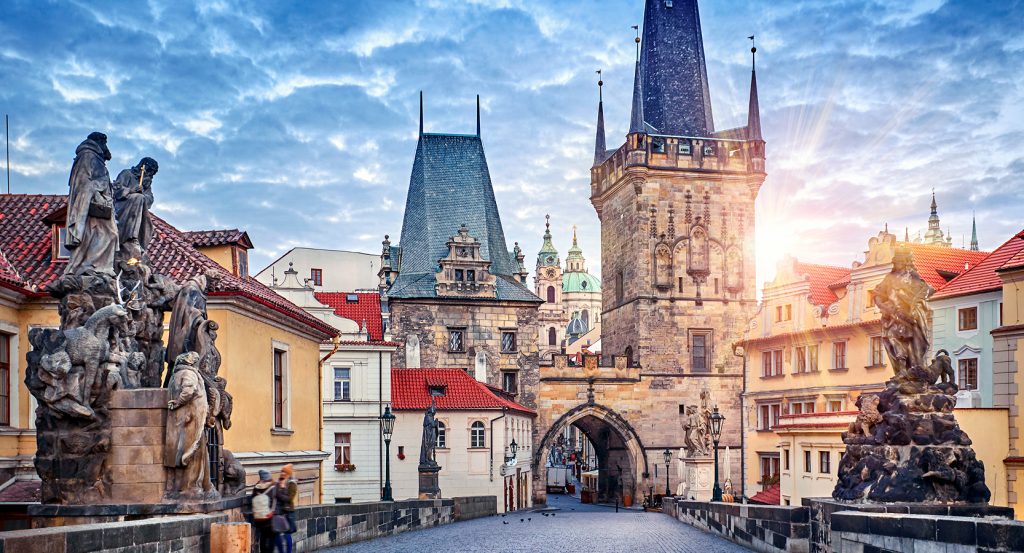
Positioned on the uppermost floor of Golden Well Hotel directly beneath Prague Castle, the restaurant occupies an elevated hillside setting between the Ledeburg Palace Gardens, the historic streets surrounding Valdštejnské náměstí and the eastern approaches to the castle complex. Its principal rooftop terrace overlooks the red-tiled roofs of Malá Strana, the Vltava and the towers of Prague's Old Town. Two outdoor terraces and an enclosed dining area provide distinct settings across the seasons, with the principal restaurant accommodating forty guests. Italian architects Lorenzo Carmellini and Katrin Herden developed the contemporary interior, incorporating Renaissance references into an arrangement of elegant furnishings and carefully controlled lighting. A smaller bar terrace extends the hospitality program through a more intimate setting, complemented by a dedicated collection of premium cognacs. The result is an exceptional hillside restaurant whose historic surroundings, accomplished contemporary design and commanding views establish a memorable setting for fine dining in Prague.
What defines Terasa U Zlaté Studně.
Terasa U Zlaté Studně is best known for bringing contemporary fine dining to a Renaissance-era property whose historical associations reach into the imperial court of Rudolf II. The building's origins date to 1528, placing its development within the architectural transformation of Malá Strana during the early Habsburg period. Its subsequent history became associated with Emperor Rudolf II, whose court established Prague as an important European center of scientific inquiry, collecting and artistic patronage. The astronomer Tycho Brahe resided in the property during his period in Prague, connecting the building with the intellectual environment surrounding the imperial court. By 1900, the premises accommodated a small tavern whose elevated position already attracted attention for its views across the city. The development of Golden Well Hotel subsequently transformed the historic building into an intimate luxury property, preserving its Renaissance character through a contemporary hospitality program. The restaurant emerged as the principal culinary destination within the hotel, extending the building's longstanding association with hospitality into an internationally recognized fine-dining enterprise. Its development included substantial architectural improvements that connected the upper dining spaces with the surrounding terraces and established a more ambitious restaurant environment. In April 2013, the establishment joined the Moët & Chandon Privilèges program, an international initiative reserved for a selected group of distinguished restaurants. The recognition reflected the growing importance of its beverage service within the broader hospitality operation. The hotel subsequently renovated its fourth-floor interior and outdoor bar terrace in August 2013, expanding the facilities available to restaurant guests. A further architectural intervention by Lorenzo Carmellini and Katrin Herden introduced a contemporary interior informed by the building's Renaissance heritage. Their work established a visual relationship between the historic property and the restaurant's increasingly sophisticated culinary ambitions. Executive chef Lukáš Hlaváček subsequently became central to its development, bringing extensive professional experience from MICHELIN-starred restaurants in Europe and the United States. His training included an appointment at The Ledbury in London, where he progressed to the position of sous-chef during three years in the kitchen. The restaurant's demanding technical environment established an important foundation for his contemporary approach to European cooking. Hlaváček continued his international development at The Restaurant at Meadowood in California's Napa Valley, an establishment that held three MICHELIN stars during his tenure. Returning to the Czech Republic, he assumed the position of executive chef at Alcron in Prague, extending his reputation within the country's fine-dining industry. Forbes subsequently included him among its Czech 30 Under 30 honorees, recognizing his professional achievements at an early stage of his career. His appointment at Terasa U Zlaté Studně introduced a chef with substantial international experience to a restaurant already distinguished by its architectural setting and established hospitality reputation. Under his leadership, the kitchen developed a contemporary European repertoire emphasizing seasonal ingredients, precise technique and accomplished presentation. The restaurant received three toques from Gault & Millau in its 2026 Czech selection, reinforcing its position among the country's distinguished fine-dining establishments. Its significance rests on the convergence of a historically consequential Prague property, an internationally trained culinary leader and a restaurant program whose architectural setting has become inseparable from its reputation.
How Terasa U Zlaté Studně fits.
Terasa U Zlaté Studně works as the dining culmination of an exploration connecting Prague's Baroque aristocratic patronage, the preservation of its Renaissance gardens and the artistic collections assembled by one of Bohemia's most influential noble families, placing the restaurant within the historical landscape beneath Prague Castle.
Begin at Wallenstein Garden, the expansive Baroque landscape developed between 1623 and 1630 as part of the palace commissioned by Albrecht von Wallenstein. One of the most powerful military and political figures of the Thirty Years' War, Wallenstein assembled an extensive urban estate intended to rival the grandeur of the royal residences above Malá Strana. Italian architects and craftsmen contributed to the development of its formal garden, establishing an arrangement of geometric pathways, ornamental planting and expansive decorative features. The eastern section incorporates an elaborate sala terrena, a garden pavilion whose painted ceiling and architectural composition connect the surrounding landscape with the ceremonial interiors of the palace. A distinctive artificial grotto wall, ornamental pond and sculptures associated with the workshop of Adrian de Vries preserve the artistic ambitions of early seventeenth-century aristocratic patronage. Continue to Ledeburg Garden, the historic terraced landscape developed along the steep hillside immediately beneath Prague Castle. Its Baroque arrangement emerged during the eighteenth century through the transformation of earlier gardens associated with the adjoining aristocratic palace. Architecturally composed terraces, retaining walls and ornamental stairways organize the steep terrain into a sequence of distinct garden spaces. A decorative sala terrena and sculptural features introduce the formal style of Baroque garden design, connecting the cultivated landscape with the surrounding palace architecture. The garden forms part of the UNESCO-listed historic gardens beneath Prague Castle, preserving an important example of the adaptation of aristocratic landscaping to Prague's distinctive topography. Conclude at Lobkowicz Palace, the sixteenth-century aristocratic residence situated within the Prague Castle complex. The building became associated with the Lobkowicz family, whose political influence and cultural patronage contributed substantially to the development of Bohemian society. Its historical collections preserve paintings, decorative arts, manuscripts and musical materials accumulated through successive generations of the family. Particularly significant holdings include original manuscripts and early editions associated with Ludwig van Beethoven, whose professional relationship with Prince Joseph Franz Maximilian Lobkowicz became central to the composer's aristocratic patronage. The palace museum connects these collections with the architectural history of the residence, establishing an exceptional encounter with the cultural achievements of Central European nobility. The progression connects the expansive ambitions of Baroque aristocratic landscaping with the preservation of Prague's terraced palace gardens and concludes at an internationally significant private collection, establishing the broader historical setting surrounding Terasa U Zlaté Studně.
Where your story begins.
Foresyte Travel reveals places that feel extraordinary long before you arrive.
Enjoy editorial crafted for luxury travelers.





































































































