
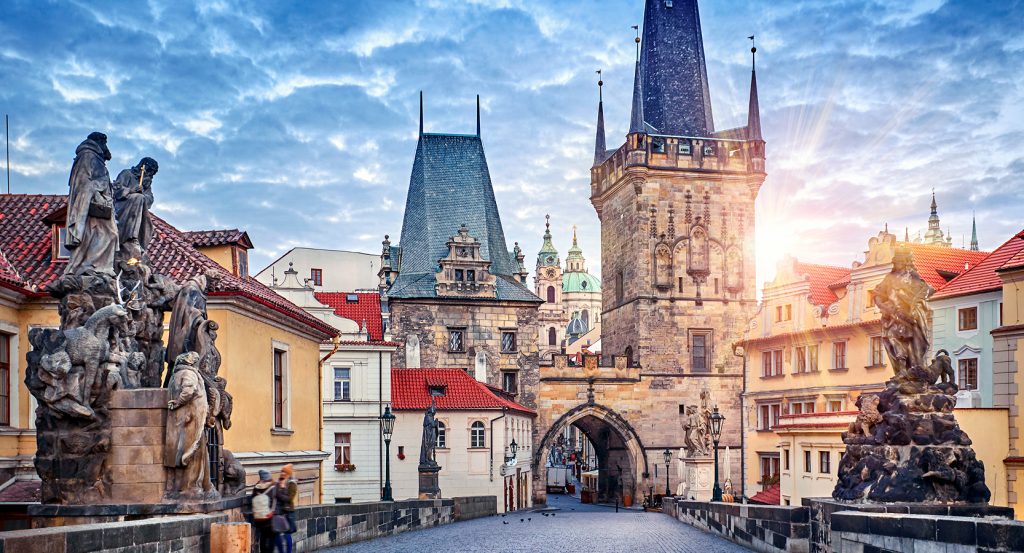
Why Charles Bridge matters.
Charles Bridge is a fourteenth-century stone crossing where Old Town's medieval commercial heritage meets the royal ambitions of Charles IV, the engineering of Gothic Prague and the religious sculpture that shaped the Vltava's principal ceremonial passage.
Extending across the Vltava River between the Old Town and Malá Strana, the bridge occupies a central position in Prague's historic urban geography, connecting the eastern riverbank near Křižovnické Square with the western approach to Mostecká Street beneath the castle district. Sixteen stone arches support its pedestrian roadway above the river channel and adjoining islands. Sandstone parapets carry sculptural groups positioned along both sides of the crossing. Fortified gateways frame the approaches, preserving the bridge's relationship with Prague's medieval street network. The result is a Gothic river crossing whose structural engineering, sculptural decoration and urban position preserve six centuries of Bohemian political and religious history.
What defines Charles Bridge.
Charles Bridge is best known for its construction under Charles IV as the principal medieval crossing between Prague's royal and commercial districts. The earlier Judith Bridge, completed during the reign of Vladislaus II in the twelfth century, had provided a permanent stone connection across the Vltava. Severe flooding in 1342 destroyed substantial portions of that structure, interrupting a major route through the Bohemian capital. Charles IV commissioned its replacement during a period of extensive investment in Prague's fortifications, churches and civic infrastructure. Construction traditionally began on 9 July 1357, a date associated with the numerical sequence 135797531 and the emperor's interest in auspicious ceremonial timing. Master builder Peter Parler, whose architectural work included major royal and ecclesiastical commissions, became closely associated with the bridge's construction. The new crossing was positioned upstream from its predecessor, allowing a more substantial arrangement of piers and arches across the river. Sandstone masonry formed the principal structural fabric, supported by foundations designed to withstand the river's changing water levels. The bridge's completion during the early fifteenth century secured a permanent route connecting the Old Town with the western bank and the approaches to Prague Castle. Its roadway became part of the Royal Route used by Bohemian monarchs traveling through the capital for coronation ceremonies. Commercial traffic, religious processions and military movements subsequently relied upon the crossing. Floods repeatedly threatened its structural integrity, including major damage during the inundation of 1890, when several arches collapsed. Reconstruction restored the affected spans and strengthened the surviving structure. The bridge remained an important transport artery until twentieth-century changes redirected vehicular movement toward newer crossings. Pedestrianization in the second half of the twentieth century consolidated its function as a historic public passage within Prague's protected urban center.
Matthias Bernard Braun's sculpture of Saint Luthgard represents one of the principal artistic commissions installed along the bridge during the Baroque period. Completed in 1710, the group depicts the saint receiving a vision of the crucified Christ, incorporating deeply modeled figures and an elaborate arrangement of drapery. The sculpture belongs to a broader program of Catholic religious imagery developed principally between the late seventeenth and early eighteenth centuries. Jan Brokoff and his son Ferdinand Maximilian Brokoff contributed works associated with saints, religious orders and devotional traditions. The bronze statue of Saint John of Nepomuk, installed in 1683, occupies a position connected with the martyrdom of the Bohemian priest, who was thrown into the Vltava in 1393. Its sculptural composition incorporates relief panels depicting episodes associated with his life and death. The statue became an important destination for Catholic devotion, contributing to the bridge's religious significance during the Habsburg period. Sculptural groups representing Saints Cyril and Methodius, Saint Francis Xavier and other religious figures extend the program across the crossing. Several original works were subsequently transferred to museum collections for conservation, with replicas occupying their former positions. The Old Town Bridge Tower rises above the eastern entrance through a composition of pointed arches, sculptural niches and royal heraldry. Its architectural decoration incorporates figures associated with Charles IV, Wenceslaus IV and the patron saints of Bohemia. The western approach passes through the Lesser Town Bridge Towers, whose surviving medieval structures preserve successive phases of defensive construction. Stone steps and adjoining embankments connect the bridge with Kampa Island and the lower riverfront. Charles Bridge's physical character develops through the relationship between its medieval masonry, Baroque religious sculpture and fortified gateways, preserving successive periods of Prague's architectural history within a continuous pedestrian crossing.
How Charles Bridge fits.
Charles Bridge works as the historic river-crossing centerpiece for a Prague outing connecting the Vltava's medieval infrastructure with the religious institutions, palace architecture and public spaces of Malá Strana.
Begin at Kampa Island, the riverfront district separated from Malá Strana by the Čertovka channel. Its development was closely associated with medieval milling activity, supported by water diverted through the narrow channel. Historic mill buildings and surviving waterwheels preserve elements of the island's industrial history. The surrounding residential streets contain Baroque houses and former workshops developed during successive phases of occupation. Kampa Park extends along the western bank of the Vltava, providing views toward the river's eastern embankment. The Museum Kampa occupies the former Sova Mills complex and contains collections devoted to Central European modern art, including works associated with František Kupka and Otto Gutfreund. Continue to St. Nicholas Church, the Baroque church dominating Malostranské Square. Construction began in 1704 under Christoph Dientzenhofer, with subsequent work directed by his son Kilian Ignaz Dientzenhofer. Its substantial dome and bell tower rise above the surrounding palace buildings, contributing to the architectural composition of the Lesser Town. The interior contains extensive fresco decoration, marble architectural elements and sculptural ornament associated with the Jesuit order. Johann Lukas Kracker painted the principal ceiling fresco depicting scenes from the life of Saint Nicholas. The church's organ is associated with performances by Wolfgang Amadeus Mozart during his visits to Prague. Conclude at Wallenstein Palace, the seventeenth-century residence commissioned by Albrecht von Wallenstein, the military commander who served Emperor Ferdinand II during the Thirty Years' War. Construction began in 1623, combining existing properties into a substantial palace complex designed to demonstrate Wallenstein's political position. Its architecture incorporates Italian Renaissance and early Baroque influences, including a formal garden organized around an expansive loggia. The garden contains bronze sculptures, fountains and carefully arranged planting beds. The palace subsequently became the seat of the Senate of the Czech Republic, preserving its institutional importance within the historic Lesser Town. The progression moves from Kampa's riverfront manufacturing history through St. Nicholas Church's Jesuit architecture and culminates at Wallenstein Palace's aristocratic gardens, connecting Charles Bridge with the religious and political development of Prague's western districts.
Where your story begins.
Foresyte Travel reveals places that feel extraordinary long before you arrive.
Enjoy editorial crafted for luxury travelers.
Foresyte may earn a commission when you book.





































































































