Perfect weekend in Toronto, Ontario.
Toronto's rise from an Indigenous gathering place on the northern shore of Lake Ontario to Canada's largest city unfolded through centuries of commerce, immigration, political change, and industrial expansion. The region formed part of an extensive network of Indigenous trading and transportation routes connecting Lake Ontario with Georgian Bay and the Upper Great Lakes. The Toronto Carrying-Place Trail facilitated movement between waterways, supporting trade among Indigenous nations long before European settlement. French traders established Fort Rouillé in 1750, strengthening commercial connections with the interior before abandoning the post during the Seven Years' War. British colonial authorities founded the Town of York in 1793 under Lieutenant Governor John Graves Simcoe, who selected the settlement as the capital of Upper Canada. American forces captured York during the War of 1812, destroying military and government property in an attack that exposed the settlement's strategic importance. Incorporated as Toronto in 1834, the growing city became an important center of banking, manufacturing, publishing, and railway transportation. The arrival of successive immigrant communities during the nineteenth and twentieth centuries transformed its social and commercial institutions, particularly following the expansion of Canadian immigration during the postwar decades. The amalgamation of six municipalities in 1998 created the modern City of Toronto, bringing together established communities across an extensive metropolitan territory. Its position as Canada's principal financial center developed alongside an increasingly international population, major universities, and cultural institutions that contributed to its influence across North America.
Toronto's artistic reputation extends through Canadian literature, international cinema, contemporary architecture, and a culinary culture shaped by immigration from across the world. The Art Gallery of Ontario, founded in 1900, developed one of Canada's most substantial art collections, including important works by the Group of Seven, Indigenous artists, and international modernists. Frank Gehry's architectural renovation, completed in 2008, transformed the institution through a sculptural glass façade and extensive gallery improvements. The Four Seasons Centre for the Performing Arts, designed by Diamond and Schmitt Architects, became the permanent home of the Canadian Opera Company and the National Ballet of Canada in 2006. The Toronto International Film Festival, established in 1976, grew into one of the world's most influential film events, attracting international premieres, filmmakers, and audiences each September. Toronto's literary heritage includes Margaret Atwood, Michael Ondaatje, and Dionne Brand, whose works have contributed substantially to Canadian and international literature. The city's musical traditions encompass jazz, classical performance, hip-hop, and the influence of Caribbean communities, with artists including Drake and The Weeknd contributing to Toronto's international reputation in contemporary popular music. Its culinary landscape incorporates Cantonese dim sum, Indian regional cooking, Caribbean specialties, Italian traditions, and the diverse cuisines of Southeast Asia and the Middle East. Ontario's agricultural production supplies seasonal vegetables, orchard fruits, freshwater fish, and regional wines, supporting contemporary restaurants that combine Canadian ingredients with international culinary techniques. A perfect weekend in Toronto brings together the city's historical foundations, multicultural neighborhoods, artistic achievements, and exceptional dining traditions along the shores of Lake Ontario.
Three day itinerary.
Day 1: The Distillery Historic District
The Distillery Historic District is best known for preserving the immense Victorian industrial complex built around Gooderham & Worts, once one of the largest distilling enterprises in the world. William Gooderham and James Worts established their partnership during the nineteenth century, expanding from milling into whisky production as Toronto grew into a major commercial center. Brick warehouses, fermenting cellars, processing buildings, chimneys, and courtyards accumulated into an unusually complete industrial precinct connected to rail and Great Lakes trade. Declining distilling activity eventually left the complex available for redevelopment, and its surviving structures were adapted into galleries, workshops, restaurants, shops, and cultural spaces. The pedestrianized district preserves industrial Toronto at extraordinary scale, embedding contemporary cultural life within the manufacturing architecture that helped build the city's nineteenth-century economy.
Day 1: Alo
Alo is best known for Patrick Kriss's tasting-menu cooking and its central role in Toronto's emergence as a serious international fine-dining city. Kriss developed his technique in demanding European kitchens before returning to Canada and building a cuisine grounded in French discipline, seasonal ingredients, and meticulously calibrated sauces. The restaurant occupies an upper floor of a heritage building at Queen Street West and Spadina Avenue, separating its intimate dining rooms from one of Downtown's busiest intersections. Multi-course menus move through seafood, vegetables, meats, and desserts with classical technique governing a distinctly contemporary presentation. Alo holds one MICHELIN star in the 2026 Toronto selection, sustaining its position among the restaurants that define the city's upper culinary tier.
Day 2: CN Tower
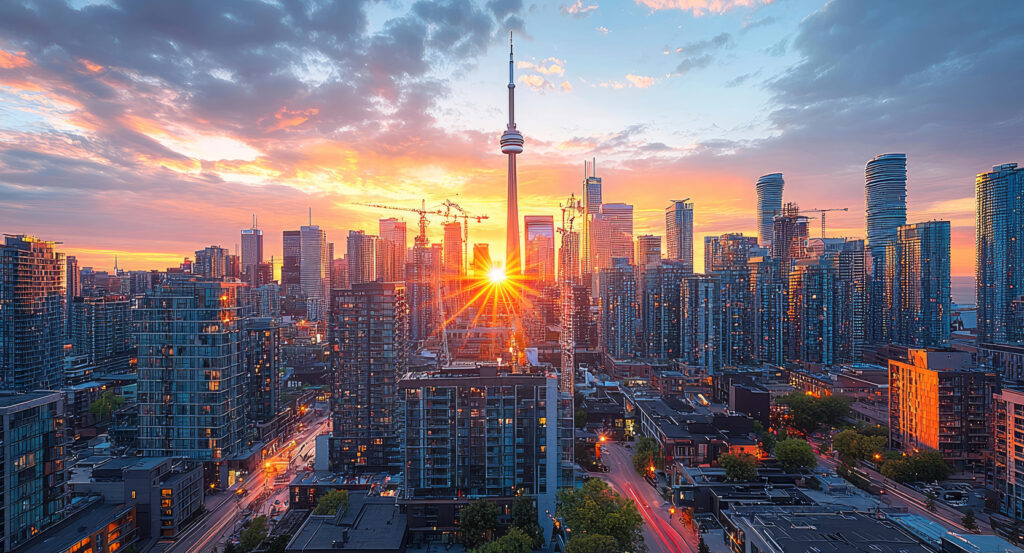
CN Tower is best known for the engineering achievement that transformed Toronto's skyline and telecommunications infrastructure during the 1970s. Canadian National developed the tower as downtown high-rises increasingly interfered with broadcast signals, creating a structure whose exceptional height placed antennas above the expanding skyline. Engineers used slip-form construction to raise the reinforced-concrete shaft continuously, producing a tapered profile capable of resisting immense wind loads. The completed tower reached 553.3 meters and held the title of the world's tallest freestanding structure for more than three decades. Its observation levels established an extraordinary visual relationship among Downtown, Lake Ontario, the Toronto Islands, and the surrounding metropolitan region. The CN Tower turned a practical telecommunications solution into the dominant vertical symbol of Canada's largest city.
Day 2: Miku Toronto
Miku Toronto is best known for introducing Aburi Restaurants' flame-seared sushi to Toronto through a waterfront dining room overlooking the city's harbor. The concept originated with Seigo Nakamura's development of aburi sushi in Canada, using direct flame to alter the texture and fat of fish immediately before service. Specialized sauces and garnishes complete individual pieces after searing, giving the technique a structured culinary character beyond conventional nigiri preparation. The Toronto restaurant extended the Vancouver-born concept eastward and added local ingredients to a Japanese culinary foundation spanning sushi, seafood, and composed plates. Miku's position beside Lake Ontario gives one of Canada's influential Japanese restaurant groups a prominent place within Toronto's waterfront dining culture.
Day 2: Royal Ontario Museum
Royal Ontario Museum is best known for uniting major collections of natural history, archaeology, art, and world cultures within one of Canada's largest museums. The institution opened in 1914 through cooperation between the Province of Ontario and the University of Toronto, initially organizing multiple specialized museums within a single complex. Successive expansions reflected the growth of collections spanning dinosaurs, minerals, biodiversity, ancient civilizations, textiles, decorative arts, and Canadian cultural material. Daniel Libeskind radically altered the museum's relationship with Bloor Street through the Michael Lee-Chin Crystal, an angular addition of intersecting volumes completed during the twenty-first century. The contrast between the historic masonry complex and Libeskind's crystalline intervention turned the building itself into a record of changing approaches to museum architecture. ROM joins encyclopedic collecting with more than a century of Toronto's institutional and architectural development.
Day 2: Restaurant 20 Victoria
Restaurant 20 Victoria is best known for Chris White and Jonathan Nicolaou's intensely focused tasting-menu restaurant within Toronto's historic financial core. The compact dining room operates at a scale that places unusual emphasis on ingredient selection, technical precision, and the sequence of individual courses. Seafood occupies a particularly important place in the kitchen, joined by seasonal vegetables, carefully constructed sauces, and restrained compositions that concentrate flavor without ornamental excess. Its location on Victoria Street places the restaurant amid the dense commercial architecture east of Bay Street, connecting a contemporary culinary institution with one of Toronto's oldest downtown districts. Restaurant 20 Victoria holds one MICHELIN star in the 2026 Toronto selection, securing its position among the city's most accomplished small-format dining rooms.
Day 3: L'Avenue
L’Avenue is best known for bringing Montréal's maximalist brunch culture into Downtown through an extravagant restaurant devoted specifically to morning and midday dining. The concept originated in Montréal, where L'Avenue developed a following around substantial egg dishes, pancakes, French toast, potatoes, fruit, and highly composed breakfast plates. Its Toronto dining room extends that character through theatrical interiors and a menu built around abundance, strong contrasts, and technically developed versions of familiar brunch preparations. Québec roots give the restaurant a distinct position within Toronto's broad daytime dining field, linking two of Canada's most influential restaurant cities through a format associated particularly strongly with Montréal. L'Avenue gives this morning position a dedicated brunch institution with far greater culinary specificity than a conventional all-day restaurant.
Day 3: St. Lawrence Market
St. Lawrence Market is best known for preserving more than two centuries of food commerce within Toronto's historic Old Town. A public market operated in the area from the early nineteenth century as the growing settlement of York concentrated civic and commercial activity near Front and King streets. The South Market incorporates the former Toronto City Hall building completed in 1845, whose surviving council chamber arch became part of the later market structure. Butchers, fishmongers, cheesemongers, bakers, produce merchants, and specialty food vendors transformed the complex into a concentrated expression of the city's evolving immigrant and culinary communities. The surrounding district developed alongside Toronto's earliest street grid and commercial waterfront. St. Lawrence Market preserves the relationship among municipal government, food distribution, immigration, and urban growth at the geographical heart of early Toronto.
Day 3: Toronto Islands
Toronto Islands are best known for forming a sheltered archipelago between Downtown and Lake Ontario from material shaped by centuries of shoreline currents and sediment deposition. The land originated as part of a long sandbar extending from the mainland before storms and changing channels progressively altered its geography. A violent storm during the nineteenth century permanently separated the peninsula from the mainland, creating the island configuration that subsequently developed offshore. Residential communities, parks, beaches, yacht clubs, recreational facilities, and Billy Bishop Toronto City Airport came to occupy different portions of the chain. The islands also protect Toronto Harbour from the open lake, giving their geography direct importance to the city's maritime development. Their low shoreline provides the defining counterpoint to Toronto's dense vertical skyline across the harbor.
Day 3: Don Alfonso 1890
Don Alfonso 1890 is best known for translating the Iaccarino family's celebrated southern Italian culinary tradition into a dining room high above Toronto Harbour. The original Don Alfonso 1890 developed at Sant'Agata sui Due Golfi on the Sorrentine Peninsula, where the Iaccarino family built its cuisine around Mediterranean produce, seafood, olive oil, citrus, vegetables, and exacting Italian technique. The Toronto restaurant extends that lineage through tasting menus shaped by the gastronomic traditions of Campania and the ingredients available in Canada. Its position atop the Westin Harbour Castle creates a dramatic relationship with Lake Ontario and the Toronto Islands below. Don Alfonso 1890 holds one MICHELIN star in the 2026 Toronto selection, joining a long-established Italian restaurant lineage to the contemporary culinary ambitions of Toronto.
Where your story begins.
Foresyte Travel reveals places that feel extraordinary long before you arrive.
Enjoy editorial crafted for luxury travelers.
Foresyte may earn a commission when you book.