
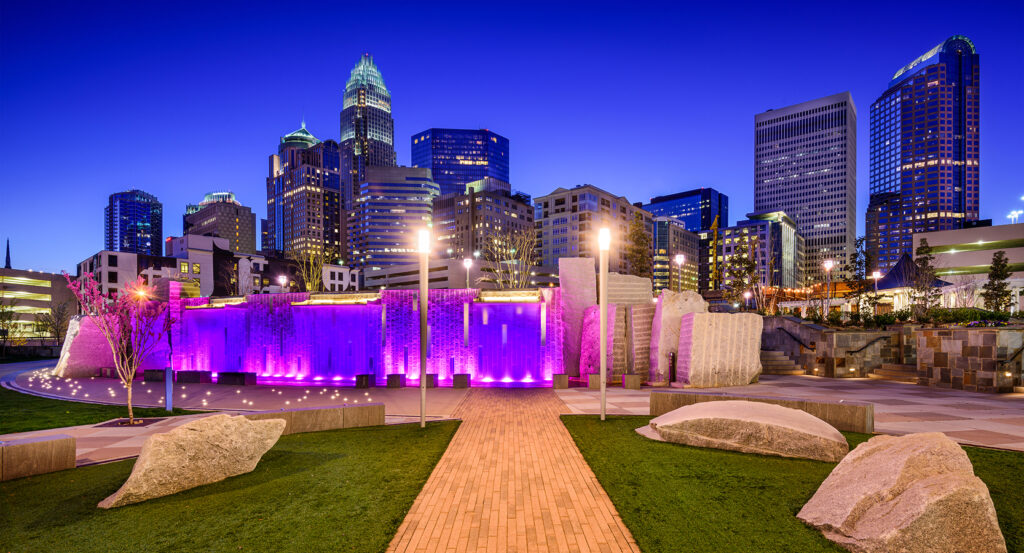
Perfect weekend in Charlotte, North Carolina.
Charlotte's rise from a colonial crossroads in the Carolina Piedmont to one of America's principal banking centers followed the expansion of gold mining, textile manufacturing, railroad commerce, and financial enterprise. Situated between the Catawba and Yadkin river systems, the city developed across rolling uplands that supported Indigenous settlement, agriculture, and regional trading routes for centuries before European colonization. The surrounding territory formed part of the ancestral homelands of the Catawba people, whose communities maintained extensive relationships throughout the Piedmont. European settlers established Charlotte Town in 1768, naming the settlement for Queen Charlotte of Mecklenburg-Strelitz, wife of King George III. Its location at the intersection of established trading routes encouraged commercial growth, and Mecklenburg County became an important agricultural district. During the American Revolution, British forces occupied Charlotte in 1780, encountering resistance from local Patriot militias during the Southern Campaign. The discovery of gold at Reed Gold Mine in nearby Cabarrus County in 1799 initiated America's first major gold rush, attracting prospectors and supporting the establishment of a United States Mint branch in Charlotte in 1837. Railroad construction during the nineteenth century connected the city with regional markets, strengthening the transportation of cotton and manufactured goods. Following the Civil War, Charlotte became a center of the New South's industrial expansion, with textile mills, machinery manufacturers, and commercial banks contributing to economic growth. During the twentieth century, financial institutions including North Carolina National Bank and First Union expanded through mergers and interstate banking, establishing Charlotte as a major American financial center. The city's subsequent development in healthcare, energy, professional sports, and technology reinforced its metropolitan importance within the southeastern United States.
North Carolinian musical traditions acquired a powerful regional voice through the Piedmont blues, whose intricate guitar techniques and rhythmic patterns influenced generations of American performers. Musicians including Blind Boy Fuller and Reverend Gary Davis developed distinctive approaches to fingerstyle guitar, combining ragtime, blues, and gospel influences into a sophisticated regional tradition. Charlotte became an important recording center during the 1930s, when visiting record companies captured performances by Southern musicians whose work contributed to the development of country, gospel, and blues. The city's artistic institutions expanded alongside its growing commercial prosperity, with the Bechtler Museum of Modern Art opening in 2010 to present a collection of twentieth-century European and American works. Its building, designed by Swiss architect Mario Botta, became a prominent addition to Charlotte's contemporary architectural landscape. The Harvey B. Gantt Center for African-American Arts + Culture, named for Charlotte's first Black mayor, developed exhibitions and educational programming devoted to African American artistic achievement. The Charlotte Symphony Orchestra, founded in 1932, strengthened the city's classical music institutions through orchestral performances and community programming. Charlotte's literary connections include Carson McCullers, whose writing explored isolation, race, and social relationships in the American South, and contemporary authors whose work examines the changing communities of North Carolina. The region's culinary foundations developed through Piedmont agriculture, Southern cooking traditions, and the foodways of African American communities. Carolina barbecue became closely associated with slow-cooked pork and vinegar-based sauces, with regional variations distinguishing the eastern and western portions of the state. Charlotte's proximity to the Piedmont contributed to traditions involving smoked pork shoulder, hush puppies, coleslaw, and seasonal vegetables. Southern preparations including fried chicken, collard greens, cornbread, and pimento cheese retain longstanding connections to family cooking and neighborhood restaurants. North Carolina's agricultural regions supply sweet potatoes, peaches, tomatoes, and leafy greens, supporting restaurants devoted to seasonal ingredients. The city's expanding international communities introduced Latin American, Indian, Vietnamese, and Middle Eastern culinary traditions, broadening the range of regional cooking available throughout the metropolitan area. Contemporary chefs incorporate these influences alongside traditional Southern ingredients and modern American techniques. A weekend in Charlotte reveals a city shaped by Piedmont musical innovation, historic residential communities, African American educational achievement, and a culinary culture grounded in the agricultural traditions of North Carolina.
Three day itinerary.
Day 1: NASCAR Hall of Fame
NASCAR Hall of Fame is best known for preserving the history of American stock-car racing in Charlotte, the operational center of NASCAR's competitive and engineering industries. Designed by Pei Cobb Freed & Partners, the museum opened in 2010 with a sweeping stainless-steel exterior inspired by the movement and geometry of a racetrack. Its Central Glory Road exhibition presents historic race cars along a dramatically banked surface, connecting vehicle design with the technical evolution of American motorsport. Richard Petty, Dale Earnhardt, Junior Johnson, and Bill France Sr. belong to the foundational figures whose careers shaped the sport's development. Exhibitions explore engines, aerodynamics, safety engineering, racing strategy, and the organization of professional teams. The surrounding Charlotte metropolitan area contains an extraordinary concentration of racing headquarters, fabrication facilities, and specialist engineering businesses. NASCAR Hall of Fame establishes Charlotte's significance as the institutional and technological capital of American stock-car racing.
Day 1: Counter-
Counter- is best known for chef Sam Hart's experimental tasting-menu restaurant, where contemporary American cooking intersects with music, visual art, performance, and carefully developed thematic presentations. Hart established the restaurant around an intimate counter format that places diners directly opposite the kitchen, creating an unusually immediate relationship between preparation and presentation. Seasonal ingredients, fermentation, preservation, modern culinary techniques, and elaborate compositions form the foundations for menus organized around changing artistic concepts. Musical selections and visual elements extend those concepts throughout the meal, connecting individual courses with a larger creative experience. Hart's work has helped establish Charlotte as a serious destination for ambitious tasting-menu dining. Counter- occupies a distinctive position in the city's restaurant culture through its combination of technical precision, culinary authorship, and multidisciplinary artistic ambition.
Day 2: Mint Museum Uptown
Mint Museum Uptown is best known for housing major collections of American, contemporary, and craft art within Charlotte's Levine Center for the Arts. The institution traces its origins to the Mint Museum of Art, established in 1936 within a former branch of the United States Mint that operated in Charlotte during the nineteenth century. The Uptown building opened in 2010 as part of a major expansion that brought the museum into the city's central cultural district. Machado and Silvetti Associates designed the facility with extensive galleries devoted to painting, sculpture, design, and decorative arts. The museum's craft collection gives particular prominence to ceramics, glass, metal, fiber, and wood, connecting traditional material practices with contemporary artistic experimentation. Its American and contemporary collections broaden that material focus through works associated with major artistic developments across multiple periods. Mint Museum Uptown captures Charlotte's emergence as a metropolitan cultural center through an institution rooted in the city's financial and industrial history.
Day 2: Mariposa
Mariposa is best known for bringing globally inspired contemporary cuisine into Charlotte's Levine Center for the Arts, connecting ambitious restaurant hospitality with one of the city's principal cultural institutions. Established by restaurateur Jill Marcus, the restaurant occupies a prominent space within Mint Museum Uptown, whose collections of American art, contemporary art, and craft and design establish a distinctive cultural setting. Its name, derived from the Spanish word for butterfly, expresses a culinary philosophy centered on transformation, cultural exchange, and the shared experience of dining. Executive chef Octavio Lopez leads a kitchen that draws upon international culinary traditions, developing dishes around seasonal ingredients, inventive flavor combinations, and preparations designed for communal dining. Small plates and larger compositions encourage exploration across different culinary influences, reflecting Charlotte's increasingly cosmopolitan restaurant culture. The restaurant's contemporary interior complements the architectural environment of the Levine Center for the Arts, placing dining within a district shaped by museums, performance spaces, and modern urban development. Mariposa represents the intersection of Charlotte's expanding cultural ambitions and its evolving gastronomic identity, establishing an especially fitting culinary counterpart to the neighboring Mint Museum Uptown.
Day 2: Levine Museum of the New South
Levine Museum of the New South is best known for examining the transformation of Charlotte and the American South following the Civil War through industrialization, urban growth, racial conflict, migration, and social change. Founded in 1991, the institution developed around the concept of the New South, a term associated with the region's transition from an agricultural economy toward manufacturing, finance, and metropolitan development. Charlotte's rise as a textile and banking center provides a central historical foundation for its exhibitions and educational work. The museum has explored segregation, civil rights, labor, immigration, and the changing relationship between communities and economic power. Its interpretation places local history within the broader transformation of the southeastern United States. Levine Museum of the New South gives Charlotte's modern economic prominence a deeper historical context through the social and political forces that shaped the region.
Day 2: The Fig Tree Restaurant
The Fig Tree Restaurant is best known for bringing refined French and Italian cooking into the historic Lucas House in Charlotte's Elizabeth neighborhood. The Queen Anne-style residence dates to 1913, giving the restaurant a domestic architectural setting associated with the city's early twentieth-century residential expansion. Chef Greg Zanitsch and his wife Sara established the restaurant in 2005, developing a menu grounded in classical European technique and premium seasonal ingredients. Seafood, meat, pasta, vegetables, sauces, and carefully composed preparations reflect Zanitsch's culinary training and longstanding commitment to formal restaurant cooking. The property's intimate dining rooms preserve the scale and character of the original residence. The Fig Tree occupies an important position in Charlotte's independent restaurant culture through its sustained commitment to classical technique and the preservation of a historic neighborhood building.
Day 3: The Asbury
The Asbury is best known for interpreting Southern breakfast and brunch traditions through ingredients and preparations connected with the Carolinas. The restaurant occupies the historic Dunhill Hotel in Uptown Charlotte, linking its dining room with a building that emerged during the city's early twentieth-century commercial expansion. Named for architect Louis Asbury Sr., whose work shaped numerous Charlotte buildings, the restaurant carries a direct association with the city's architectural history. Its kitchen draws on regional products including stone-ground grits, country ham, eggs, biscuits, seasonal vegetables, and locally sourced ingredients. Contemporary preparations give familiar Southern dishes greater technical refinement while preserving their regional foundations. The Asbury establishes a distinctly Charlotte character for brunch through the convergence of Southern food traditions, historic architecture, and the city's evolving hospitality culture.
Day 3: Freedom Park
Freedom Park is best known for preserving an expansive landscaped public space between Charlotte's Dilworth and Myers Park neighborhoods. The park developed during the mid-twentieth century on land associated with the city's expanding residential districts, becoming one of Charlotte's principal recreational landscapes. Its central lake, pedestrian bridges, wooded paths, lawns, and athletic facilities organize the grounds around a combination of natural scenery and civic recreation. The Little Sugar Creek Greenway connects the park with a larger network of public landscapes extending through the city. Mature trees and planted gardens give the grounds a character shaped by the Piedmont region's climate and vegetation. Freedom Park occupies a central position in Charlotte's urban geography through its relationship with established residential neighborhoods and the city's growing network of connected green spaces.
Day 3: Wing Haven
Wing Haven is best known for preserving an extraordinary garden sanctuary created by Elizabeth and Edwin Clarkson within Charlotte's historic Myers Park neighborhood. The Clarksons began developing their property during the 1920s, transforming a residential parcel into a carefully composed landscape devoted to birds, native plants, and horticultural beauty. Elizabeth Clarkson's design integrated winding paths, garden rooms, pools, fountains, dense plantings, and sheltered habitats into an intimate environment shaped by decades of personal cultivation. The property subsequently became part of a broader nonprofit institution devoted to environmental education and the preservation of historic gardens. Its collections and landscapes reveal the relationship between residential garden design, urban ecology, and Charlotte's early twentieth-century suburban development. Wing Haven preserves a remarkable example of private horticultural vision transformed into a lasting public cultural resource.
Day 3: Restaurant Constance
Restaurant Constance is best known for chef Sam Diminich's contemporary interpretation of Carolina ingredients through a deeply personal approach to regional American cooking. Diminich developed his culinary career in Charlotte before establishing a restaurant whose character centers on local farms, seasonal produce, regional seafood, meats, vegetables, and ingredients associated with the agricultural traditions of the Carolinas. His work emphasizes close relationships with growers and producers, allowing the availability and character of individual products to shape the kitchen's preparations. Classical techniques provide structure for dishes that express the flavors and agricultural heritage of the surrounding region. The restaurant's intimate dining environment reinforces its concentration on ingredient quality and careful execution. Restaurant Constance represents an important expression of Charlotte's increasingly sophisticated independent restaurant culture through its commitment to regional sourcing and chef-driven culinary authorship.
Where your story begins.
Foresyte Travel reveals places that feel extraordinary long before you arrive.
Enjoy editorial crafted for luxury travelers.
Foresyte may earn a commission when you book.







































































































