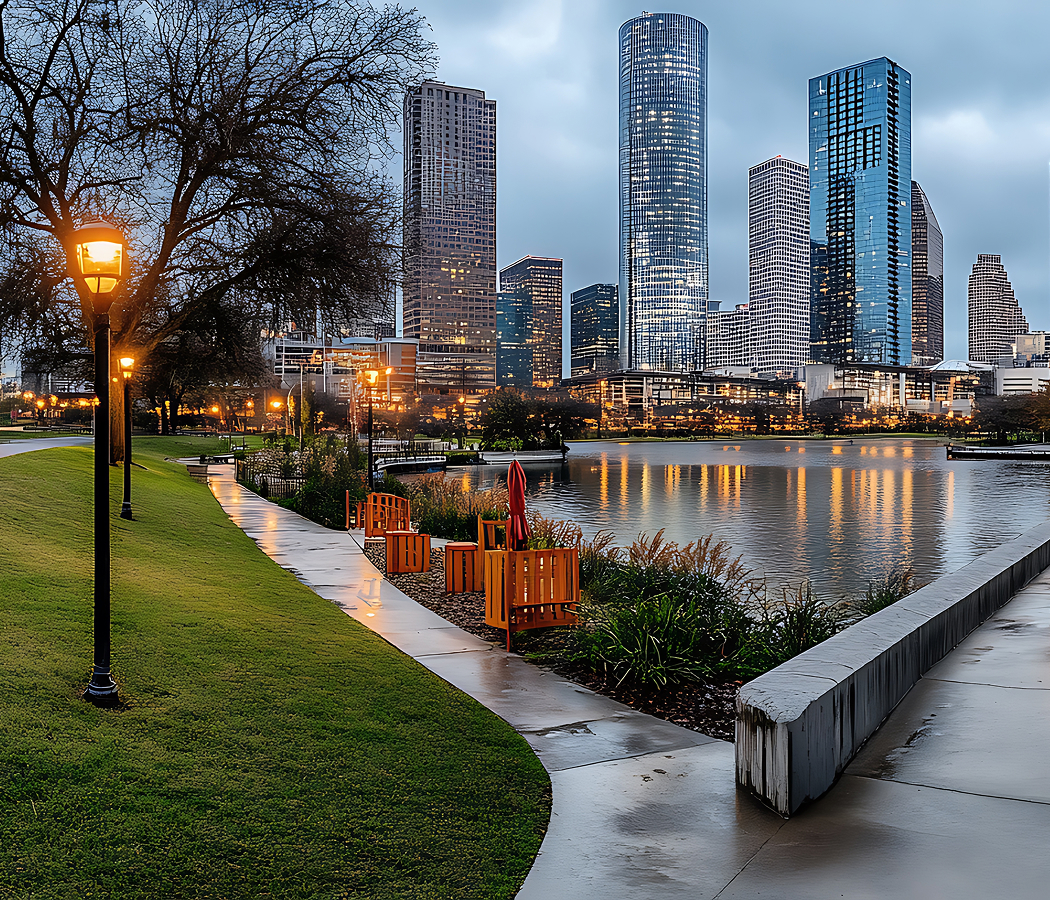
Perfect weekend in Houston, Texas.
Houston's rise from a settlement along the coastal plains of southeastern Texas to one of America's largest metropolitan centers followed the expansion of maritime commerce, petroleum production, medical research, and international trade. Situated near the Gulf of Mexico, the city developed across a landscape of winding bayous, coastal prairies, and forested waterways that connected inland communities with Galveston Bay. The region formed part of the ancestral territories of Indigenous peoples including the Akokisa and Karankawa, whose communities relied upon coastal fisheries, hunting, and regional trading networks. Following Texas independence from Mexico in 1836, brothers Augustus Chapman Allen and John Kirby Allen purchased land near the confluence of Buffalo Bayou and White Oak Bayou, establishing a settlement named for General Sam Houston. The city incorporated in 1837 and briefly served as the capital of the Republic of Texas. Houston's commercial importance increased through cotton transportation and the expansion of steamboat navigation, connecting agricultural producers with markets along the Gulf Coast. Railroad construction during the nineteenth century strengthened these relationships, attracting merchants, warehouses, and manufacturing enterprises. The discovery of oil at Spindletop near Beaumont in 1901 accelerated the development of the regional petroleum industry. Completion of the Houston Ship Channel in 1914 established a deepwater connection between the city's industrial waterfront and international shipping routes, supporting the growth of refineries, chemical plants, and maritime businesses. During the twentieth century, Houston became a principal center of American energy production, attracting engineering firms, financial institutions, and international investment. The establishment of NASA's Manned Spacecraft Center in 1961 strengthened the city's relationship with aerospace engineering and human spaceflight. The Texas Medical Center subsequently expanded into a major concentration of hospitals, universities, and biomedical research institutions. Successive generations of migration from Latin America, Asia, Africa, and the Middle East contributed to Houston's population growth, establishing a metropolitan economy closely connected to international commerce and scientific enterprise.
Texan cultural innovation acquired a particularly international character in Houston, where the city's energy economy, universities, and immigrant communities supported the growth of major artistic and culinary institutions. The Menil Collection, established by philanthropists John and Dominique de Menil and opened in 1987, became an important center for modern art, Surrealism, and works from ancient and Indigenous cultures. Its principal building, designed by Renzo Piano, introduced an architectural approach emphasizing natural light and the relationship between art and its surrounding residential setting. The Rothko Chapel, commissioned by the de Menils and dedicated in 1971, contains fourteen paintings by Mark Rothko and became a significant space associated with contemporary art and interfaith contemplation. Houston's musical history encompasses blues, gospel, country, and hip-hop, with African American performers contributing to the development of regional recording traditions. Lightnin' Hopkins established a powerful association with the city through his distinctive blues guitar playing and songwriting. During the 1990s, Houston developed a nationally influential hip-hop sound through artists including DJ Screw, whose slowed recording techniques became closely associated with the city's musical culture. Beyoncé, raised in Houston, subsequently achieved international prominence through recordings and performances that incorporated rhythm and blues, pop, and influences from Southern Black musical traditions. The Houston Grand Opera, founded in 1955, contributed to the city's performing arts institutions through major productions and commissions of contemporary American opera. Houston's culinary traditions developed through Gulf Coast seafood, Texas cattle ranching, Southern cooking, and the foodways of successive immigrant communities. Regional specialties include smoked brisket, beef ribs, crawfish, oysters, and Gulf shrimp, supported by longstanding relationships with coastal fisheries and agricultural producers. Mexican American communities established traditions of barbacoa, tamales, breakfast tacos, and chile-based preparations throughout the metropolitan region. Vietnamese immigration following the Vietnam War contributed pho, bánh mì, and seafood preparations that became integral to Houston's restaurant culture. The combination of Vietnamese culinary techniques with Louisiana crawfish traditions produced a distinctive regional approach to seasoned shellfish. Nigerian, Indian, Pakistani, and Chinese communities further expanded the city's culinary landscape through restaurants specializing in regional preparations and traditional ingredients. Contemporary chefs draw upon this extraordinary concentration of culinary influences, incorporating Gulf seafood, Texas meats, seasonal produce, and techniques from across the world. A weekend in Houston reveals a city whose achievements in modern art, music, scientific enterprise, and international cooking grew from the commercial ambitions and cultural diversity of the Texas Gulf Coast.
Three day itinerary.
Day 1: Buffalo Bayou Park
Buffalo Bayou Park is best known for transforming Houston's foundational waterway into a major civic landscape through flood infrastructure, ecological restoration, and public-space design. Buffalo Bayou shaped the city from its founding in 1836, when Augustus Chapman Allen and John Kirby Allen established Houston near the confluence with White Oak Bayou. Twentieth-century flood-control interventions substantially altered the waterway as the metropolitan region expanded around it. A major twenty-first-century redevelopment restored native landscapes, improved drainage, expanded trails, and created recreational and cultural spaces across the 160-acre park. The project reconnected Central Houston with the bayou that determined its original location, turning essential hydrological infrastructure into one of the city's defining public landscapes.
Day 1: March
March is best known for Felipe Riccio's exploration of Mediterranean culinary history through rigorously researched regional tasting menus. Riccio was born in Mexico and raised partly in Italy, developing a culinary perspective shaped by the food traditions surrounding the Mediterranean basin before establishing his career in Houston. March emerged from the Goodnight Hospitality group as an intimate tasting-menu restaurant whose menus examine individual regions and historical patterns of migration, agriculture, trade, and cooking. Each iteration concentrates on a specific geographic tradition, translating its ingredients and techniques through contemporary fine-dining execution. MICHELIN recognition placed March among Houston's leading restaurants and gave the city an unusually intellectual culinary institution grounded in the interconnected food cultures of the Mediterranean.
Day 2: Space Center Houston
Space Center Houston is best known for interpreting the history and engineering of American human spaceflight beside NASA's Johnson Space Center. The federal complex opened as the Manned Spacecraft Center during the 1960s and became the operational center for astronaut training, spacecraft development, and mission control during the Gemini and Apollo programs. Flight controllers in Houston directed Apollo 11 during humanity's first crewed lunar landing in 1969, permanently linking the city's name to space exploration. The center subsequently led mission operations for the Space Shuttle and became central to the International Space Station program. Space Center Houston preserves spacecraft, astronaut equipment, training hardware, and access to NASA facilities, connecting visitors directly to the institution that coordinated some of the most consequential missions in spaceflight history.
Day 2: Truth BBQ
Truth BBQ is best known for Leonard Botello IV's refinement of Central Texas barbecue through painstaking fire management and a distinctive Houston identity. Botello established the original Truth in Brenham before expanding to Houston, building his cooking around offset smokers, post oak, carefully rendered brisket, pork ribs, sausage, and long cooking cycles governed by temperature and smoke. House-made sides and elaborate layer cakes broadened the restaurant beyond the traditional meat-counter model without displacing barbecue as its central discipline. The Houston location brought Botello's work into one of America's most competitive barbecue regions and strengthened the city's position within modern Texas barbecue culture. National recognition subsequently established Truth as one of the restaurants carrying the state's historic smoking traditions into a new generation.
Day 2: Houston Zoo
Houston Zoo is best known for developing from a small municipal animal collection into a major institution for wildlife conservation and zoological science. The zoo began in Hermann Park during the 1920s and progressively expanded as Houston's population and civic institutions grew around the surrounding museum district. Successive habitat projects replaced earlier forms of animal exhibition with environments structured around species behavior, ecological relationships, and conservation priorities. Programs devoted to endangered wildlife extended the institution's work beyond Houston through partnerships supporting species and habitats around the world. Its position inside Hermann Park places zoological conservation within a larger civic landscape containing museums, medical institutions, gardens, and public spaces, making the zoo an important component of Houston's exceptional concentration of scientific and cultural organizations.
Day 2: BCN Taste & Tradition
BCN Taste & Tradition is best known for Luis Roger's highly disciplined interpretation of Spanish cuisine inside a historic Montrose residence. Roger trained in Barcelona and developed his career in kitchens associated with major figures in Spanish gastronomy before bringing that technical foundation to Houston. The restaurant takes its name from Barcelona's airport code and is best known for products imported from Spain, including seafood, olive oil, cured meats, cheeses, and ingredients integral to Catalan and broader Iberian cooking. Classical preparations appear beside contemporary compositions grounded in precise technique and restrained presentation. MICHELIN recognition placed BCN among Houston's leading fine-dining restaurants, giving the city a sophisticated expression of Spanish gastronomy shaped by direct culinary connections to Barcelona.
Day 3: Koffeteria
Koffeteria is best known for Vanarin Kuch's transformation of Houston's multicultural food traditions into an inventive contemporary bakery. Kuch grew up in a Cambodian-American family in Houston and developed his pastry career through professional kitchens before establishing Koffeteria in EaDo. His baking combines classical pastry technique with ingredients and references drawn from Cambodian, Vietnamese, Texan, and wider Asian-American food cultures. Croissants, buns, cookies, savory pastries, and laminated doughs become vehicles for combinations involving pandan, ube, Southeast Asian seasonings, barbecue, and other flavors connected to the city's extraordinary immigrant communities. Koffeteria gives Houston breakfast a distinctly local expression, translating the city's cultural diversity through one of the most technically demanding branches of professional cooking.
Day 3: The Museum of Fine Arts
The Museum of Fine Arts is best known for building one of the largest and most architecturally ambitious art institutions in the United States. The museum opened its first purpose-built structure in 1924, with William Ward Watkin designing a neoclassical building that established a permanent center for visual art in Houston. Ludwig Mies van der Rohe subsequently transformed the campus through Cullinan Hall and the Brown Pavilion, creating a major American example of museum modernism. Rafael Moneo added the Audrey Jones Beck Building in 2000, substantially expanding gallery space. Steven Holl Architects completed the Nancy and Rich Kinder Building in 2020 for modern and contemporary art, creating a campus whose architectural development parallels nearly a century of Houston's cultural growth.
Day 3: Downtown Aquarium
Downtown Aquarium is best known for adapting a former municipal waterworks and fire-station site into a large entertainment and aquatic complex beside Buffalo Bayou. The project incorporated two historic downtown structures into a redevelopment centered on aquatic exhibits, restaurants, public attractions, and landscaped spaces. Its location beside the bayou connects the complex to the water infrastructure and industrial geography that shaped Central Houston's development. Freshwater and marine environments present species from multiple ecosystems, placing aquatic life inside a setting whose earlier purpose was itself tied to the management of urban water. The resulting complex represents a distinctive example of adaptive reuse within the northwestern edge of downtown and preserves elements of Houston's municipal infrastructure within a radically different contemporary function.
Day 3: Tatemó
Tatemó is best known for Emmanuel Chavez's exploration of Mexican heirloom corn as the foundation of an entire culinary program. Chavez, who was born in Mexico and raised in the United States, developed the Houston restaurant around nixtamalization, the ancient alkaline process that transforms dried maize into masa. Different corn varieties become tortillas, tostadas, tamales, and other preparations whose flavors and textures depend directly on the grain itself. The kitchen connects those techniques with Gulf Coast ingredients and Houston's Mexican-American culinary environment, placing agriculture at the center of contemporary fine dining. National and MICHELIN recognition established Tatemó as one of Houston's defining independent restaurants and strengthened the broader revival of heirloom corn within modern Mexican cooking.
Where your story begins.
Foresyte Travel reveals places that feel extraordinary long before you arrive.
Enjoy editorial crafted for luxury travelers.
Foresyte may earn a commission when you book.