
Why Buffalo Bayou Park matters.
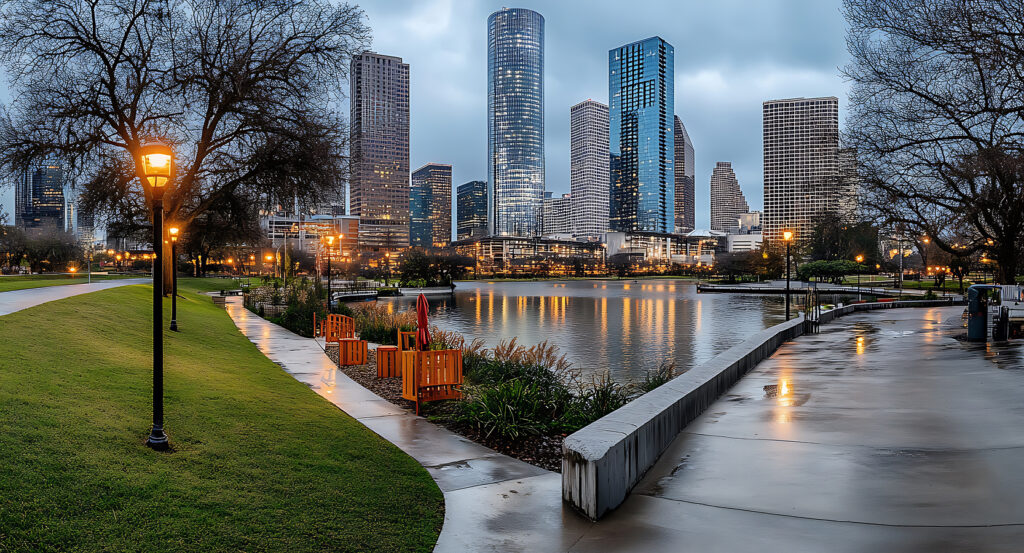
Buffalo Bayou Park is an expansive urban greenway where Houston's historic relationship with its waterways meets ambitious landscape restoration, contemporary public art, and the transformation of a flood-prone corridor into one of Texas's most distinctive metropolitan parks.
Set along Allen Parkway near Montrose Boulevard and just steps from the residential streets surrounding Memorial Heights, the park occupies a winding stretch of Buffalo Bayou between Downtown and Shepherd Drive, connecting wooded riverbanks, open meadows, and elevated pedestrian paths beneath the surrounding skyline. Sloping lawns descend toward the water, creating alternating views of the bayou and the commercial towers beyond its banks. Native trees, restored vegetation, and carefully maintained planting areas establish a landscape shaped by the waterway's changing elevations. Pedestrian and cycling paths connect recreational areas through bridges, wooded passages, and open stretches of waterfront. The result is a substantial urban landscape whose natural topography supports recreation, ecological restoration, and an unusually direct relationship with Houston's central waterway.
What defines Buffalo Bayou Park.
Buffalo Bayou Park is best known for the transformation of a neglected urban waterway into a nationally influential example of landscape restoration, flood-conscious design, and public-private investment. Buffalo Bayou played a central role in Houston's founding after brothers Augustus Chapman Allen and John Kirby Allen established the settlement in 1836 near the confluence of Buffalo and White Oak bayous. The waterway became an essential transportation route, connecting the developing settlement with Galveston Bay and the commercial networks of the Gulf Coast. Its navigable sections supported the movement of goods and encouraged the expansion of Houston's port economy during the nineteenth century. Urban growth subsequently altered the surrounding watershed through drainage projects, channel modifications, and extensive construction along the banks. Major floods exposed the vulnerability of development near the waterway, prompting successive engineering efforts to manage stormwater and protect surrounding neighborhoods. Twentieth-century transportation projects introduced major roadways alongside the bayou, creating substantial physical barriers between the water and adjoining communities. The corridor gradually suffered from erosion, invasive vegetation, deteriorating infrastructure, and limited public access. Buffalo Bayou Partnership emerged in 1986 as a nonprofit organization dedicated to improving the waterway and coordinating long-term redevelopment. Its work attracted substantial philanthropic support, including a $30 million contribution from the Kinder Foundation toward an ambitious restoration project. Landscape architecture firm SWA Group developed the park's comprehensive design, incorporating flood-resilient landscapes, restored habitat, and recreational infrastructure. Construction transformed 160 acres of the central bayou corridor through extensive earthwork, planting, and public-space development. The renovated park opened in October 2015, establishing a major new recreational destination within Central Houston. Its completion demonstrated how ecological restoration and public recreation could be coordinated within a flood-prone urban landscape.
SWA Group's landscape strategy incorporated the bayou's natural flooding patterns into the design of recreational spaces and restored vegetation. Terraced banks and carefully graded slopes accommodate fluctuations in water levels, allowing portions of the landscape to absorb floodwater during substantial storms. Native grasses and riparian plantings stabilize soil and contribute to the ecological recovery of previously degraded areas. The project also introduced erosion-control systems designed to protect vulnerable banks while supporting vegetation growth. The park's extensive trail network establishes separate opportunities for walking, running, and cycling, connecting recreational areas through bridges and landscaped passages. Pedestrian bridges provide elevated views across the waterway, revealing the relationship between the bayou's meandering course and the surrounding urban development. Public art became an important component of the landscape, with commissioned installations introducing contemporary sculpture and site-specific works into the recreational environment. The park's lighting program incorporates carefully designed illumination along selected paths and gathering spaces, extending access into evening hours. Recreational facilities include open lawns, exercise areas, and spaces designed for community events, supporting a broad range of activities within the restored corridor. Buffalo Bayou Partnership coordinates maintenance and programming through a nonprofit management model, sustaining the landscape through ongoing stewardship and private support. The park's ecological design gained particular significance following Hurricane Harvey in 2017, when extensive flooding tested the resilience of its restored landscapes and infrastructure. Subsequent recovery efforts reinforced the importance of designing public spaces around Houston's natural hydrological conditions. Buffalo Bayou Park's enduring significance emerges from this relationship between flood management, ecological rehabilitation, and the creation of accessible public space within a major American city.
How Buffalo Bayou Park fits.
Buffalo Bayou Park works as the anchor for a Houston outing connecting an expansive underground reservoir, a contemporary public artwork, and a historic burial ground associated with the city's nineteenth-century development.
Begin at Buffalo Bayou Park Cistern, the former municipal drinking-water reservoir constructed in 1926 beneath the surrounding landscape. Its cavernous interior contains 221 concrete columns arranged in a repeating grid, creating an extraordinary architectural environment originally designed for water storage. The reservoir operated for decades before a leak led to its decommissioning in 2007. Buffalo Bayou Partnership subsequently preserved the structure and opened it to the public in 2016, establishing a venue for guided visits and contemporary art installations. Its immense interior proportions and distinctive acoustics create an unusual setting for exploring Houston's historic infrastructure. Continue to Tolerance, the expansive public artwork created by Spanish artist Jaume Plensa and installed in 2011 along the bayou corridor. The installation consists of seven seated human figures formed from stainless-steel letters representing different world languages. Plensa's sculptures explore the relationship between language, cultural difference, and shared humanity, using the human form as a structure for international communication. Their placement within the landscaped waterfront connects contemporary public art with the city's multicultural population. The figures' open construction allows light and surrounding scenery to pass through their surfaces, creating changing visual relationships throughout the day. Conclude at Glenwood Cemetery, the historic burial ground established in 1871 along the northern banks of Buffalo Bayou. Its landscaped grounds incorporate rolling terrain, mature trees, and elaborate funerary monuments, reflecting nineteenth-century traditions of rural cemetery design. Prominent Houstonians buried there include Howard Hughes, whose family connections to the city contributed to its industrial and aviation history. The cemetery also contains graves associated with important political, commercial, and cultural figures, preserving a substantial record of Houston's development. Its winding paths and carefully maintained memorial landscapes establish a contemplative environment overlooking the surrounding urban corridor. The progression moves from Buffalo Bayou Park Cistern's preserved municipal infrastructure through Tolerance's exploration of language and human connection and culminates at Glenwood Cemetery's historical landscape, connecting three distinctive dimensions of Houston's civic and cultural heritage.
Where your story begins.
Foresyte Travel reveals places that feel extraordinary long before you arrive.
Enjoy editorial crafted for luxury travelers.
Foresyte may earn a commission when you book.














































































































