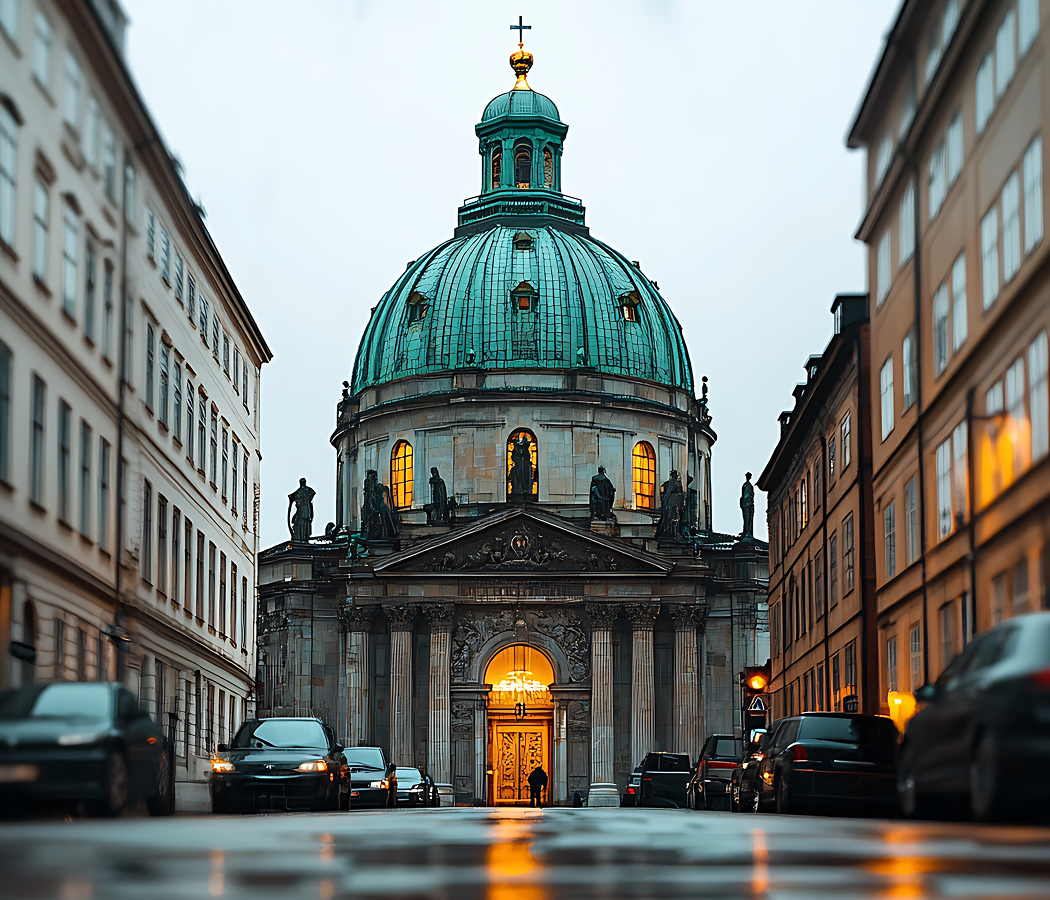
Perfect weekend in Copenhagen, Denmark.
Copenhagen's transformation from a medieval fishing settlement into Denmark's royal capital established the city as a center of Scandinavian maritime commerce, political authority, and architectural innovation. Situated on the eastern coast of Zealand beside the Øresund strait, Copenhagen developed around a natural harbor connecting the Baltic Sea with the trading routes of northern Europe. The settlement gained commercial importance during the twelfth century under Bishop Absalon, whose construction of a fortified stronghold in 1167 strengthened its defenses and encouraged the expansion of regional trade. Copenhagen received municipal privileges during the thirteenth century, subsequently becoming an important commercial competitor to the Hanseatic cities that dominated Baltic maritime exchange. The city's political importance increased during the fifteenth century when Christopher of Bavaria established Copenhagen as the principal royal residence of the Danish monarchy. Under Christian IV, who ruled from 1588 to 1648, Copenhagen experienced extensive construction and commercial expansion, with new fortifications, naval facilities, and Renaissance buildings expressing Denmark's ambitions as a northern European power. The establishment of the Danish East India Company in 1616 strengthened commercial connections with Asia, contributing to the development of overseas trading enterprises. Devastating fires in 1728 and 1795 destroyed substantial portions of the medieval city, prompting reconstruction that introduced new architectural forms and improvements to urban infrastructure. The British bombardment of Copenhagen in 1807 inflicted further destruction during the Napoleonic Wars, contributing to a period of economic and political instability. During the nineteenth and twentieth centuries, industrialization, constitutional reform, and the expansion of public institutions transformed Copenhagen into a modern Scandinavian capital distinguished by its maritime heritage and influential traditions of civic planning.
Copenhagen's international cultural reputation rests upon Danish design, architectural experimentation, literary achievement, and a culinary tradition closely connected to the agricultural and marine resources of Scandinavia. The National Museum of Denmark preserves extensive collections devoted to Danish prehistory, Viking civilization, medieval society, and the country's relationships with cultures throughout the world. The Ny Carlsberg Glyptotek, founded by brewer and collector Carl Jacobsen, houses distinguished collections of ancient Mediterranean sculpture and European painting, including important works by French Impressionists and Post-Impressionists. Danish architectural modernism achieved international influence through designers including Arne Jacobsen, whose furniture, buildings, and industrial designs contributed to the development of twentieth-century Scandinavian functionalism. The Danish Design Museum preserves important examples of furniture, decorative arts, and industrial craftsmanship, connecting traditional production methods with modern approaches to design. Copenhagen's literary heritage includes Hans Christian Andersen, whose fairy tales became foundational works of international children's literature, and Søren Kierkegaard, whose philosophical writings profoundly influenced existentialist thought. The city's culinary traditions draw upon Baltic and North Sea seafood, Danish dairy production, regional vegetables, and preservation techniques developed through generations of Nordic agriculture. Smørrebrød, traditional open-faced sandwiches prepared with rye bread and carefully arranged toppings, occupies an established place within Danish food culture, accompanied by specialties including pickled herring, cured fish, and seasonal pastries. Copenhagen's contemporary restaurant movement has expanded these foundations through fermentation, foraged ingredients, regional agriculture, and innovative interpretations of Nordic cooking. A perfect weekend in Copenhagen brings together royal history, Scandinavian design, literary heritage, and the sophisticated culinary traditions of Denmark's historic capital.
Three day itinerary.
Day 1: Tivoli Gardens
Tivoli Gardens is best known for joining amusement, landscape design, architecture, performance, and illumination within a pleasure garden operating in Central Copenhagen since 1843. Georg Carstensen secured royal permission from Christian VIII to establish the attraction beyond the city's fortifications, creating an entertainment ground whose early program combined gardens, music, theater, restaurants, and mechanical amusements. Tivoli subsequently became enclosed by the expanding capital as Copenhagen demolished its ramparts and urbanized the surrounding land. The wooden Rutschebanen roller coaster entered the park in 1914 and preserved the tradition of manually controlled scenic railways. Tivoli's architecture accumulated exoticist and theatrical influences across generations, making visual fantasy fundamental to the grounds. Its combination of gardens and entertainment profoundly influenced the development of the modern amusement park.
Day 1: Alchemist
Alchemist is best known for Rasmus Munk's extraordinarily ambitious fusion of gastronomy, theater, visual art, technology, and social commentary. Munk established the original Alchemist before expanding the project into a vast former industrial space on Refshaleøen, where dinner unfolds across multiple rooms and dozens of individual impressions. A planetarium-scale dome surrounds diners with projected imagery, turning the physical environment into an active component of the meal. Individual preparations engage subjects extending from industrial food production and plastic pollution to blood donation and animal welfare, giving technical cooking an unusually explicit intellectual purpose. Fermentation, seafood, meat, plant ingredients, sculptural presentation, and experimental technique operate within this broader physical structure. Two MICHELIN stars accompany a restaurant whose scale and conceptual ambition have made it one of Copenhagen's defining contemporary culinary institutions.
Day 2: Rosenborg Castle
Rosenborg Castle is best known for preserving the material world of Denmark's early modern monarchy within Christian IV's Renaissance pleasure palace. Christian IV began the complex during the early seventeenth century, gradually expanding a country retreat into an elaborate royal residence distinguished by stepped gables, towers, red brick, and sandstone ornament. The Long Hall became a ceremonial interior containing royal thrones and silver lions associated with absolutist monarchy. Rosenborg subsequently developed into a repository for dynastic collections after royal residence shifted elsewhere. The Danish Crown Jewels and regalia occupy its treasury, joining portraits, furnishings, weapons, decorative arts, and personal objects accumulated across generations of rulers. Rosenborg compresses royal architecture, collecting, ceremony, and the political transformation of the Danish monarchy into one exceptionally intact historic complex.
Day 2: Søllerød Kro
Søllerød Kro is best known for sustaining centuries of Danish hospitality within a historic inn north of Copenhagen. The establishment traces its origins to the seventeenth century, when roadside inns served travelers moving through the countryside beyond the capital. Its whitewashed buildings and village setting preserve a markedly different architectural scale from Copenhagen's urban dining rooms. Modern culinary leadership transformed that inherited setting into one of Denmark's most accomplished restaurants, with French technique supporting seafood, vegetables, meat, sauces, and Nordic seasonal ingredients. The kitchen's refinement exists in direct discussion with the long institutional life of the inn itself. A MICHELIN star gives Søllerød Kro unusual authority as a restaurant where contemporary Danish gastronomy operates inside a hospitality tradition extending across several centuries.
Day 2: Amalienborg Palace
Amalienborg Palace is best known for organizing the residence of the Danish monarchy around one of Europe's great Rococo urban spaces. Four aristocratic palaces arose around an octagonal square during the eighteenth-century development of Frederiksstaden, the expansive district commissioned under Frederik V. Architect Nicolai Eigtved established the architectural language that gave the ensemble its exceptional unity. The royal family acquired the palaces after Christiansborg Palace burned in 1794, transforming an aristocratic development into the principal royal residence. Jacques Saly's equestrian statue of Frederik V occupies the center of the square, reinforcing the relationship between architecture and royal patronage. Amalienborg captures the Danish monarchy through urban planning and residential architecture rather than a single expansive palace block.
Day 2: Kadeau
Kadeau is best known for translating the landscape and food traditions of Bornholm into one of Denmark's most sophisticated contemporary cuisines. Nicolai Nørregaard and his collaborators developed Kadeau from a restaurant on the Baltic island before creating its Copenhagen counterpart. Preservation gives the kitchen its fundamental structure, allowing ingredients harvested during short Nordic growing seasons to persist through fermentation, drying, smoking, curing, pickling, and aging. Berries, herbs, flowers, vegetables, seafood, meat, grains, and preserved products carry the ecological character of Bornholm into the capital. The restaurant treats an island landscape as a culinary archive extending across seasons. Two MICHELIN stars place Kadeau among Copenhagen's elite restaurants and make it a decisive replacement for Pomodoro.
Day 3: Hart
Hart is best known for helping redefine contemporary Copenhagen baking through exceptional sourdough bread, laminated pastry, and grain-focused craftsmanship. British baker Richard Hart established the bakery after leading the bread program at Noma, bringing fermentation and meticulous flour selection into a neighborhood bakery format. Long-fermented loaves develop deeply caramelized crusts and open interiors, and laminated pastries apply comparable precision to butter, grain, temperature, and texture. Copenhagen's modern bakery movement emerged alongside New Nordic gastronomy but translated its concern with ingredients and process into food consumed as part of everyday city life. Hart became one of the movement's defining institutions. Its breakfast position gives the itinerary a direct encounter with the craft culture that reshaped Copenhagen baking far beyond the formal tasting-menu world.
Day 3: Nyhavn
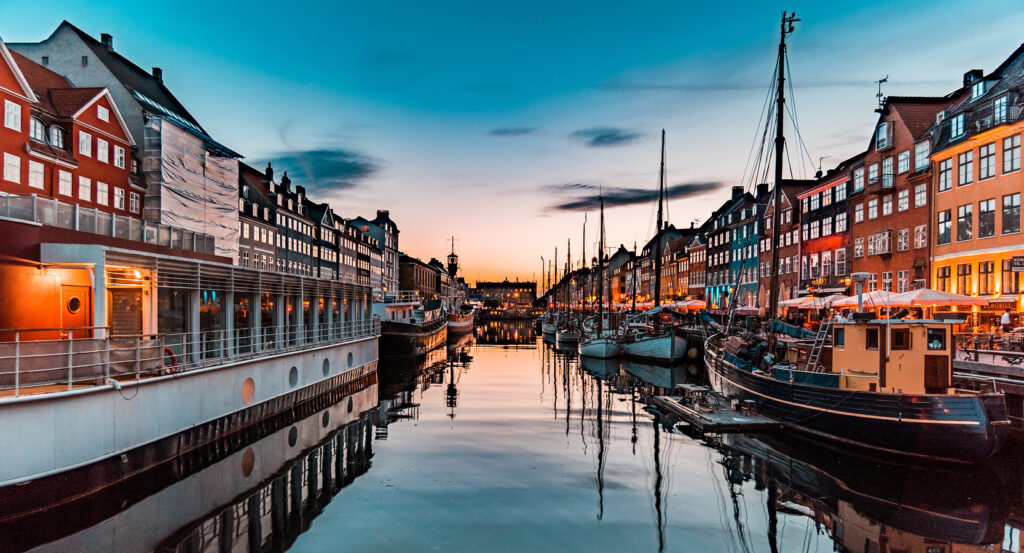
Nyhavn is best known for transforming a seventeenth-century commercial harbor into Copenhagen's most recognizable historic waterfront. Christian V ordered the canal excavated during the 1670s to bring ships and cargo directly from the harbor toward Kongens Nytorv. Merchants, sailors, taverns, warehouses, and townhouses subsequently concentrated along its quays, producing a working maritime district embedded within the expanding capital. Hans Christian Andersen lived at several Nyhavn addresses during his long association with Copenhagen, connecting the waterfront with Denmark's literary history. Wooden ships preserve the canal's maritime character after commercial port activity migrated elsewhere. The surviving townhouses, water, vessels, and quays reveal the intimate scale at which Copenhagen's commercial and urban development once met the Baltic maritime world.
Day 3: Øresund Bridge
Øresund Bridge is best known for physically integrating Copenhagen and southern Sweden through one of Europe's most consequential cross-border infrastructure projects. The fixed link opened in 2000 between Denmark and Sweden, combining an immersed tunnel, artificial island, and cable-stayed bridge across the Øresund. The Danish approach passes through the Drogden Tunnel before emerging on Peberholm, an artificial island constructed as the transition between tunnel and bridge. Rail and motorway traffic share the link, allowing metropolitan movement between Copenhagen and Malmö across a national boundary that had historically required maritime passage. Its cable-stayed section rises above the shipping channel approaching the Baltic. The Øresund connection transformed regional commuting, commerce, transportation, and labor mobility, giving physical form to an increasingly integrated Scandinavian metropolitan region.
Day 3: Geranium
Geranium is best known for Rasmus Kofoed's exceptionally precise interpretation of Scandinavian ingredients from a dining room overlooking Copenhagen's Fælledparken. Kofoed uniquely won bronze, silver, and gold medals at successive Bocuse d'Or competitions, culminating in victory in 2011 and establishing his technical authority before Geranium reached its highest international stature. Vegetables, seafood, grains, herbs, preserved ingredients, and intricate sauces drive a cuisine whose construction emphasizes clarity, seasonality, and exact execution. The restaurant progressively moved away from meat as its menus developed a more concentrated relationship with plants and marine products. Geranium became Denmark's first restaurant to receive three MICHELIN stars in 2016. Its combination of Danish ingredients, competitive mastery, and sustained culinary influence gives Copenhagen an overwhelming final-dinner institution.
Where your story begins.
Foresyte Travel reveals places that feel extraordinary long before you arrive.
Enjoy editorial crafted for luxury travelers.
Foresyte may earn a commission when you book.