Why Øresund Bridge matters.
Øresund Bridge is a cable-stayed transport crossing where the Øresund region's maritime geography meets Scandinavian engineering, the integration of Danish and Swedish rail networks and the creation of a permanent land connection between Copenhagen and Malmö.
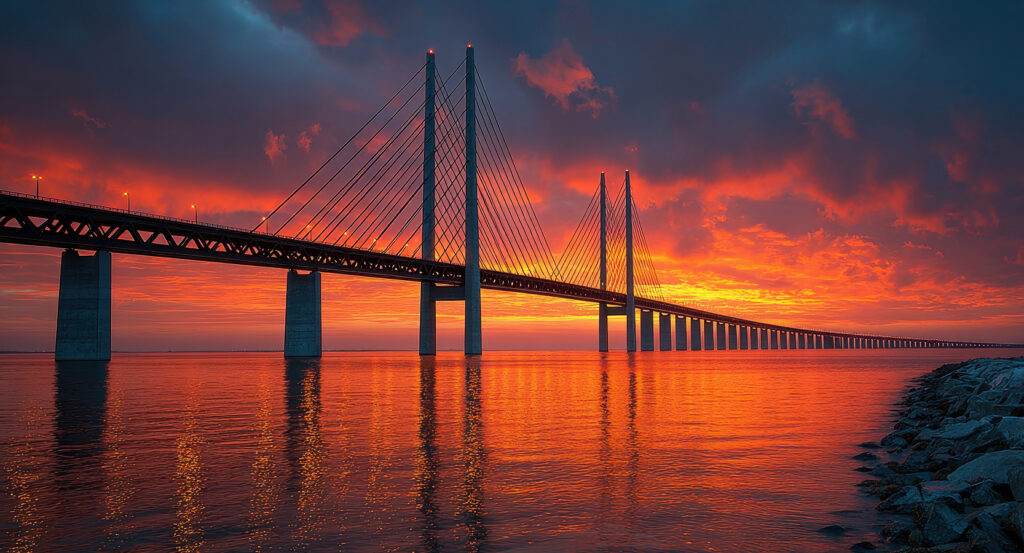
Extending eastward from the Danish coast at Kastrup toward the artificial island of Peberholm, the crossing occupies the western section of the Øresund Strait, where the railway and E20 motorway rise above the shipping channel before descending toward the Swedish shoreline at Lernacken, south of Malmö. Twin concrete pylons support the central cable-stayed span above the water. Two railway tracks run beneath the four-lane motorway, integrating road and rail traffic within a single structural deck. The western approach connects with the immersed tunnel leading toward Copenhagen Airport. The result is a fixed transport corridor linking two national infrastructure systems across a strait historically dependent upon maritime crossings.
What defines Øresund Bridge.
Øresund Bridge is best known for connecting Denmark and Sweden through a combined road and railway crossing that opened in 2000, establishing a permanent transport route between Copenhagen and Malmö. Proposals for a fixed crossing of the Øresund Strait developed during the twentieth century as commercial and passenger traffic increased between the two countries. The Danish and Swedish governments reached an agreement in 1991 to construct a combined road and rail connection. The project required coordination between national transport authorities, environmental regulators and engineering organizations responsible for the strait's shipping channels. Its design incorporated a bridge, an artificial island and an immersed tunnel to accommodate maritime navigation and aircraft operations near Copenhagen Airport. The construction consortium Sundlink began major works during the 1990s, assembling a crossing that combined several distinct engineering systems. The artificial island of Peberholm was created from dredged material and excavated rock, forming the transition between the bridge and tunnel sections. Construction of the immersed tunnel required prefabricated concrete elements to be lowered into a prepared trench beneath the seabed. The bridge's main cable-stayed section was designed to provide sufficient clearance for shipping traffic passing through the eastern portion of the strait. The completed connection was inaugurated on 1 July 2000 by Queen Margrethe II of Denmark and King Carl XVI Gustaf of Sweden. Its opening substantially reduced the practical separation between Copenhagen and Malmö, supporting commuting, freight transport and cross-border commercial activity. Rail services connected the Danish and Swedish networks through the new infrastructure, establishing direct passenger routes across the strait. The crossing became an important component of the transport system linking southern Sweden with Copenhagen Airport and the wider European rail network. Its operation contributed to the development of the Øresund region as an interconnected metropolitan area extending across the national boundary.
Peberholm forms the central transition between the elevated bridge and the submerged tunnel, creating an artificial landmass within the strait. The island extends four kilometers and was constructed specifically for the fixed crossing project. Its name refers to the neighboring natural island of Saltholm, creating a linguistic pairing between pepper and salt. The bridge section extends 7.8 kilometers between the Swedish coast and Peberholm. Its central cable-stayed span measures 490 meters, supported by four pylons rising 204 meters above sea level. Steel and concrete structural components distribute the loads of road and rail traffic through the deck and supporting piers. The railway occupies the lower level, protected beneath the motorway deck as the crossing approaches the central span. The Drogden Tunnel extends four kilometers beneath the western shipping channel, allowing vessels to pass above the submerged structure. Its immersed construction incorporates separate road and railway passages within prefabricated concrete elements. The tunnel connects with the Danish mainland through an approach route passing near Copenhagen Airport. The artificial island's undeveloped surfaces have become habitats for plants and birds colonizing the exposed terrain. Access restrictions protect its ecological development and separate the natural environment from the operating transport infrastructure. The crossing's combination of elevated, surface-level and submerged sections addresses the competing requirements of shipping, aviation and terrestrial transport. Its engineering integrates national railway systems, motorway traffic and marine navigation within a single coordinated corridor. The structure's continuing operation supports passenger movement and freight distribution between Denmark and Sweden.
How Øresund Bridge fits.
Øresund Bridge works as the engineering centerpiece for a cross-border itinerary connecting Copenhagen's maritime infrastructure, the coastal development of southern Sweden and the urban transformation of Malmö's waterfront.
Begin at Kastrup Sea Bath, the circular waterfront bathing structure situated along the Danish coast south of Copenhagen Airport. Designed by White Arkitekter, the facility opened in 2005 and incorporates a timber enclosure extending into the Øresund. Its circular form protects an interior bathing area from coastal winds, with elevated platforms providing access to the water. The structure's wooden surfaces weather naturally in the marine environment, connecting its architectural character with the surrounding coastline. The sea bath forms part of the recreational development of the Amager waterfront, where public access to the strait has expanded through parks, beaches and coastal infrastructure. Continue to Ribersborg Beach, the coastal recreational area extending along Malmö's western shoreline. The beach developed through land reclamation and waterfront improvements during the twentieth century, creating a substantial public bathing landscape beside the city. Its sandy shoreline, grassy recreational grounds and pedestrian routes face the Øresund and the distant Danish coast. Ribersborgs Kallbadhus, the historic open-air bathing establishment founded in 1898, occupies a timber structure extending into the water. The facility preserves Scandinavian bathing traditions associated with saunas and direct access to the sea. The surrounding coastline provides views of the strait's shipping traffic and the fixed crossing farther south. Conclude at Turning Torso, the residential skyscraper standing within Malmö's Västra Hamnen district. Designed by architect Santiago Calatrava, the building was completed in 2005 and reaches 190 meters in height. Its form consists of nine stacked cubic sections rotating through a total of ninety degrees, producing a twisting profile above the waterfront. The project became a focal point of Malmö's redevelopment of former industrial and harbor land. Västra Hamnen's transformation incorporated residential construction, public promenades and environmental planning associated with the city's postindustrial development. The progression moves from Copenhagen's recreational shoreline through Malmö's historic bathing coast and culminates at a contemporary waterfront tower, connecting Øresund Bridge with the architectural and maritime development of both sides of the strait.
Where your story begins.
Foresyte Travel reveals places that feel extraordinary long before you arrive.
Enjoy editorial crafted for luxury travelers.
Foresyte may earn a commission when you book.