Fun facts about Copenhagen, Denmark.
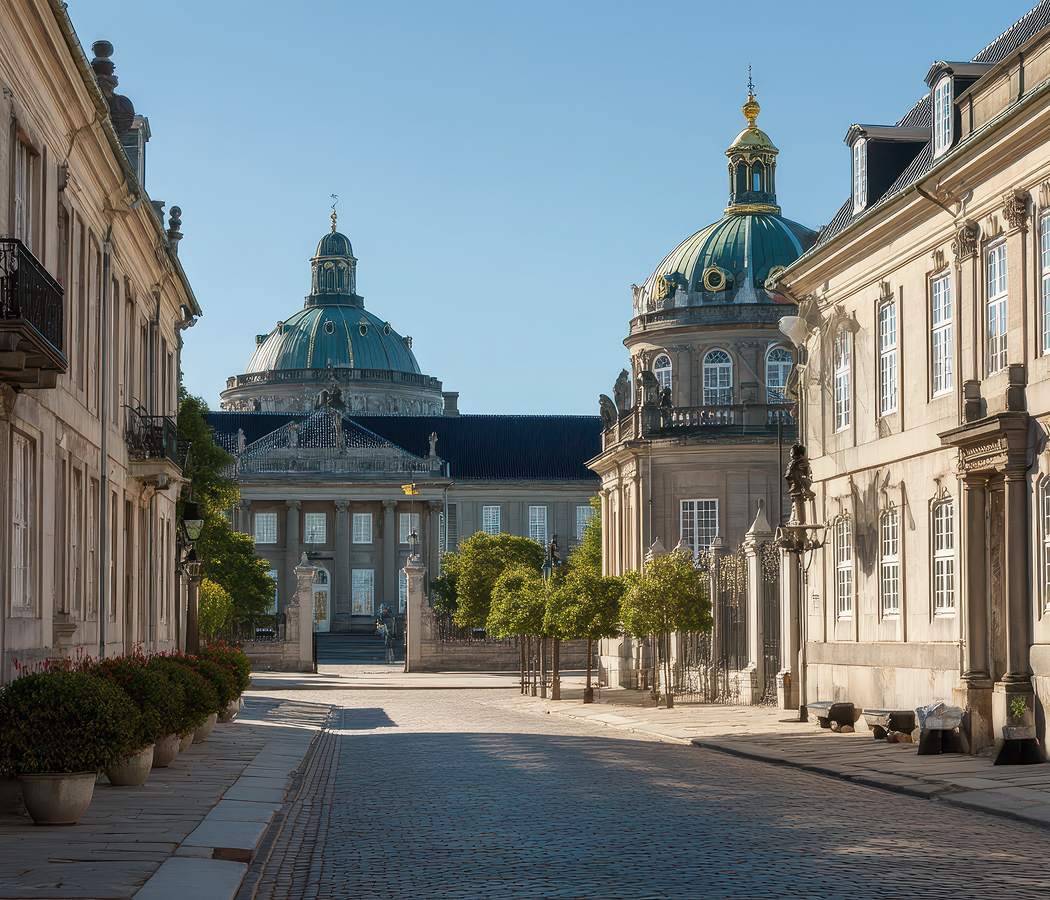
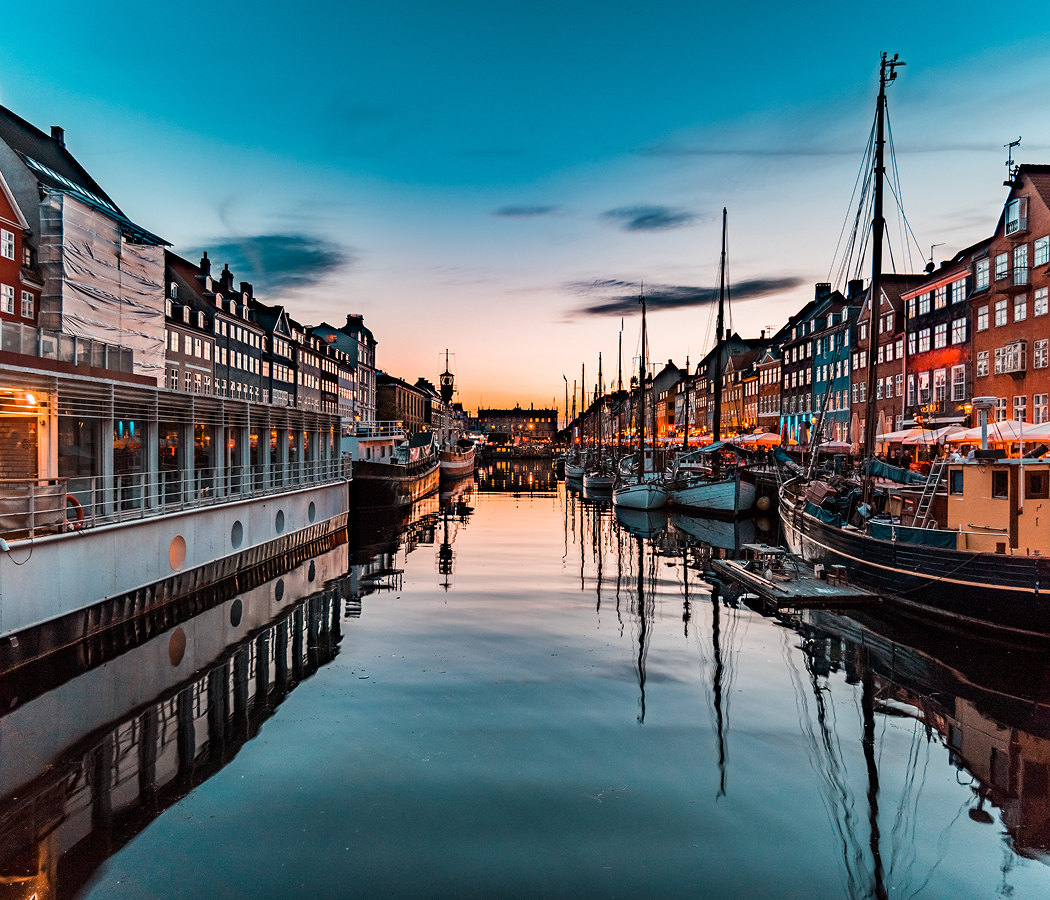
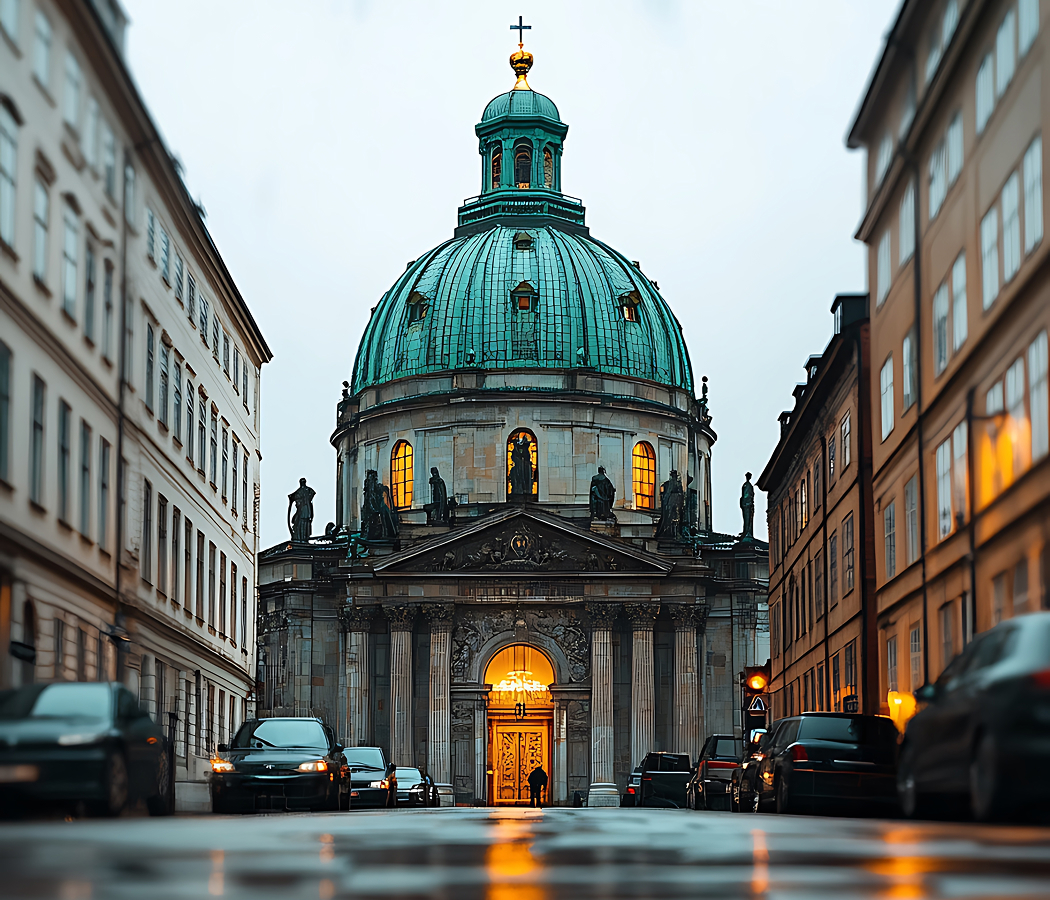
Copenhagen occupies the eastern shore of Zealand and the northern portion of Amager, facing the Øresund strait across a landscape of islands, canals, harbors, and relatively level coastal terrain. Its historic center developed around a sheltered harbor whose waterways continue to organize the city's principal neighborhoods and public spaces. Indre By contains the medieval core, where narrow streets, pedestrian shopping corridors, historic squares, and grand buildings reflect successive periods of royal and commercial development. Strøget, among Europe's prominent pedestrian shopping streets, connects City Hall Square with Kongens Nytorv through a sequence of interconnected streets and plazas. Copenhagen City Hall, completed in 1905, occupies the western end of this corridor, its National Romantic architecture distinguished by red brick, decorative stonework, and a prominent clock tower. Eastward, Kongens Nytorv forms a grand square bordered by the Royal Danish Theatre, Hotel d'Angleterre, and historic commercial buildings. Nearby, Nyhavn follows a seventeenth-century canal lined with brightly colored townhouses, former merchants' residences, and historic vessels moored along the waterfront. The district's narrow façades and waterside restaurants have become among Copenhagen's most recognizable urban scenes. South of the commercial center, Slotsholmen contains Christiansborg Palace, the seat of the Danish Parliament, alongside the Supreme Court and royal reception rooms. The palace occupies the historic site of Absalon's medieval fortress, connecting contemporary national government with the city's earliest political foundations. Nearby, the former Børsen building presents a distinctive Dutch Renaissance silhouette crowned by its celebrated dragon-spire design, although a major fire in 2024 severely damaged the historic structure. North of Slotsholmen, the Round Tower rises above the old university quarter, its cylindrical form and internal spiral ramp reflecting seventeenth-century astronomical ambitions. Rosenborg Castle stands within the landscaped grounds of the King's Garden, combining Dutch Renaissance architecture with collections associated with the Danish monarchy. Farther east, Frederiksstaden presents a more formal eighteenth-century urban composition centered on Amalienborg Palace, whose four Rococo façades surround an octagonal square. Frederik's Church, commonly known as the Marble Church, completes the grand axis through its immense copper dome. The nearby waterfront contains the Royal Danish Opera House, designed by Henning Larsen, whose broad roof and glass façade establish a contemporary counterpart to the royal district across the harbor. Across the water, Christianshavn retains a distinctive canal network established during Christian IV's expansion, with narrow streets, former warehouses, houseboats, and historic churches arranged around sheltered waterways. The Church of Our Saviour is distinguished by its external spiral staircase winding around a tall Baroque spire. Northward, Holmen occupies former naval dockyards and military lands that now accommodate cultural institutions, residential developments, and creative businesses. West of the historic center, Vesterbro combines nineteenth-century apartment blocks, former industrial buildings, and contemporary commercial streets. The Meatpacking District, known as Kødbyen, occupies a collection of former wholesale meat facilities transformed into restaurants, galleries, and entertainment venues. Nørrebro extends northwest through dense residential neighborhoods, independent shops, cafés, and public spaces reflecting Copenhagen's multicultural population. Assistens Cemetery provides a landscaped historic setting containing the graves of Hans Christian Andersen and Søren Kierkegaard. Østerbro presents broad residential streets, parks, and waterfront districts extending toward the northern harbor. Along the coast, the Little Mermaid sculpture occupies a rocky position beside the Langelinie promenade, commemorating Andersen's celebrated fairy tale. Copenhagen's extensive cycling infrastructure forms an essential element of its contemporary urban design, with dedicated bicycle lanes, bridges, and public spaces supporting everyday movement throughout the metropolitan area. The city's physical character is defined by the exceptional continuity between its royal architecture, historic harbor districts, contemporary waterfront development, and carefully planned pedestrian and cycling networks.
Danish design and intellectual culture have achieved international influence through Copenhagen, where traditions of craftsmanship, functional architecture, literature, and contemporary gastronomy shape a distinctive urban environment. The city played a central role in the development of modern Scandinavian design, particularly through the work of architects and furniture designers who emphasized elegant proportions, natural materials, and practical domestic objects. Arne Jacobsen contributed influential furniture designs and major architectural projects, including the SAS Royal Hotel, completed in 1960 and now operating as the Radisson Collection Royal Hotel. His Egg and Swan chairs became celebrated examples of twentieth-century furniture design. Hans J. Wegner developed an extensive body of work distinguished by refined joinery, sculptural wooden forms, and a close relationship between craftsmanship and function. The Designmuseum Danmark presents collections encompassing furniture, textiles, decorative arts, and industrial design, exploring the development of Danish creative traditions. Copenhagen's literary heritage includes Hans Christian Andersen, whose fairy tales achieved worldwide recognition through works such as The Little Mermaid, The Snow Queen, and The Ugly Duckling. Philosopher Søren Kierkegaard developed foundational ideas in existential thought through writings that examined faith, anxiety, individual responsibility, and human freedom. The Royal Danish Theatre, founded during the eighteenth century, became an important institution for drama, opera, and ballet, supporting the development of Danish performing arts. The Royal Danish Ballet established an internationally influential classical tradition through the choreography of August Bournonville, whose nineteenth-century works remain central to its repertoire. The National Museum of Denmark preserves collections spanning prehistoric Scandinavia, Viking culture, medieval history, and Danish social development. The Ny Carlsberg Glyptotek, established through the patronage of brewer Carl Jacobsen, contains major collections of ancient Mediterranean sculpture and European art within a grand museum complex near Tivoli Gardens. The Louisiana Museum of Modern Art, located north of Copenhagen in Humlebæk, contributes another major cultural destination through its international collections and architecture integrated with coastal gardens. Tivoli Gardens, opened in 1843, remains a defining institution of Copenhagen's public entertainment culture, combining landscaped grounds, historic amusement attractions, concerts, and seasonal celebrations. The city's contemporary music scene encompasses jazz, classical performance, electronic music, and independent venues, with the Copenhagen Jazz Festival bringing international performers to concert halls, clubs, and public spaces each summer. Copenhagen's culinary reputation has undergone a major transformation through the New Nordic movement, which emphasized regional ingredients, seasonal production, fermentation, and innovative interpretations of Scandinavian food traditions. Noma, founded by chef René Redzepi in 2003, played a decisive role in establishing the city as an internationally influential center of contemporary gastronomy. Traditional Danish cooking remains equally important, particularly smørrebrød, open-faced rye-bread sandwiches topped with combinations of fish, meat, vegetables, and carefully arranged garnishes. Pickled herring, cured salmon, roast pork, and seasonal root vegetables reflect the agricultural and maritime resources of Denmark. The city's bakeries are celebrated for wienerbrød, the laminated pastries internationally known as Danish pastries, along with cinnamon rolls and cardamom-flavored baked goods. Torvehallerne, a covered food-market complex near Nørreport Station, brings together produce merchants, fishmongers, specialty vendors, and contemporary food businesses. Copenhagen's café culture supports the Danish concept of hygge, associated with conviviality, comfort, and informal social gathering. Seasonal celebrations bring additional traditions into public life, particularly Christmas markets, illuminated streets, and festive programming at Tivoli Gardens. Copenhagen's cultural distinction lies in the close relationship between its influential design heritage, major literary and artistic institutions, ambitious contemporary cuisine, and an everyday urban culture organized around craftsmanship, public space, and social connection.
Five fascinations.
5. Copenhagen's famous waterfront began as a working commercial harbor.
Nyhavn was excavated in the seventeenth century to create a direct water connection between Copenhagen's inner city and its busy harbor. Merchant ships once crowded the canal, and warehouses, taverns, and residences developed along its quays to serve the maritime economy. Hans Christian Andersen later lived at several addresses beside the canal during his long association with Copenhagen. As larger ships and changing port infrastructure reduced Nyhavn's commercial importance, the waterfront evolved into a recreational district filled with restaurants and historic vessels. Its brightly painted façades belong to a much deeper landscape shaped by centuries of shipping, trade, literature, and urban transformation.
4. Copenhagen replaced its medieval fortifications with some of its most important parks and neighborhoods.
For centuries, Copenhagen existed within an elaborate defensive system of walls, bastions, gates, and moats that constrained urban expansion. Nineteenth-century military and demographic changes made much of the fortification system obsolete, opening enormous areas around the historic center for redevelopment. New neighborhoods expanded beyond the former gates, while sections of the defensive landscape evolved into parks and lakes. Tivoli Gardens itself developed beside the old fortifications, and surviving bastions remain particularly visible around Kastellet. Copenhagen's spacious green belt around the historic core reflects a dramatic conversion of military infrastructure into recreational landscapes and expanding urban districts.
3. Copenhagen contains one of the world's oldest continuously operating amusement parks.
Tivoli Gardens opened in 1843 just beyond Copenhagen's historic fortifications and developed into an unusual combination of landscaped garden, performance venue, restaurants, architecture, and amusement rides. Founder Georg Carstensen persuaded King Christian VIII to support the project, establishing an entertainment institution that survived profound changes in the surrounding city. Tivoli's wooden Rutschebanen roller coaster has operated since 1914, with a brakeman still riding aboard to control its speed. The park later became associated with Walt Disney, who visited Tivoli before Disneyland opened in California. Copenhagen preserved a nineteenth-century pleasure garden as a living component of the modern capital.
2. Copenhagen transformed a military harbor into one of Europe's most recognizable cultural waterfronts.
Holmen served for centuries as a center of Danish naval activity, containing shipyards, workshops, warehouses, barracks, and other infrastructure across islands in Copenhagen Harbor. As military functions contracted, former naval territory opened to new cultural, residential, educational, and creative uses. The Royal Danish Opera now faces the city from the harbor, while former industrial and military buildings accommodate institutions and businesses nearby. This transformation forms part of Copenhagen's broader reinvention of its waterfront from a heavily industrial working harbor into an accessible urban landscape. Large sections of the modern city occupy maritime infrastructure whose original purpose was shipbuilding and national defense.
1. Copenhagen turned its harbor from an industrial waterway into a place clean enough for swimming.
For much of the twentieth century, industrial activity and sewage pollution made Copenhagen Harbor unsuitable for recreation. Major investments in wastewater treatment, sewer infrastructure, and harbor cleanup radically improved water quality around the turn of the twenty-first century. Purpose-built harbor baths subsequently opened directly within the urban waterfront, allowing swimming beside dense neighborhoods and contemporary architecture. Islands Brygge became one of the most prominent examples, integrating aquatic recreation into public space only a short distance from the historic center. Copenhagen's harbor transformation represents more than beautification: infrastructure engineering converted formerly polluted industrial water into an everyday recreational environment at the heart of the city.
Where your story begins.
Foresyte Travel reveals places that feel extraordinary long before you arrive.
Enjoy editorial crafted for luxury travelers.
Foresyte may earn a commission when you book.