Why Tivoli Gardens matters.
Tivoli Gardens is a nineteenth-century amusement garden where Copenhagen's historic entertainment traditions meet Danish theatrical design, the development of mechanical rides and the cultural institutions that have shaped public recreation since 1843.
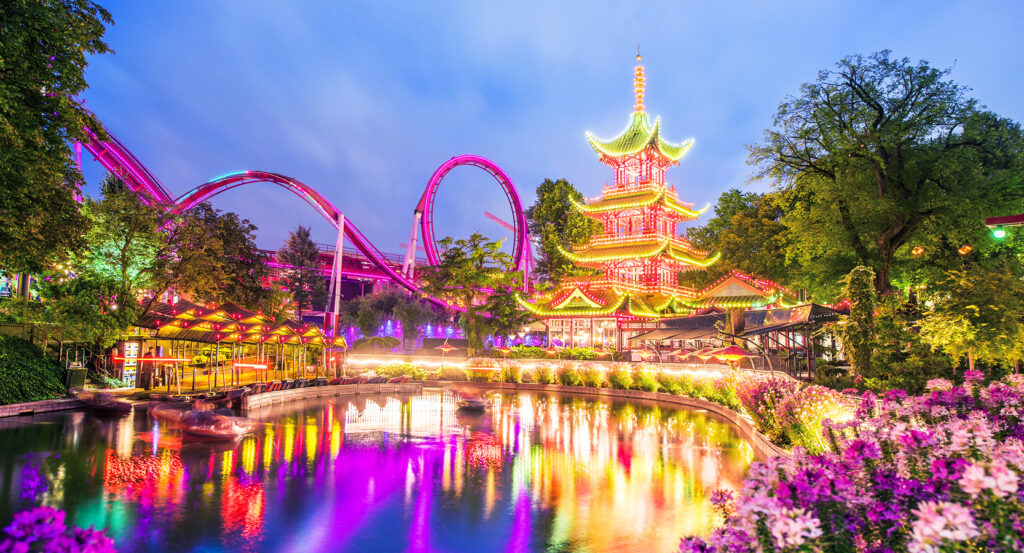
Set along Vesterbrogade near H. C. Andersens Boulevard and directly across from Copenhagen Central Station, the amusement garden occupies a walled city-center precinct between Rådhuspladsen and Bernstorffsgade, with its landscaped grounds extending behind the street-facing buildings toward the railway approaches of Vesterbro. Ornamental gates separate the surrounding streets from gardens organized around ponds, performance venues and amusement rides. Historic pavilions stand beside theatrical buildings, restaurants and landscaped promenades. The park's illuminated structures establish a nighttime streetscape distinct from the surrounding commercial blocks. The result is an enclosed urban garden whose physical arrangement preserves the relationship between nineteenth-century public entertainment and Copenhagen's metropolitan development.
What defines Tivoli Gardens.
Tivoli Gardens is best known for its founding in 1843, its combination of landscaped pleasure grounds and mechanical amusements, and its influence on the development of modern amusement parks. Danish entrepreneur Georg Carstensen secured royal permission from King Christian VIII to establish the gardens outside Copenhagen's fortified urban core. Carstensen promoted the project as a public entertainment institution combining music, dining, theatrical performances and recreational attractions. The gardens opened on 15 August 1843 under the name Tivoli & Vauxhall, drawing inspiration from European pleasure gardens and entertainment establishments. Their original location stood beyond the city's western defensive works, where open land accommodated gardens and purpose-built recreational structures. Early attractions included a theater, bandstands, restaurants, landscaped walks and a carousel. The development coincided with Copenhagen's transition from a fortified capital toward a larger industrial and commercial city. The removal of the city's fortifications during the nineteenth century gradually brought the gardens into the expanding urban center. Tivoli developed a distinctive architectural program incorporating European historicist styles, ornamental gardens and theatrical references to distant cultures. Its Chinese-inspired structures and illuminated pavilions became important components of the park's visual character. Mechanical amusements expanded during the late nineteenth and early twentieth centuries as engineering advances introduced new forms of recreational machinery. The wooden roller coaster Rutschebanen opened in 1914, becoming one of the park's defining attractions. During the German occupation of Denmark, sabotage in June 1944 destroyed several buildings, including the original concert hall. Reconstruction after the Second World War restored damaged facilities and introduced new architectural projects. Tivoli's continuing development preserved its founding combination of gardens, performing arts, restaurants and mechanical attractions within Copenhagen's historic center.
Georg Carstensen's founding concept placed public entertainment within landscaped grounds where architecture, performance and recreational machinery formed a coordinated visitor environment. The Pantomime Theatre, constructed in 1874, incorporates a Chinese-inspired façade and a mechanical peacock-tail curtain that opens across the stage. Its performances preserve traditions of Italian commedia dell'arte through characters including Harlequin, Columbine and Pierrot. The theater's open-air arrangement connects its performances with the surrounding gardens and pedestrian promenades. Rutschebanen operates through a wooden track supported by a substantial timber structure, with a brake operator accompanying the train to regulate its speed. The ride's engineering preserves an early twentieth-century approach to roller coaster operation. Tivoli Concert Hall, completed in 1956, provides a dedicated setting for orchestral performances and other musical events. The Tivoli Youth Guard, established in 1844, maintains a tradition of musical training and ceremonial performances associated with the gardens. The park's lake forms a central landscape feature, bordered by planted areas, illuminated structures and waterside restaurants. Nimb, the hotel and restaurant building overlooking the gardens, incorporates Moorish-inspired architectural elements developed through the park's historicist design traditions. Seasonal decoration changes the appearance of the grounds during Halloween and Christmas, incorporating extensive lighting installations and temporary attractions. Evening illumination remains a central component of the gardens' entertainment program, continuing practices established during the nineteenth century. Mechanical rides occupy separate areas of the grounds, ranging from historic attractions to contemporary installations. Gardens and flowerbeds provide planted spaces between the entertainment structures, maintaining the original relationship between horticulture and recreation. The resulting arrangement preserves Tivoli's historical combination of theatrical performance, decorative architecture, landscaped public space and mechanical amusement.
How Tivoli Gardens fits.
Tivoli Gardens works as the entertainment centerpiece for a Central Copenhagen itinerary connecting Danish cultural institutions, nineteenth-century urban development and the architectural traditions of the capital's civic center.
Begin at Copenhagen City Hall, the municipal building standing on Rådhuspladsen immediately northeast of the gardens. Architect Martin Nyrop designed the structure, which was completed in 1905 and incorporates influences from Italian Renaissance civic architecture and Danish medieval building traditions. Its brick façade, ornamental stonework and substantial clock tower establish a formal presence on the public square. The interior contains ceremonial halls, staircases and decorative programs associated with Copenhagen's municipal government. Jens Olsen's World Clock, installed in 1955, incorporates a complex astronomical mechanism displaying time and celestial movements. The building connects the expansion of modern Copenhagen with the architectural ambitions of its municipal institutions. Continue to Ny Carlsberg Glyptotek, the art museum founded by brewer and collector Carl Jacobsen. The institution opened in 1897 to house collections assembled through Jacobsen's interest in ancient sculpture and European art. Its galleries contain Egyptian, Greek and Roman antiquities alongside nineteenth-century Danish and French paintings and sculpture. Architect Vilhelm Dahlerup designed the original museum building, which was subsequently expanded through additional architectural projects. A Central Winter Garden contains palms and other plants beneath a glass dome, connecting the museum's collections with a landscaped interior. The institution preserves the relationship between Copenhagen's brewing industry, private collecting and public cultural patronage. Conclude at the National Museum of Denmark, housed in the former Prince's Palace near Frederiksholms Kanal. The museum's collections trace Danish history through prehistoric artifacts, Viking Age objects, medieval material culture and later periods of national development. The Golden Horns, represented through reconstructions, connect the institution with early Danish archaeological discoveries. Exhibitions examine the development of settlement, craftsmanship, religion and political institutions across successive centuries. The palace building incorporates eighteenth-century architectural features associated with Denmark's royal court. The progression moves from municipal government through private artistic patronage and culminates at the national historical collections, connecting Tivoli Gardens with the civic and cultural institutions of Central Copenhagen.
Where your story begins.
Foresyte Travel reveals places that feel extraordinary long before you arrive.
Enjoy editorial crafted for luxury travelers.
Foresyte may earn a commission when you book.