Why The Round Tower matters.
The Round Tower isn't just an architectural wonder, it's Copenhagen's spiral of history, a living timepiece winding upward through centuries of art, science, and soul.
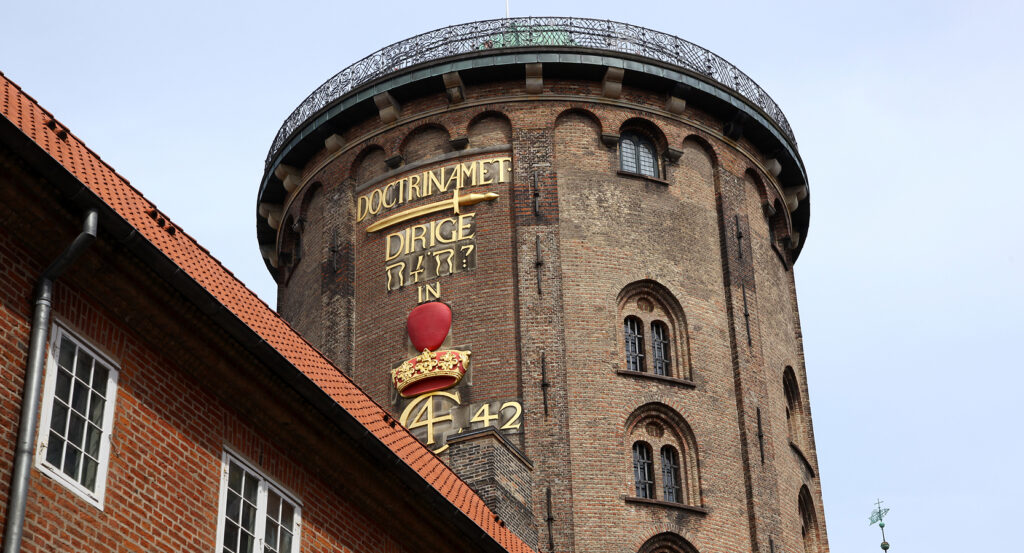
Rising gently above the city's cobblestone core, the 17th-century Rundetaarn captures Denmark's quiet genius, never boastful, but beautifully deliberate. Commissioned by King Christian IV and completed in 1642, the tower was built as an astronomical observatory, a library, and a chapel, three worlds of thought intertwined within a single structure. Its most remarkable feature is the spiral ramp, a continuous brick walkway that winds 268 meters to the top instead of stairs, designed so horses could carry instruments to the observatory. As you ascend, the sound softens, the light changes, and you feel the rhythm of another age still echoing through the walls. The climb is meditative, an architectural pilgrimage through Danish history. At the summit, a viewing platform rewards the effort with sweeping views over Copenhagen's copper rooftops, spires, and waterways. On windy days, the city hums below like an organ, modern life played against the soft persistence of the past. The Round Tower doesn't define Copenhagen's skyline; it elevates it, proof that brilliance often speaks in curves, not height.
What defines The Round Tower.
Behind its tranquil spiral lies one of Europe's most innovative stories of form meeting function.
When King Christian IV envisioned The Round Tower, he wanted more than a monument, he wanted a place that symbolized Denmark's intellectual awakening. The tower was part of the Trinitatis Complex, combining a church, university library, and observatory, a physical manifestation of heaven, knowledge, and faith intertwined. The spiral ramp was inspired by Renaissance fortifications and designed by architect Hans van Steenwinckel the Younger, using over 3.5 million bricks arranged in a subtle helical pattern. The observatory at its crown became Scandinavia's first major astronomical research center, attracting scholars from across Europe to study the stars through telescopes imported from Holland. Its library, situated halfway up, once held Denmark's entire academic collection before moving to the University of Copenhagen. During the 18th and 19th centuries, poets and philosophers would gather in its quiet alcoves, H.C. Andersen himself wandered these halls, noting the tower's “gentle turning” as a metaphor for thought itself. Today, The Round Tower continues to evolve: the library hall has transformed into a cultural venue for exhibitions, concerts, and readings, while the observatory still functions, making it the oldest working public observatory in Europe. Few realize the precision with which it was built, the incline averages only 3.74°, an astonishing feat of geometry that ensures the ascent feels smooth, almost effortless. The tower's copper-clad dome, weathered to green, remains one of the most beloved silhouettes in Denmark, not because it shouts, but because it endures.
How The Round Tower fits.
Climbing The Round Tower isn't just sightseeing, it's an act of slow discovery, best savored like a story unfolding page by page.
Begin your visit in the morning when the cobblestone streets of Købmagergade are just waking up and sunlight spills into the tower's arched windows. As you start the spiral climb, take your time, the acoustics change as you rise, footsteps echoing differently on each turn. Stop midway to visit the former library hall, now a cultural gallery hosting rotating art exhibits and installations that bridge the past and the present. Continue upward toward the narrow staircase that leads to the observatory dome, where the air cools and the sounds of the city fade. Step onto the viewing platform and let Copenhagen unfurl around you, the spires of Rosenborg Castle and Christiansborg Palace piercing the skyline, the distant shimmer of the harbor, the rhythmic sweep of cyclists threading the streets below. On clear evenings, return for the nighttime opening hours when the observatory's telescope is available to the public, a rare chance to look at the same stars once charted by scholars four centuries ago. Afterward, stroll through the surrounding Latin Quarter, dotted with bookshops, cafés, and boutiques that mirror the tower's quiet intellectual charm. Stop for coffee at a nearby café, and if you listen closely, you can almost hear the city breathing through the centuries. The Round Tower is more than architecture, it's an ascent through thought, a living museum of how curiosity built the modern world. The Round Tower doesn't compete for attention, it invites reflection. It rises not to impress, but to remind us that every height worth reaching begins with a single graceful turn.
Where your story begins.
Foresyte Travel reveals places that feel extraordinary long before you arrive.
Enjoy editorial crafted for luxury travelers.
Foresyte may earn a commission when you book.