Fun facts about Vietnam.
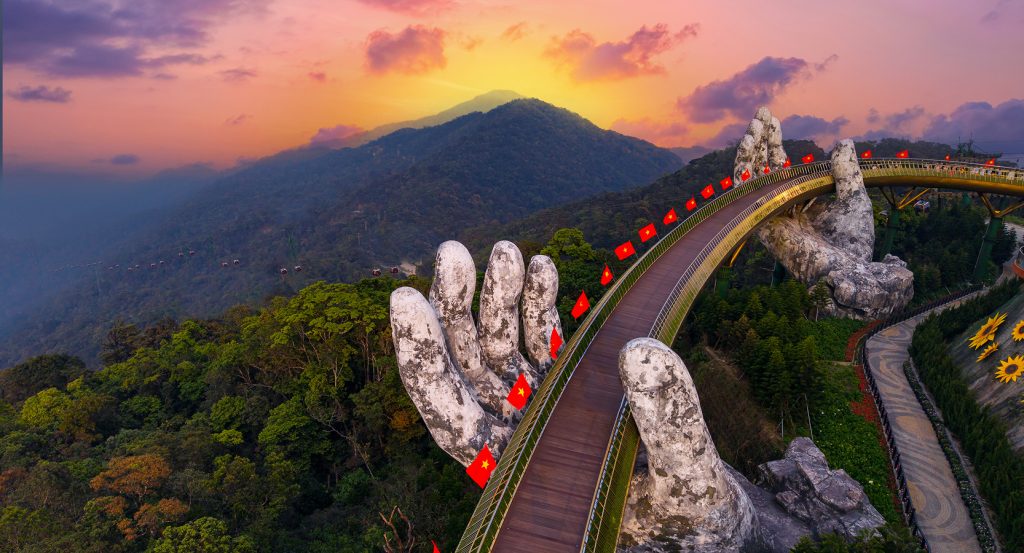
Da Nang occupies a broad coastal plain where the Hàn River meets the South China Sea, framed by forested mountains, sandy beaches, and the sheltered waters of Da Nang Bay. Its geography places the city between the Hải Vân mountain range to the north and the coastal landscapes extending toward Hội An to the south, creating a distinctive combination of maritime infrastructure and tropical scenery. The Hàn River forms the principal geographic axis of Central Da Nang, dividing the commercial districts on its western bank from extensive residential neighborhoods and coastal development to the east. A series of major bridges connects the two sides, reflecting the city's rapid expansion and substantial investment in urban infrastructure. The Dragon Bridge, opened in 2013, extends across the river through a striking steel structure shaped like a golden dragon, incorporating illuminated architectural elements and a mechanical head capable of releasing fire and water. Farther north, the Hàn River Bridge, completed in 2000, introduced a rotating central span designed to accommodate river traffic. The nearby Trần Thị Lý Bridge presents another contemporary engineering landmark through its inclined pylon and cable-stayed structure. Along the western waterfront, Bạch Đằng Street follows the river through landscaped promenades, commercial buildings, and public spaces overlooking the eastern districts. The surrounding city center contains markets, administrative institutions, historic religious buildings, and contemporary hotels developed within an increasingly dense urban grid. Chợ Hàn remains an important commercial landmark, with stalls selling produce, textiles, household goods, and regional specialties. The pink-painted Da Nang Cathedral, completed in 1923, introduces a distinctive example of French colonial ecclesiastical architecture through its Gothic Revival forms and prominent spire. South of the central district, the Museum of Cham Sculpture contains one of the world's most significant collections of Cham stone carving, displayed within an early twentieth-century building associated with French archaeological scholarship. East of the river, Mỹ Khê Beach extends along a broad sandy shoreline facing the South China Sea, connecting urban neighborhoods with an extensive coastal recreational landscape. The beach continues southward through a succession of waterfront districts toward the Non Nước area, where resort developments occupy land between the sea and the Marble Mountains. These five limestone and marble hills rise abruptly from the coastal plain, containing caves, Buddhist sanctuaries, stone stairways, and elevated viewpoints. Thủy Sơn, the largest and most visited hill, contains religious sites including Linh Ứng Pagoda and the dramatic Huyền Không Cave. The surrounding Non Nước stone-carving village preserves a longstanding tradition of sculpture and decorative stonework associated with the local landscape. North of Central Da Nang, the Sơn Trà Peninsula extends into the sea through steep forested terrain, providing a natural barrier around the eastern entrance to Da Nang Bay. Its protected landscapes support substantial biodiversity, including the endangered red-shanked douc langur. The Linh Ứng Pagoda complex on the peninsula contains an expansive white statue of the bodhisattva Avalokiteśvara overlooking the coastline. Farther northwest, Hải Vân Pass crosses the mountains separating Da Nang from the coastal plains approaching Huế, offering dramatic views of the bay and surrounding forested slopes. The nearby Hải Vân tunnels carry major road traffic beneath the mountain range, strengthening transportation connections along Vietnam's north-south corridor. Inland, the Bà Nà Hills rise into a cooler mountainous environment containing forests, steep valleys, and extensive tourism infrastructure. The Golden Bridge, opened in 2018, crosses a mountainside through a curved pedestrian structure supported visually by two enormous sculpted hands. Da Nang's physical distinction lies in the close proximity of an active commercial port, a rapidly modernizing riverfront, expansive beaches, and protected mountain landscapes within a single coastal metropolis.
Vietnamese cultural traditions in Da Nang draw upon the historical inheritance of Champa, the Buddhist and Confucian institutions of Central Vietnam, and the maritime customs of communities living between the mountains and the sea. The region's Cham heritage survives most prominently through sculpture, architecture, and religious traditions associated with the former kingdom's Hindu sanctuaries. The Museum of Cham Sculpture preserves an exceptional collection of sandstone figures, temple decorations, and architectural fragments, including representations of Shiva, Vishnu, apsaras, and other subjects associated with the religious traditions of ancient Champa. Its collections encompass major artistic centers including Mỹ Sơn, Trà Kiệu, and Đồng Dương, illustrating the development of Cham sculpture across successive centuries. The broader region's cultural history also reflects the influence of the Nguyễn imperial court at Huế, whose ceremonial traditions, architecture, and classical music shaped Central Vietnamese artistic life. Da Nang's Buddhist communities maintain temples and pagodas associated with local religious practice, including sites within the Marble Mountains where natural caves have served as places of worship and contemplation. Traditional festivals bring neighborhood communities together through processions, devotional ceremonies, and performances connected to local spiritual traditions. The annual Quán Thế Âm Festival, held at the Marble Mountains, honors the bodhisattva Avalokiteśvara through Buddhist rituals and cultural activities. Coastal fishing communities preserve ceremonies devoted to Cá Ông, the whale spirit revered as a protector of seafarers, reflecting the importance of maritime livelihoods along Vietnam's central coast. The city's performing arts heritage includes bài chòi, a traditional form combining folk singing, theatrical performance, and a communal game played through the use of demonstrated cards. Associated with Central Vietnam, bài chòi received UNESCO recognition as intangible cultural heritage in 2017. Da Nang's contemporary cultural institutions support exhibitions, public performances, and artistic education, connecting regional traditions with the creative practices of a growing metropolitan population. The city's culinary traditions are particularly distinctive within Vietnamese regional cooking, combining the agricultural products of Quảng Nam with seafood from the central coast. Mì Quảng, a signature noodle dish associated with the wider Quảng Nam-Da Nang region, combines broad turmeric-colored rice noodles with a concentrated broth, herbs, peanuts, rice crackers, and ingredients such as shrimp, pork, or chicken. Its relatively small quantity of broth distinguishes the preparation from many other Vietnamese noodle dishes. Bún chả cá features rice noodles served in a fragrant fish-based broth with fish cakes, vegetables, and aromatic herbs, reflecting the central role of seafood in local cooking. Bánh tráng cuốn thịt heo combines sliced pork, fresh herbs, vegetables, and rice paper, typically accompanied by a richly flavored fermented fish sauce. The region's use of mắm nêm, a pungent fermented anchovy sauce, contributes a particularly recognizable element to Central Vietnamese cuisine. Fresh seafood remains central to neighborhood restaurants and coastal markets, with clams, squid, prawns, and locally caught fish prepared through grilling, steaming, and aromatic marinades. The nearby agricultural districts of Quảng Nam supply rice, herbs, vegetables, and other ingredients that sustain the city's everyday food culture. Da Nang's contemporary cultural development also reflects its role as a regional university and technology center, attracting students, entrepreneurs, and creative professionals from across Central Vietnam. The city's artistic inheritance and culinary traditions preserve the influence of Cham civilization, Vietnamese imperial history, and generations of coastal communities whose livelihoods have depended upon the resources and trading connections of the central coast.
Five fascinations.
5. Da Nang contains a mountain landscape riddled with caves, temples, and Buddhist sanctuaries.
The Marble Mountains rise abruptly from the coastal plain south of Central Da Nang as a cluster of limestone and marble hills traditionally associated with the five elements. Natural caves penetrate the formations, and generations of worshippers transformed many of these spaces with pagodas, shrines, statues, stairways, and carved religious imagery. Huyền Không Cave became particularly striking as openings in its ceiling allow shafts of sunlight to penetrate the cavern. Da Nang contains a sacred landscape where geology and religious architecture have developed together, turning natural rock formations into places of worship and pilgrimage over centuries.
4. Da Nang's most famous modern bridge breathes fire.
The Dragon Bridge opened across the Hàn River in 2013 with an enormous steel dragon forming the structural and visual centerpiece of the crossing. Its design references the dragon of Vietnam's Lý dynasty, connecting a contemporary infrastructure project with imagery rooted in Vietnamese cultural history. At scheduled performances, the dragon's head emits bursts of fire followed by sprays of water, turning an ordinary transportation link into a recurring urban performance. The bridge became a defining symbol of modern Da Nang, demonstrating how the rapidly developing city transformed essential river infrastructure into expansive public architecture and nighttime entertainment.
3. The Sơn Trà Peninsula shelters one of the world's rarest primates beside a major city.
Forest-covered Sơn Trà rises immediately northeast of Da Nang, creating an extraordinary ecological refuge beside the expanding urban coastline. The peninsula supports the red-shanked douc langur, a brilliantly colored primate native to mainland Southeast Asia and threatened by habitat loss and other pressures. Its population survives among tropical forest overlooking the city and the South China Sea. Roads and viewpoints make the peninsula unusually accessible for such biologically significant habitat. Da Nang places dense urban development, beaches, mountainous forest, and globally important wildlife within a remarkably compressed geographic area.
2. Da Nang once contained one of the most important American air bases of the Vietnam War.
Da Nang Air Base became a major military aviation center during the Vietnam War, supporting extensive operations by American and South Vietnamese forces. Its strategic position near the coast and Central Vietnam made the surrounding city a critical logistical hub as military infrastructure expanded dramatically during the 1960s. The conflict transformed Da Nang's population, physical development, transportation systems, and international significance. After reunification, the area entered an entirely different period of urban growth. Modern Da Nang's broad avenues, airport infrastructure, resorts, and expanding skyline occupy a city profoundly reshaped during one of the twentieth century's defining conflicts.
1. Da Nang possesses one of the world's longest cable-car journeys above a mountain landscape.
The Bà Nà Hills complex west of Da Nang is reached through an extraordinary network of aerial cable cars climbing from tropical foothills toward a mountaintop resort more than a kilometer above sea level. Successive lines have achieved major engineering records for their length and elevation change, carrying passengers across forested valleys and steep mountain terrain. The highlands themselves first developed as a retreat during the French colonial period before their twenty-first-century reinvention as a major visitor destination. Da Nang turned extreme topography into part of the attraction, making the ascent through the mountains nearly as dramatic as the destination above.
Where your story begins.
Foresyte Travel reveals places that feel extraordinary long before you arrive.
Enjoy editorial crafted for luxury travelers.
Foresyte may earn a commission when you book.