Fun facts about New Mexico.
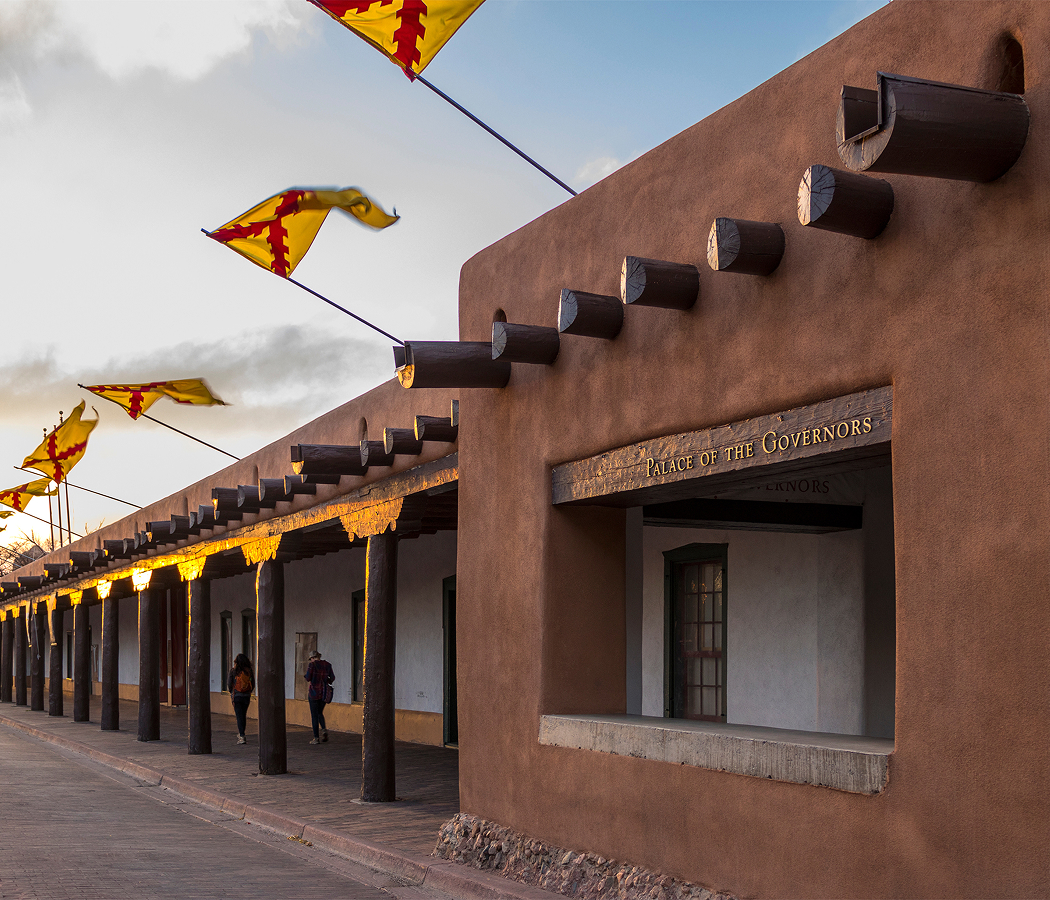
Santa Fe lies at 7,000 feet above sea level in the northern Rio Grande region, where the foothills of the Sangre de Cristo Mountains descend toward broad high-desert valleys covered with piñon pine, juniper, and sagebrush. The city occupies the Upper Santa Fe River watershed, with mountain streams, arroyos, and gently sloping terrain shaping its historic settlement pattern. The Sangre de Cristo Mountains rise immediately to the east, forming the southern extension of the Rocky Mountains and providing a dramatic backdrop of forested ridges and seasonal snow. The Santa Fe Plaza anchors the historic center, preserving the spatial organization established during Spanish colonial rule. Its landscaped square is surrounded by adobe-style commercial buildings, civic institutions, and pedestrian streets that maintain the scale of an early colonial settlement. Along the northern edge stands the Palace of the Governors, constructed beginning in 1610 and among the oldest surviving public buildings in the United States. Its long portal, thick earthen walls, and traditional wooden structural elements reflect the region's enduring architectural methods. The adjoining New Mexico History Museum extends the historic complex through contemporary exhibition spaces. East of the plaza, the Cathedral Basilica of St. Francis of Assisi presents a Romanesque Revival façade constructed primarily during the nineteenth century, contrasting with the surrounding adobe architecture. Nearby, Loretto Chapel contains a celebrated spiral staircase built during the 1870s, distinguished by its unusual construction and graceful curvature. The San Miguel Chapel, traditionally associated with the earliest decades of Spanish settlement, preserves another important example of historic religious architecture. Santa Fe's distinctive streetscape developed through the widespread use of adobe construction, incorporating earthen walls, flat roofs, projecting wooden beams known as vigas, and recessed courtyards. During the twentieth century, local architectural regulations reinforced the Pueblo Revival and Territorial Revival styles, establishing a consistent visual language across much of the historic district. The New Mexico Museum of Art, completed in 1917, presents a major example of Pueblo Revival architecture through its sculpted adobe forms, shaded portals, and restrained ornamentation. South of the plaza, the Railyard District occupies former railroad property transformed into a mixed-use neighborhood containing galleries, markets, restaurants, and public spaces. The Santa Fe Farmers' Market contributes an important agricultural connection to the surrounding region, bringing produce and specialty foods from northern New Mexico into the city. Southeast of downtown, Canyon Road follows a historic route through a residential district distinguished by adobe houses, enclosed gardens, and an extensive concentration of art galleries. Its narrow streets and intimate courtyards preserve the scale of an older neighborhood within the contemporary cultural center. Museum Hill rises south of the historic district, bringing together major institutions within a landscaped setting overlooking the surrounding mountains. The Museum of International Folk Art, Museum of Indian Arts and Culture, and Wheelwright Museum of the American Indian form a significant concentration of regional and international collections. Farther east, the Santa Fe National Forest extends into the Sangre de Cristo Mountains, where alpine forests, mountain trails, and high-elevation recreation areas provide access to a contrasting environment above the desert city. The nearby Pecos Wilderness contains extensive mountain terrain, lakes, and river valleys within the southern Rockies. Westward, the landscape opens toward the Rio Grande basin, with volcanic formations, mesas, and distant mountain ranges defining the broader northern New Mexico setting. Santa Fe's physical distinction comes from the continuity of its historic plaza, earthen architecture, mountain geography, and the close integration of civic institutions with the surrounding high desert.
New Mexican art and literature have developed through sustained exchanges among Pueblo, Hispanic, and Anglo-American communities, with Santa Fe serving as a major center for Indigenous craftsmanship, regional modernism, and the preservation of Southwestern cultural heritage. Pueblo pottery, weaving, jewelry, and ceremonial arts reflect artistic systems maintained across generations, with individual communities developing distinctive materials, techniques, and decorative traditions. The annual Santa Fe Indian Market, organized by the Southwestern Association for Indian Arts, brings Indigenous artists from across North America into the historic center, presenting contemporary and traditional works in jewelry, pottery, textiles, painting, and sculpture. Established in 1922, the market has become one of the country's most important gatherings devoted to Native American art. The Museum of Indian Arts and Culture preserves extensive archaeological and ethnographic collections, connecting contemporary artistic production with the history of the region's Indigenous communities. The Wheelwright Museum of the American Indian contributes another important institution through exhibitions and collections emphasizing Native American artistic achievement. Santa Fe's modern art movement developed during the early twentieth century as painters and writers sought new approaches to the landscapes, architecture, and communities of northern New Mexico. Artists including Robert Henri, John Sloan, and Randall Davey contributed to the city's growing reputation as a center of American painting. The establishment of the Santa Fe Art Colony attracted additional artists whose work engaged with the region's light, geology, and cultural environment. Georgia O'Keeffe developed a profound artistic relationship with northern New Mexico beginning in 1929, eventually settling permanently in the region. Her paintings of desert cliffs, bones, flowers, and architectural forms became defining works of American modernism. The Georgia O'Keeffe Museum, opened in 1997, preserves an extensive collection of her paintings, drawings, and related materials. Santa Fe's literary heritage includes Willa Cather, whose novel Death Comes for the Archbishop drew upon the religious and historical landscape of nineteenth-century New Mexico. The city's performing arts institutions include the Santa Fe Opera, founded in 1956 by John Crosby. Its open-air theater occupies a hillside north of the city, combining international opera productions with expansive views of the surrounding mountains. The Santa Fe Chamber Music Festival contributes another major annual program, bringing internationally recognized performers to the city during the summer. Contemporary artistic experimentation is represented by SITE Santa Fe, established in 1995, which has presented major exhibitions and international biennials exploring developments in contemporary art. Santa Fe's culinary traditions draw upon Pueblo agriculture, Spanish colonial cooking, and Mexican influences, with chile peppers occupying a central place in regional food. New Mexican red and green chile sauces accompany enchiladas, tamales, burritos, and other dishes, with the familiar question of “red or green?” reflecting the importance of both preparations. Posole, a hominy-based stew, and carne adovada, pork marinated in red chile, remain important regional specialties. Blue corn, beans, squash, and locally cultivated produce connect contemporary cooking with agricultural practices established long before European colonization. The city's seasonal celebrations include the Fiestas de Santa Fe, whose historical associations with the Spanish reconquest have generated continuing debates over colonial memory and Indigenous representation. Santa Fe's cultural importance derives from the exceptional concentration of Indigenous artistic institutions, modern American painting, regional literature, opera, and a culinary heritage rooted in the agricultural landscapes of northern New Mexico.
Five fascinations.
5. Santa Fe was founded more than a decade before the Mayflower reached Plymouth.
Spanish colonists established Santa Fe as the capital of Nuevo México in 1610, making it among the oldest continuously occupied European-founded cities in the United States. Its full Spanish name invoked the Holy Faith of Saint Francis of Assisi, and its position near long-established Pueblo communities placed the settlement within a cultural landscape whose human history extended far deeper. Santa Fe subsequently served under Spanish, Mexican, and American governments while retaining its role as a regional capital. Its extraordinary continuity makes the modern city inseparable from more than four centuries of colonial, Indigenous, territorial, and state history.
4. The Pueblo Revolt drove Spanish colonists out of Santa Fe for twelve years.
In 1680, Pueblo peoples coordinated one of the most consequential Indigenous uprisings in North American history against Spanish colonial rule. Led by Popé of Ohkay Owingeh, the revolt forced Spanish settlers from Santa Fe and much of present-day New Mexico, restoring Pueblo control across the region. Spanish authority did not return to Santa Fe until Diego de Vargas led a reconquest in 1692. The twelve-year interruption profoundly distinguishes the city's colonial history from a simple narrative of uninterrupted Spanish expansion. Santa Fe occupies a central place in the history of Indigenous resistance, colonial conflict, and the enduring cultural power of the Pueblo peoples.
3. Santa Fe deliberately turned adobe architecture into a citywide identity.
During the early twentieth century, civic leaders and architects sought to distinguish Santa Fe from rapidly modernizing American cities by promoting architecture derived from Pueblo and Spanish Colonial traditions. The resulting Santa Fe Style emphasized adobe-colored walls, rounded forms, projecting wooden vigas, flat roofs, courtyards, and restrained building heights. Historic structures supplied inspiration, but architects adapted those forms for hotels, museums, residences, government buildings, and commercial properties. Design controls later reinforced the aesthetic across central districts. Santa Fe's remarkably coherent appearance is partly the product of deliberate architectural revival, making historic regional building traditions foundational to the modern city's visual identity.
2. Santa Fe became an artistic center partly because a railroad bypassed it.
The Atchison, Topeka and Santa Fe Railway reached New Mexico in the nineteenth century, yet its principal transcontinental route bypassed Santa Fe because the city's elevation and mountainous approaches complicated mainline construction. A branch line connected the capital, leaving it somewhat removed from the rapid industrial growth experienced by major railroad centers. That relative isolation eventually became an advantage as artists, writers, archaeologists, and cultural institutions gravitated toward Santa Fe's distinctive landscape and architecture. By the early twentieth century, figures including Robert Henri and Georgia O'Keeffe were associated with northern New Mexico, helping transform the region into one of America's most influential artistic destinations.
1. Santa Fe contains the oldest continuously occupied public building in the United States.
The Palace of the Governors was constructed under Spanish rule beginning 1610 on the north side of what became Santa Fe Plaza. Over the following centuries, the long adobe structure served governments representing Spain, Pueblo resistance, Mexico, the United States, the New Mexico Territory, and eventually the state's historical institutions. Its architecture changed repeatedly, yet the building endured as political regimes shifted around it. Native American artisans today sell jewelry and other handmade works beneath its portal through a long-established program. Few American buildings compress so many layers of political and cultural history into a single site at the center of a living city.
Where your story begins.
Foresyte Travel reveals places that feel extraordinary long before you arrive.
Enjoy editorial crafted for luxury travelers.
Foresyte may earn a commission when you book.