
Why The Cathedral Basilica of St. Francis of Assisi matters.
The Cathedral Basilica of St. Francis of Assisi is a commanding Romanesque Revival cathedral where Downtown Santa Fe's Spanish colonial heritage meets the architectural ambitions of nineteenth-century Catholic New Mexico and the enduring religious traditions of the American Southwest.
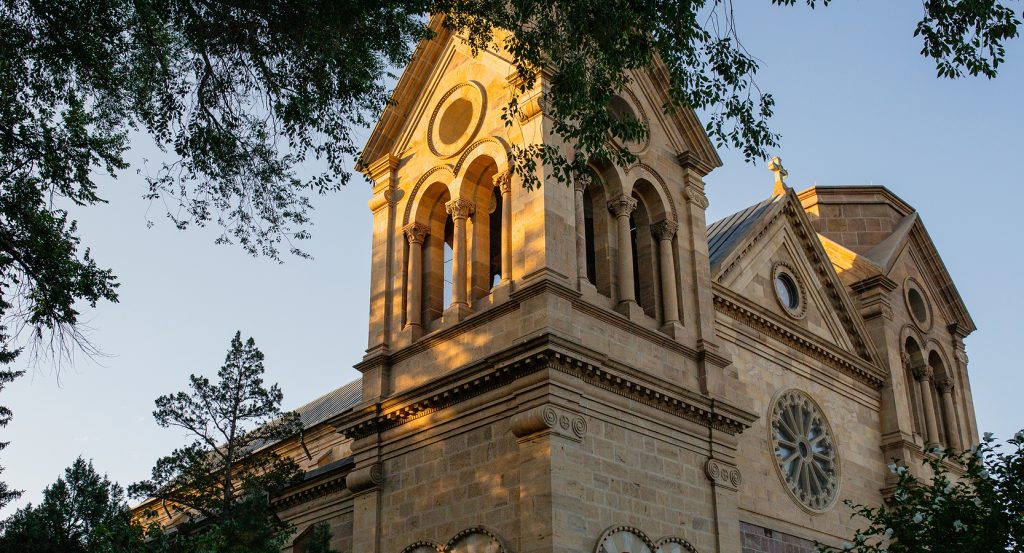
Standing on Cathedral Place immediately east of Santa Fe Plaza, the cathedral occupies a prominent position within the historic downtown district, where its pale stone towers rise above the surrounding adobe buildings and establish a striking architectural presence along the eastern edge of the city's colonial street network. Its symmetrical façade combines rounded arches, substantial masonry walls and paired bell towers overlooking a landscaped forecourt. The building's interior extends through a high central nave toward an elevated sanctuary, with stained-glass windows illuminating the stone surfaces. The adjoining grounds contain devotional sculptures, commemorative features and pathways connecting the cathedral with the surrounding historic district. The result is a religious complex whose expansive scale, European architectural character and deep regional associations distinguish it within Santa Fe's historic urban landscape.
What defines The Cathedral Basilica of St. Francis of Assisi.
The Cathedral Basilica of St. Francis of Assisi is best known for its French Romanesque Revival architecture, its association with Archbishop Jean-Baptiste Lamy and its position as the principal cathedral of the Roman Catholic Archdiocese of Santa Fe. Catholic religious institutions entered northern New Mexico during the Spanish colonial period, following the establishment of Santa Fe as the provincial capital in 1610. Franciscan missionaries developed churches and missions across the region, connecting colonial settlement with the expansion of Catholic religious practice. The Pueblo Revolt of 1680 disrupted Spanish authority and resulted in the destruction of numerous colonial religious buildings. Spanish reconquest during the 1690s restored colonial administration and initiated the rebuilding of Catholic institutions. A parish church dedicated to St. Francis of Assisi subsequently occupied the site associated with the present cathedral. During the nineteenth century, the region underwent major political changes following Mexican independence in 1821 and the incorporation of New Mexico into the United States after the Mexican-American War. Pope Pius IX established the Vicariate Apostolic of New Mexico in 1850, appointing Jean-Baptiste Lamy as its first bishop. Lamy arrived in Santa Fe in 1851 and began reorganizing the Catholic administration of the territory. His efforts included the establishment of educational institutions, the recruitment of religious communities and the construction of new churches. The Diocese of Santa Fe was established in 1853, strengthening the institutional structure of Catholicism in the region. Lamy envisioned a substantial cathedral that would express the growing importance of the diocese through a European architectural language. Construction began in 1869, replacing the earlier parish church while incorporating portions of its historic fabric. French architect Antoine Mouly contributed to the cathedral's design, introducing Romanesque Revival forms inspired by ecclesiastical architecture in France. Construction proceeded over several decades, with the principal building substantially completed in 1886. The cathedral's distinctive stone construction established a dramatic contrast with Santa Fe's traditional adobe architecture. The Diocese of Santa Fe was elevated to an archdiocese in 1875, establishing the city as the seat of a metropolitan Catholic jurisdiction. Lamy died in 1888, leaving the cathedral as the most prominent architectural expression of his ecclesiastical ambitions. Pope Benedict XVI designated the church a minor basilica in 2005, recognizing its historical and religious significance. The building continues to serve as the cathedral church of the Archdiocese of Santa Fe and an important center of Catholic worship in northern New Mexico.
Antoine Mouly's Romanesque Revival design established the cathedral's architectural character through rounded arches, heavy masonry and a symmetrical composition associated with medieval European church construction. The exterior incorporates locally quarried limestone, whose pale coloration distinguishes the building from the earth-toned architecture surrounding it. Paired towers frame the principal entrance, creating a vertical emphasis above the broad central façade. The towers were originally intended to support taller spires, although those elements were never completed. A large circular rose window occupies the upper central façade, introducing a prominent decorative feature above the entrance arches. The principal doorway contains sculptural and architectural details that reinforce the building's religious dedication. Inside, the nave extends beneath a high ceiling supported by substantial columns and rounded arches. The interior's spatial arrangement directs attention toward the sanctuary, where the altar occupies the principal liturgical position. Stained-glass windows manufactured in France introduce colored light and depict saints and religious subjects associated with Catholic tradition. The cathedral preserves La Conquistadora, a historic Marian statue associated with Spanish colonial New Mexico and the region's longstanding devotional practices. The statue dates to the early seventeenth century and became closely connected with the Catholic history of Santa Fe. Its survival through periods of political and religious upheaval established its importance within regional religious memory. The cathedral also contains the remains of Archbishop Lamy, preserving a direct physical association with its principal patron. Devotional artworks and commemorative features connect the interior with generations of Catholic worship in northern New Mexico. The building's liturgical calendar includes major religious observances, maintaining its function as an active ecclesiastical institution. Its combination of French architectural design, colonial devotional objects and regional religious history establishes a distinctive relationship between European Catholic traditions and the cultural development of Santa Fe.
How The Cathedral Basilica of St. Francis of Assisi fits.
The Cathedral Basilica of St. Francis of Assisi works as the ecclesiastical anchor for a Santa Fe outing connecting the city's colonial administration, its artistic heritage and the preservation of Indigenous cultural history in northern New Mexico.
Begin at Palace of the Governors, the historic government building occupying the northern side of Santa Fe Plaza. Constructed in 1610 under Spanish colonial administration, the building served as the seat of government for successive Spanish, Mexican and American territorial authorities. Its long adobe façade and shaded portal preserve architectural features associated with the city's earliest European settlement. The building became part of the Museum of New Mexico in the early twentieth century, supporting the preservation and interpretation of regional history. Native American artisans sell handmade jewelry and crafts beneath its portal through an established program connecting contemporary Indigenous artistic production with the historic civic center. Continue to New Mexico Museum of Art, the institution housed in a Pueblo Revival building completed in 1917 near the plaza. Designed by Isaac Rapp, the museum incorporates architectural elements inspired by the region's historic Pueblo and Spanish colonial building traditions. Its collections examine the development of art in New Mexico, including works associated with the Santa Fe and Taos art communities. Exhibitions address painting, photography, sculpture and other artistic practices shaped by the Southwest's cultural and geographical environments. The building's courtyard and architectural detailing preserve an important example of the regional revival movement that influenced Santa Fe's twentieth-century appearance. Conclude at Museum of Indian Arts & Culture, the institution situated on Museum Hill southeast of Downtown Santa Fe. Established as part of the Museum of New Mexico system, the museum preserves and interprets the artistic and cultural heritage of Indigenous peoples throughout the Southwest. Its collections include pottery, textiles, jewelry and archaeological materials associated with numerous Native American communities. Exhibitions examine the continuity of Indigenous cultural practices and the historical relationships between communities and their ancestral territories. The museum's position within the Museum Hill cultural district provides a broader perspective on the region's Indigenous heritage. The progression moves from Palace of the Governors' colonial administrative history through New Mexico Museum of Art's regional artistic development and culminates at Museum of Indian Arts & Culture's Indigenous collections, connecting the cathedral with the institutions that preserve Santa Fe's cultural history.
Where your story begins.
Foresyte Travel reveals places that feel extraordinary long before you arrive.
Enjoy editorial crafted for luxury travelers.
Foresyte may earn a commission when you book.


























































































































