
Why Restaurant Mlýnec matters.
Restaurant Mlýnec is a contemporary Czech fine-dining restaurant where Staré Město's medieval riverfront heritage meets Vladimír Vaníček's reinterpretation of Bohemian cooking, the development of Prague's modern restaurant culture and an exceptional setting overlooking Charles Bridge.
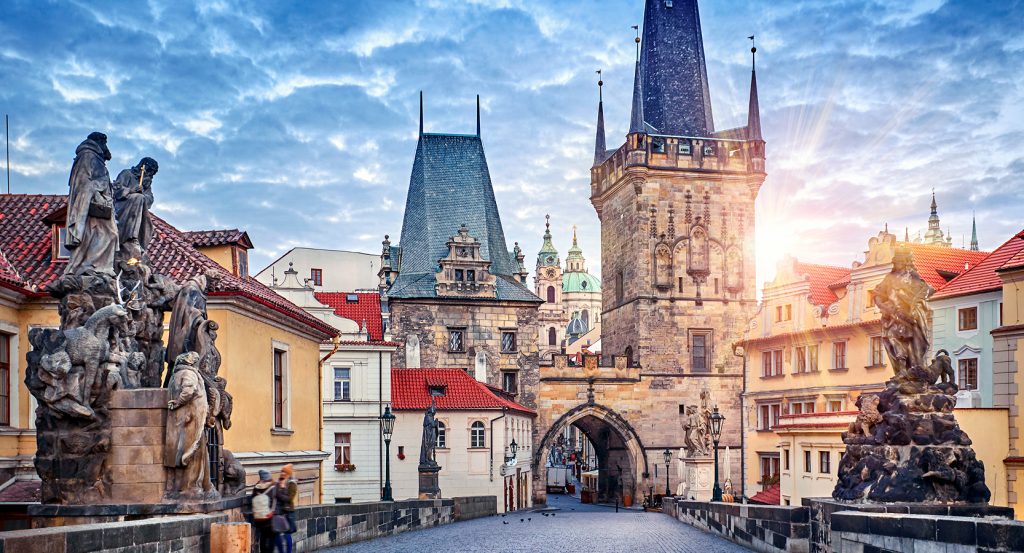
Positioned at Novotného lávka 9 on the eastern bank of the Vltava, the restaurant occupies a prominent waterfront location between Smetanovo nábřeží, the Old Town Bridge Tower and the historic buildings surrounding Křižovnické náměstí. Its principal dining room opens toward Charles Bridge through expansive floor-to-ceiling windows, establishing uninterrupted views of the river, medieval stone arches and the architectural panorama of Malá Strana. A narrow balcony terrace extends the dining space directly above the water, providing an unusually close encounter with Prague's historic riverfront. Inside, contemporary furnishings, sculptural lighting and decorative surfaces inspired by the movement of water establish a sophisticated contrast with the surrounding medieval architecture. An open kitchen introduces a direct visual connection between the culinary team and the dining room, reinforcing the restaurant's emphasis on carefully coordinated preparation and service. The result is a distinguished waterfront restaurant whose contemporary interiors and exceptional geographical position connect Prague's evolving gastronomic culture with one of the city's most consequential historic crossings.
What defines Restaurant Mlýnec.
Restaurant Mlýnec is best known for the development of contemporary Czech cooking within the Zátiší Group, an influential hospitality enterprise that emerged during Prague's economic transformation following the Velvet Revolution. Its origins are closely connected to Sanjiv Suri, an Indian-born entrepreneur whose arrival in Prague during the early 1990s coincided with the rapid expansion of private hospitality businesses in the newly democratic Czech Republic. Suri recognized an opportunity to introduce internationally informed restaurant standards to a market undergoing substantial commercial change. Working with Dana Krautstenglová, he established V Zátiší on Liliová Street, creating a restaurant that attracted diplomats, business leaders and members of Prague's emerging international community. The establishment became the foundation of a broader restaurant enterprise that developed several influential dining concepts throughout the decade. Parnas followed in 1992, establishing an important presence within the company's growing portfolio. The business subsequently expanded through additional restaurants, including U Modré růže, Avalon and Circle Line, reflecting the increasing diversity of Prague's post-communist hospitality industry. In 1997, Parnas relocated and developed into Bellevue, strengthening the group's association with refined dining in the historic city center. The enterprise introduced Mlýnec in 2000 through the transformation of its former Corona premises, establishing a new restaurant directly beside the Vltava. Its development extended the company's ambition to combine accomplished cooking with distinctive architectural settings and professional hospitality. The restaurant subsequently became an established destination for contemporary European gastronomy, attracting international visitors alongside Prague residents. Its culinary direction evolved toward a more explicit interpretation of Czech ingredients and regional preparations, reflecting the growing influence of local sourcing within the country's restaurant industry. Vladimír Vaníček joined Mlýnec in 2014, beginning his professional development in the cold kitchen. He subsequently worked across successive kitchen stations, gaining experience in the preparation and execution of the restaurant's evolving repertoire. His progression culminated in appointment as head chef, establishing continuity through extensive practical knowledge of the operation. Vaníček introduced a culinary approach emphasizing Czech agricultural products, seasonal ingredients and contemporary interpretations of familiar national dishes. His work strengthened relationships with local producers and incorporated techniques intended to reduce ingredient waste. Restaurant manager Pavel Štěpánek contributes another substantial chapter of professional continuity, having joined the Zátiší Group in 1997 before developing experience across its restaurants and catering operations. The restaurant's inclusion in the MICHELIN Guide established its position within Prague's internationally recognized dining landscape, earning a recommendation for accomplished contemporary cooking. The broader hospitality group achieved B Corp certification in 2026, becoming the first food-service and hospitality company in Central Europe to receive that distinction. Mlýnec's development reflects the transformation of Prague's restaurant industry from the entrepreneurial expansion of the 1990s into a mature culinary culture increasingly defined by regional sourcing, professional specialization and contemporary Czech gastronomy.
Vladimír Vaníček's cooking develops through the relationship between traditional Czech ingredients, contemporary European technique and the agricultural resources of Bohemia and Moravia. His approach emphasizes seasonal produce, carefully prepared meats and freshwater fish, incorporating familiar national flavor combinations into compositions distinguished by precise textures and restrained presentation. The restaurant provides an à la carte selection alongside three established menu formats: The Most Popular, Tartare & Steak and Vegetarian. These complementary formats accommodate different approaches to the kitchen's repertoire, allowing guests to explore individual preparations or a more structured progression through contrasting courses. Freshly smoked veal tartare provides a representative introduction, combining finely prepared meat with buckwheat, cornichons, mustard seeds, yuzu mayonnaise and watercress. The preparation develops the relationship between the richness of veal, the acidity of preserved vegetables and the distinctive character of traditional Czech grains. Smoked eel introduces another expression of regional cooking through a combination of chicken consommé, crème fraîche and caviar. Its concentrated flavors connect the natural richness of freshwater fish with the depth of carefully prepared broth and cultured dairy. Duck-leg confit accompanied by poppy-seed dumpling, red cabbage and lightly smoked demi-glace offers a more substantial interpretation of Bohemian culinary traditions. The dish preserves the recognizable relationship between duck, dumplings and braised cabbage, developing greater complexity through controlled cooking and a concentrated sauce. Veal fillet mignon prepared in the style of schnitzel represents another important element of the restaurant's repertoire, connecting a familiar Central European preparation with carefully selected meat and contemporary accompaniments. Seasonal vegetable dishes extend the kitchen's emphasis on regional agriculture through preparations incorporating mushrooms, root vegetables, grains and aromatic herbs. A vegetarian mushroom risotto with truffle, parsley and black garlic demonstrates the kitchen's broader European influences through a combination of substantial earthy flavors and precise contemporary technique. The restaurant also maintains dedicated lunch and weekend brunch programs, introducing different expressions of its culinary repertoire throughout the week. Wine selections complement the kitchen's balance of Czech traditions and international influences, incorporating bottles suited to delicate seafood, substantial meat preparations and vegetable-focused dishes. Restaurant Mlýnec's culinary distinction emerges from this integration of recognizable Bohemian flavors, accomplished contemporary cooking and seasonal regional ingredients, establishing a refined interpretation of Czech gastronomy within an internationally informed restaurant program.
How Restaurant Mlýnec fits.
Restaurant Mlýnec works as the dining culmination of an exploration connecting Prague's nineteenth-century musical heritage, the architectural ambitions of the Luxembourg dynasty and the medieval development of the city's principal river crossing, placing the restaurant within the historical landscape of the Vltava waterfront.
Begin at Bedřich Smetana Museum, the institution dedicated to the life and work of the Czech composer whose achievements helped establish a distinct national tradition of classical music. Founded in 1926, the museum developed through an organization established to commemorate Smetana and preserve material associated with his professional career. Its collections found a permanent home in the former Old Town Waterworks, a Neo-Renaissance building constructed between 1883 and 1884 to designs by architect Antonín Wiehl. The exterior incorporates elaborate sgraffito decoration designed by Josef Ženíšek and Mikoláš Aleš, connecting the building with the artistic ambitions of the Czech National Revival. The museum opened to the public on May 12, 1936, in the presence of former Czechoslovak president Edvard Beneš, establishing a permanent institution devoted to one of the country's most consequential composers. Continue to Old Town Bridge Tower, the expansive Gothic gateway constructed during the reign of Emperor Charles IV. Designed within the architectural workshop of Peter Parler during the second half of the fourteenth century, the tower formed part of an ambitious program connecting Prague's royal institutions with the expanding urban landscape. Its elaborate sculptural decoration incorporates representations of Charles IV, Wenceslas IV and religious figures associated with the Bohemian monarchy. The gateway became an important ceremonial passage along the Royal Route, through which Czech kings traveled during their coronation processions. Its elevated viewing gallery, reached by 138 steps, provides an exceptional perspective across the river and the surrounding medieval city. Conclude at Charles Bridge, the historic stone crossing commissioned by Charles IV following the destruction of the earlier Judith Bridge during the catastrophic floods of 1342. Construction began in 1357, and the bridge was completed in 1402, establishing a durable connection between Prague's Old Town and Malá Strana. Its sandstone arches supported an important commercial and ceremonial route across the Vltava, strengthening the relationship between the city's principal districts. Between 1683 and 1928, thirty statues and sculptural groups were installed along the crossing, transforming its medieval structure into an extraordinary collection of Baroque religious sculpture. The bridge subsequently became a defining monument of Prague's architectural heritage, preserving the relationship between medieval engineering, royal patronage and the artistic achievements of successive centuries. The progression connects Czech musical history with the ceremonial architecture of the Luxembourg dynasty and concludes at Prague's celebrated medieval river crossing, establishing the broader historical setting surrounding Restaurant Mlýnec.
Where your story begins.
Foresyte Travel reveals places that feel extraordinary long before you arrive.
Enjoy editorial crafted for luxury travelers.
Foresyte may earn a commission when you book.





































































































