
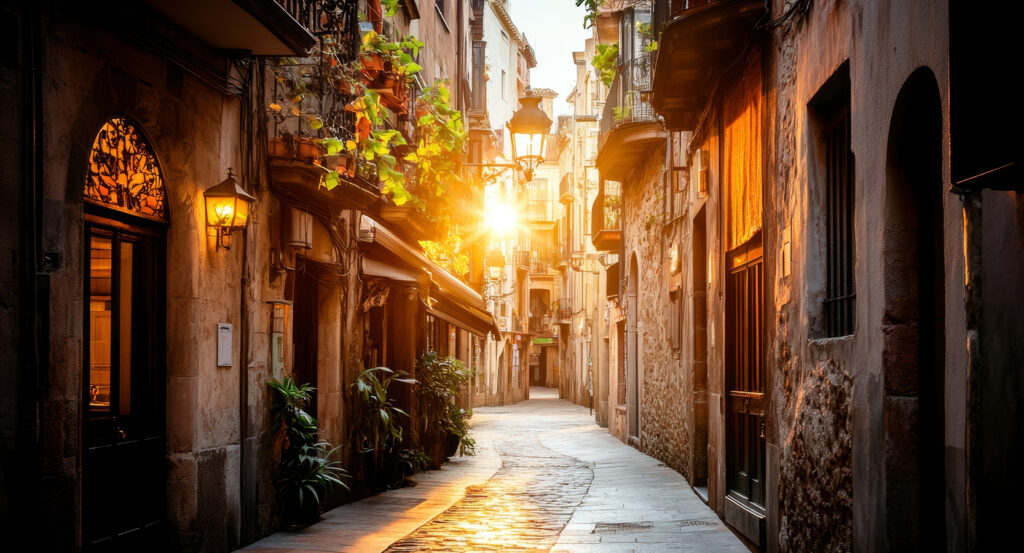
Why Gothic Quarter matters.
Gothic Quarter is a historic urban enclave where Barcelona's Mediterranean commercial heritage meets the Roman foundations of Barcino, the political institutions of medieval Catalonia and an architectural landscape shaped by two millennia of civic, religious and mercantile development.
Positioned between El Raval, El Born and the waterfront approaches of Port Vell, the neighborhood occupies the central portion of Ciutat Vella between La Rambla and Via Laietana, with narrow medieval streets connecting irregular public squares, former merchant residences and substantial ecclesiastical buildings. Limestone walls, vaulted passageways and closely arranged residential facades establish an intimate pedestrian environment punctuated by imposing civic architecture. Fragments of ancient fortifications survive within later buildings, revealing the accumulation of successive construction periods beneath the neighborhood's present street pattern. Small commercial premises occupy ground floors beneath residential apartments, preserving the relationship between urban habitation and specialized trade. The result is a densely layered historic district whose preserved urban fabric, institutional architecture and continuing civic functions establish the geographical and historical center of Barcelona.
What defines Gothic Quarter.
Gothic Quarter is best known for preserving the ancient nucleus of Barcelona, where Roman urban planning, medieval political institutions and later architectural reconstruction created the city's historic center. Roman authorities founded the colony of Barcino during the reign of Augustus, establishing a fortified settlement on the elevated ground of Mont Tàber near the Mediterranean coast. The original colony followed a rectilinear street plan organized around the cardo and decumanus, with its principal public buildings concentrated near their intersection. A defensive perimeter enclosed the settlement, and substantial reinforcements constructed during the late third and early fourth centuries incorporated numerous towers into the fortifications. Barcelona subsequently developed into an important urban center under Visigothic rule, briefly serving as a royal residence during the early fifth century. Muslim forces captured the city in the early eighth century, introducing a period of political change that ended when Frankish armies under Louis the Pious conquered Barcelona in 801. The city became the center of a frontier county within the Carolingian political system, eventually developing greater autonomy under successive counts. The authority of the counts of Barcelona expanded during the eleventh and twelfth centuries, culminating in the dynastic union of Ramon Berenguer IV and Petronilla of Aragon. Barcelona's maritime commerce strengthened considerably during the following centuries, supporting the growth of merchant institutions, craft organizations and substantial urban residences. The medieval city developed an extensive network of religious foundations and administrative buildings, demonstrating the concentration of ecclesiastical and political authority within its fortified center. The Jewish community occupied the district known as El Call, contributing to commercial, intellectual and medical activity before the violent attacks of 1391 devastated the community. The Catalan civil war of 1462 to 1472 weakened the city's economy and political institutions, initiating a prolonged period of commercial difficulties. Barcelona's urban development subsequently accelerated during the eighteenth and nineteenth centuries, although its historic center retained much of its medieval street arrangement. The demolition of the city's outer defensive walls beginning in 1854 facilitated expansion beyond the old urban perimeter. The construction of Via Laietana during the early twentieth century required extensive demolition and the relocation of several historic buildings, substantially altering the eastern edge of the old city. Municipal authorities and architects simultaneously promoted the preservation and reconstruction of medieval architecture, contributing to the creation of the Gothic Quarter as a formally recognized historic district. The neighborhood contains authentic medieval structures alongside nineteenth- and twentieth-century architectural interventions, preserving a complex relationship between historical continuity and deliberate urban reconstruction.
August Font i Carreras designed the neo-Gothic facade of Barcelona Cathedral during the late nineteenth century, completing an exterior transformation that substantially altered the appearance of the medieval religious complex. The cathedral's principal construction had begun in 1298, and its architectural development extended across several centuries before the completion of its modern facade and central spire. Its interior incorporates a broad nave, chapels arranged between structural buttresses and elaborate choir stalls associated with the Order of the Golden Fleece. The adjoining cloister contains a garden and a traditional colony of thirteen white geese associated with the martyrdom of Saint Eulalia, Barcelona's co-patron saint. Nearby, the Pont del Bisbe connects two historic buildings across Carrer del Bisbe through a neo-Gothic bridge designed by Joan Rubió i Bellver in 1928. Its elaborate stone tracery demonstrates the early twentieth-century effort to create architectural continuity between surviving medieval structures. The Palau de la Generalitat preserves an extensive sequence of Gothic and Renaissance architectural elements developed as the institutions of Catalan government expanded. The building originated through the acquisition of a property in 1400 and subsequently incorporated ceremonial halls, courtyards and richly decorated administrative spaces. Architect Marc Safont contributed substantially to its fifteenth-century development, including the Gothic gallery and the chapel dedicated to Saint George. The Renaissance facade facing Plaça de Sant Jaume was designed by Pere Blai during the late sixteenth century, introducing a classical composition into the older institutional complex. Opposite stands Barcelona City Hall, whose medieval Saló de Cent recalls the municipal council established during the thirteenth century. The council's historical functions included the administration of urban affairs and the regulation of municipal institutions during Barcelona's commercial expansion. Narrow streets surrounding these governmental buildings contain former guild premises, merchant houses and religious properties that demonstrate the close relationship between commerce and civic authority. Their architectural features include carved stone portals, internal courtyards, Gothic windows and later residential modifications. The neighborhood's present architectural character developed through the survival of these historical structures and their adaptation to changing political, commercial and residential requirements.
How Gothic Quarter fits.
Gothic Quarter works as the historical anchor for a Barcelona outing connecting the city's Roman archaeological foundations, the ceremonial architecture of its medieval rulers and the religious institutions that shaped Catalan urban society.
Begin at MUHBA Temple d'August, the surviving remains of a Roman temple situated on Carrer del Paradís near the highest point of ancient Mont Tàber. Four Corinthian columns preserve part of the structure that once dominated Barcino's principal ceremonial precinct. The temple formed an important component of the Roman forum, where political administration, religious observance and commercial activity converged. Its surviving architectural fragments demonstrate the scale and technical sophistication of the original colonial settlement. The columns stand within the courtyard of a later building, preserving an unusual physical relationship between Roman architecture and the subsequent development of medieval Barcelona. Continue to Plaça del Rei, the enclosed medieval square dominated by the Palau Reial Major, the former residence of the counts of Barcelona and monarchs of the Crown of Aragon. The palace's Saló del Tinell was constructed during the fourteenth century under King Peter IV, incorporating a series of substantial semicircular arches supporting an expansive ceremonial hall. The adjoining Chapel of Santa Àgata contains a fifteenth-century altarpiece painted by Jaume Huguet. The square also includes the Renaissance Palau del Lloctinent and Casa Padellàs, a historic residence relocated during twentieth-century urban reconstruction. These buildings establish a concentrated architectural account of Barcelona's medieval royal institutions. Conclude at Basílica de Santa Maria del Pi, the Gothic church overlooking Plaça del Pi in the western portion of the historic center. Construction developed principally during the fourteenth century, producing a broad single-nave interior characteristic of Catalan Gothic architecture. Its imposing stone facade contains an extensive rose window, reconstructed following damage during the Spanish Civil War. The church's substantial bell tower rises above the surrounding residential streets, establishing a prominent feature of the neighborhood's historic skyline. Its architectural arrangement emphasizes uninterrupted interior space and carefully proportioned structural elements, demonstrating the regional interpretation of medieval ecclesiastical design. The progression moves from MUHBA Temple d'August's Roman foundations through Plaça del Rei's royal architecture and culminates at Basílica de Santa Maria del Pi's Gothic religious heritage, connecting Gothic Quarter with the institutions that shaped Barcelona across successive historical periods.
Where your story begins.
Foresyte Travel reveals places that feel extraordinary long before you arrive.
Enjoy editorial crafted for luxury travelers.
Foresyte may earn a commission when you book.














































































































