Why Marine Drive matters.
Marine Drive is an Art Deco waterfront corridor where South Mumbai's colonial-era urban development meets the reclamation of land from the Arabian Sea, the architectural ambitions of Bombay's twentieth-century commercial elite and the sweeping coastal promenade known as the Queen's Necklace.
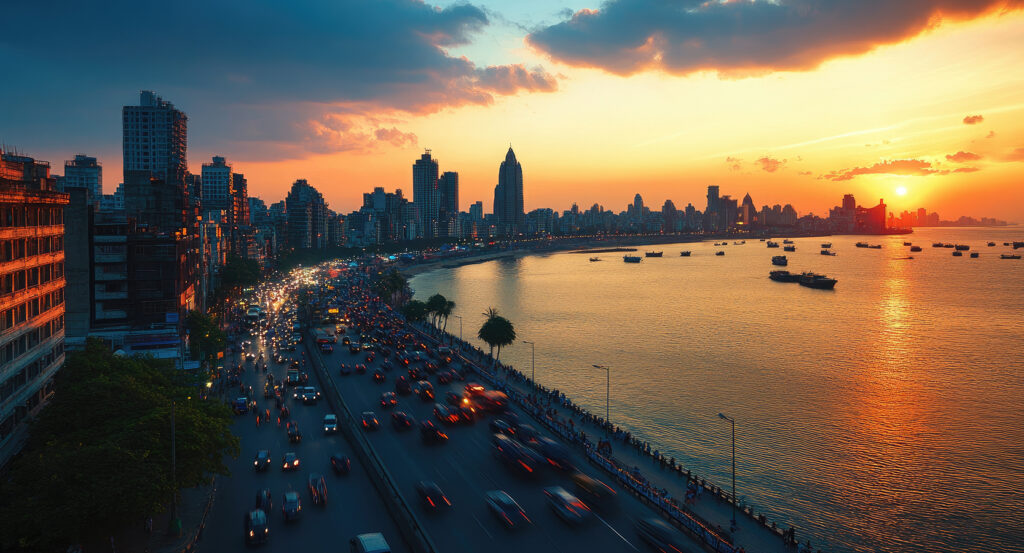
Running along Netaji Subhash Chandra Bose Road between Nariman Point and Girgaon Chowpatty, the boulevard follows the eastern edge of Back Bay, curving northward from Mumbai's southern business district toward Malabar Hill, with the Arabian Sea stretching west and dense residential blocks occupying the reclaimed land to the east. Its broad carriageway runs beside a continuous pedestrian promenade protected by a substantial seawall. Apartment buildings with rounded balconies, horizontal bands and streamlined façades form a distinctive architectural frontage. Streetlights trace the coastline's broad curve, creating the illuminated necklace associated with the boulevard's popular name. The result is a waterfront corridor whose geometry, architecture and public access preserve a defining chapter in Mumbai's twentieth-century urban expansion.
What defines Marine Drive.
Marine Drive is best known for its curved waterfront promenade, concentration of Art Deco residential buildings and historical association with Bombay's reclamation and modernization during the twentieth century. The coastline originally formed part of Back Bay, an extensive tidal indentation separating the southern peninsula's developed districts from the western shoreline. British colonial authorities pursued successive reclamation schemes during the nineteenth century as Bombay expanded into a major commercial port. Railway development, cotton trading and maritime commerce increased demand for residential and commercial land near the colonial administrative center. In 1918, the Back Bay Reclamation Scheme was initiated to create new urban land along the western coast of the peninsula. The project involved substantial marine engineering, including the construction of seawalls and the deposition of material into shallow coastal waters. Reclamation proceeded during the 1920s, reshaping the shoreline and establishing the geographical foundation for the future boulevard. The scheme encountered financial difficulties, engineering problems and criticism concerning its administration, limiting the extent of the original development proposals. Nevertheless, the completed reclamation created valuable waterfront parcels that attracted residential construction during the following decades. Bombay's growing community of Indian merchants, industrialists and professionals commissioned apartment buildings that combined modern architectural forms with contemporary domestic requirements. Art Deco became especially influential during the 1930s and 1940s, supported by architects familiar with international developments in commercial and residential design. The new buildings introduced reinforced-concrete construction, streamlined façades, geometric ornamentation and architectural details associated with the machine age. Their development coincided with the expansion of cinema, aviation and modern consumer culture in colonial Bombay. Following Indian independence in 1947, Marine Drive retained its importance as a residential address and public waterfront within the growing metropolis. In 2018, the Art Deco ensemble associated with Marine Drive became part of the UNESCO World Heritage inscription for the Victorian Gothic and Art Deco Ensembles of Mumbai, recognizing the architectural relationship between the city's nineteenth-century colonial institutions and twentieth-century urban development.
Claude Batley's architectural work contributed to the development of Bombay's modern residential architecture, including the adaptation of European design principles to the city's tropical climate. The Art Deco apartment buildings facing the boulevard employ reinforced-concrete frames that permit projecting balconies, curved corners and horizontal window arrangements. Their façades incorporate geometric ornament, stepped parapets and decorative lettering associated with the architectural fashions of the interwar period. Buildings such as Soona Mahal and Keval Mahal demonstrate the combination of streamlined architectural composition with residential accommodation overlooking the Arabian Sea. Curved balconies extend outward from individual apartments, creating shaded outdoor spaces exposed to coastal breezes. Horizontal sunshades protect windows from direct sunlight and monsoon rainfall. Stairwells and entrance halls incorporate decorative metalwork, terrazzo flooring and geometric patterns associated with Art Deco interior design. Some buildings retain original nameplates and architectural lettering that connect their façades with the visual culture of the 1930s. The continuous frontage establishes a distinctive relationship between private residential architecture and the public waterfront. The promenade follows the curve of Back Bay, providing an uninterrupted pedestrian route beside the seawall. Tetrapod concrete blocks protect sections of the shoreline from wave action, particularly during the southwest monsoon. The sea-facing pavement accommodates walking, running and informal public gatherings throughout the day. At sunset, the boulevard provides views across the Arabian Sea as the surrounding apartment façades receive the changing coastal light. After dark, streetlights outline the bay's broad arc, producing the illuminated formation known as the Queen's Necklace. The road's physical arrangement connects architectural preservation with public access to the coastline, maintaining a direct relationship between the city's residential development and its maritime geography.
How Marine Drive fits.
Marine Drive works as the architectural and geographical centerpiece for a South Mumbai itinerary connecting the city's Art Deco cinema heritage, colonial-era civic institutions and the historic public spaces surrounding its western shoreline.
Begin at Eros Cinema, the Art Deco picture palace situated opposite Churchgate railway station. Designed by architect Sohrabji Bhedwar, the cinema opened in 1938 during Bombay's emergence as a major center of Indian film production. Its architectural composition incorporates a stepped central tower, streamlined horizontal detailing and decorative elements associated with interwar cinema design. The building's interior was conceived as a substantial entertainment venue, with an auditorium, ornamental finishes and circulation spaces developed for large audiences. Its construction connected the city's commercial expansion with the growing cultural importance of motion pictures. The cinema's restoration has preserved an important example of Bombay's theatrical architecture. Continue to Oval Maidan, the historic open ground situated between the Fort district and the residential neighborhoods of Churchgate. The elongated public space developed during the nineteenth century following the removal of Bombay's colonial fortifications. Its western boundary contains Art Deco apartment buildings, and its eastern side faces Victorian Gothic institutions constructed during British rule. The arrangement creates a direct architectural comparison between two major periods of the city's development. Cricket grounds occupy substantial sections of the maidan, preserving the sporting traditions associated with Bombay's public open spaces. The surrounding architecture forms a central component of Mumbai's UNESCO World Heritage ensemble. Conclude at Girgaon Chowpatty, the public beach occupying the northern end of Back Bay. Its sandy shoreline provides a recreational space between the Arabian Sea and the densely populated neighborhoods extending toward Girgaon. The beach has long been associated with public festivals, political gatherings and the everyday recreational activities of Mumbai residents. Ganesh Chaturthi celebrations bring large processions to the waterfront for the immersion of Ganesh idols, connecting the shoreline with Maharashtra's religious traditions. Food stalls serve regional snacks, including bhel puri, pav bhaji and other preparations associated with Mumbai's street-food culture. The progression moves from Art Deco entertainment architecture through colonial and modern civic landscapes and culminates in the religious and recreational traditions of Mumbai's western waterfront.
Where your story begins.
Foresyte Travel reveals places that feel extraordinary long before you arrive.
Enjoy editorial crafted for luxury travelers.
Foresyte may earn a commission when you book.