Why The Dubai Fountain matters.
The Dubai Fountain is a choreographed water installation where Downtown Dubai's architectural ambition meets the theatrical engineering of WET Design and the transformation of Burj Lake into one of the city's defining public attractions.
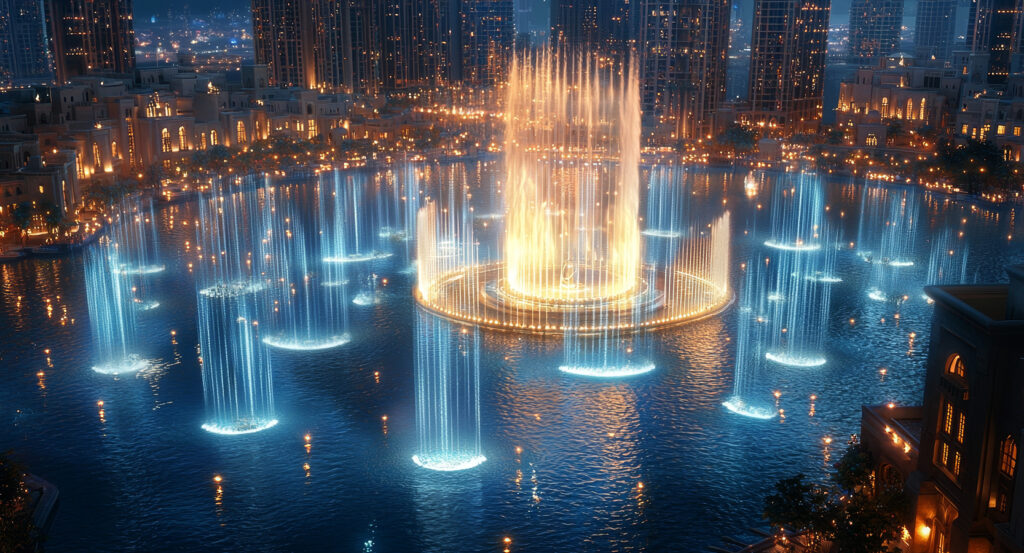
Set along Sheikh Mohammed bin Rashid Boulevard near Financial Centre Road and just steps from Souk Al Bahar, the fountain occupies the artificial lake at the center of Downtown Dubai, between Burj Khalifa's landscaped podium, Dubai Mall's waterfront terraces and the residential towers surrounding the district's southern promenades. Five circular formations and two sweeping arcs organize the submerged fountain system across an elongated stretch of water, establishing the geometry for performances visible from the surrounding shorelines. Powerful jets rise above the lake in coordinated sequences, with submerged lighting illuminating individual streams against the towers and pedestrian terraces enclosing the basin. Broad waterfront promenades, restaurant balconies and pedestrian bridges create multiple viewing elevations, integrating the installation into the district's public circulation network. The result is a large-scale aquatic performance environment whose engineered precision, architectural setting and extensive public visibility give Downtown Dubai a distinctive ceremonial centerpiece.
What defines The Dubai Fountain.
The Dubai Fountain is best known for its synchronized water performances, developed by Emaar Properties as a central attraction within the master-planned Downtown Dubai district. The project emerged during the development of a major urban destination combining residential towers, luxury hotels, commercial facilities and extensive public spaces around a constructed waterfront. Emaar commissioned WET Design, the California-based firm founded by Mark Fuller, Melanie Simon and Alan Robinson, to create an installation capable of integrating large-scale hydraulic effects with music and theatrical illumination. WET had previously developed the Fountains of Bellagio in Las Vegas, establishing an influential model for choreographed water entertainment within a major hospitality development. The Dubai commission extended that engineering approach to a substantially larger urban setting, positioning the installation within an outdoor lake surrounded by high-rise architecture. Construction required the installation of extensive underwater piping, high-pressure pumps, specialized nozzles and electrical systems capable of supporting coordinated performances across a broad aquatic surface. The fountain opened on May 8, 2009, during the inauguration of Dubai Mall's waterfront promenade, becoming an important attraction during the district's early development. Its construction cost $218 million, reflecting the scale of its hydraulic infrastructure, theatrical lighting and specialized engineering. The installation extends across 275 meters of Burj Lake, creating an unusually broad performance field within the surrounding commercial development. Its principal water jets reach heights of 150 meters, producing vertical formations comparable to the height of a substantial skyscraper. The fountain's opening established a major public gathering place within Downtown Dubai, bringing visitors onto the lakefront terraces during scheduled performances. The project contributed to Emaar's development strategy by linking major private commercial investments with a freely accessible outdoor attraction. International attention strengthened the fountain's association with Dubai's large-scale architectural projects and the emirate's investment in technically ambitious entertainment infrastructure. The installation subsequently became an important component of the city's tourism economy, connecting the surrounding retail and hospitality destinations through a shared waterfront performance. Its historical significance rests on the application of advanced theatrical engineering to a major urban development and the creation of an internationally recognized public attraction within an entirely constructed metropolitan landscape.
How The Dubai Fountain fits.
The Dubai Fountain works as the waterfront centerpiece for a Downtown Dubai itinerary connecting the district's contemporary cultural architecture, its international retail development and the elevated observation infrastructure associated with the city's extraordinary vertical expansion.
Begin at Dubai Opera, the performing arts institution whose distinctive architectural form draws inspiration from the traditional Arabian dhow. Designed by Janus Rostock of Atkins, the building opened in 2016 as a major venue for opera, theater, concerts and other cultural productions. Its adaptable auditorium accommodates different performance configurations, allowing the building to support a broad range of theatrical and musical programs. The exterior incorporates extensive glazing and carefully arranged structural elements, establishing a prominent cultural destination within the surrounding high-rise district. Its location near the waterfront connects Dubai's investment in formal performing arts institutions with the extensive public spaces developed around the central lake. Continue to Dubai Mall, the immense retail and entertainment complex developed by Emaar Properties and opened in 2008. Its interior contains expansive shopping galleries, major international luxury boutiques and extensive recreational attractions organized around substantial public circulation spaces. Dubai Aquarium & Underwater Zoo occupies a prominent position within the complex, presenting marine life through a vast aquarium installation and associated educational exhibits. The mall's architectural organization connects multiple commercial precincts through interior atriums, escalator networks and broad pedestrian corridors. Its scale reflects Dubai's development as an international destination for luxury retail, entertainment and hospitality, creating a substantial commercial counterpart to the surrounding public attractions. Conclude at At the Top, Burj Khalifa, the elevated observation attraction occupying Levels 124 and 125 of the world's tallest building. High-speed elevators transport visitors to panoramic viewing galleries overlooking the metropolitan skyline, the Arabian Gulf and the surrounding desert. The observation decks provide an extensive perspective on Downtown Dubai's geometric street arrangement, artificial lake and concentration of high-rise architecture. Interactive exhibits introduce the tower's development and the engineering challenges associated with extreme-height construction. The attraction establishes a direct connection between the district's public waterfront and the architectural project that transformed Dubai's international skyline. The progression moves from the district's principal performing arts institution through its extensive commercial development and culminates in an elevated architectural perspective over the constructed waterfront surrounding The Dubai Fountain.
Where your story begins.
Foresyte Travel reveals places that feel extraordinary long before you arrive.
Enjoy editorial crafted for luxury travelers.