
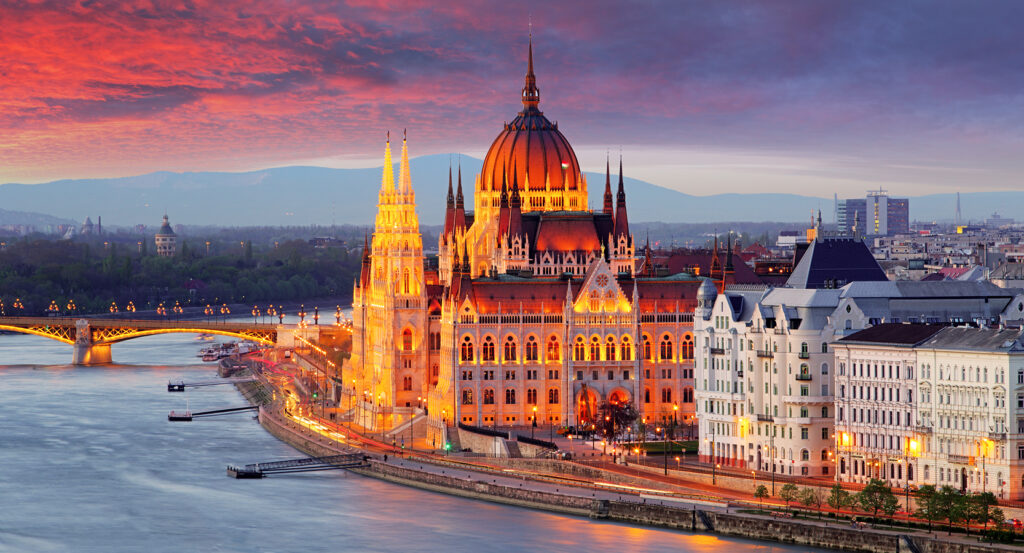
Why Fisherman's Bastion matters.
Fisherman's Bastion is a Neo-Romanesque viewing terrace where Castle Hill's medieval fortifications meet Frigyes Schulek's nineteenth-century architectural reconstruction, the memory of Hungary's founding rulers and panoramic views across the Danube toward Pest.
Standing along the eastern edge of Castle Hill above the Víziváros district, the bastion occupies an elevated terrace overlooking the Danube, where arcaded walkways, conical towers and stone staircases connect the historic streets surrounding Szentháromság Square with the steep hillside descending toward the river. Seven turreted structures punctuate the limestone parapets, creating a continuous architectural composition above the lower city. Open arches frame views across the river toward Pest's parliamentary and commercial districts. Broad staircases descend between terraces, joining the upper precinct with the streets below. The result is a public viewing structure whose medieval architectural references frame Budapest's river geography and the historical development of Castle Hill.
What defines Fisherman's Bastion.
Fisherman's Bastion is best known for its seven Neo-Romanesque towers, its panoramic terraces and its association with the medieval defensive walls of Buda. The site formed part of the fortified settlement that developed on Castle Hill following the Mongol invasion of Hungary in 1241-1242. King Béla IV encouraged the construction of fortified towns and defensive structures, establishing Buda as a principal royal and urban center. The eastern walls protected the settlement above the Danube and the lower riverside districts. The section later associated with the bastion acquired its name through the fishing community connected with the riverside settlement beneath Castle Hill. Medieval guild traditions associated the fishermen with responsibility for defending this portion of the fortifications. The military importance of the walls changed during the Ottoman occupation of Buda, which began in 1541 and ended with the Habsburg reconquest in 1686. Subsequent rebuilding altered the defensive structures and surrounding streets as the castle district developed under Habsburg administration. During the nineteenth century, Budapest's municipal unification and preparations for the millennium of the Hungarian conquest encouraged major architectural projects across the capital. Architect Frigyes Schulek developed plans to reconstruct the adjoining ecclesiastical precinct and create an expansive terrace along the former defensive line. Construction of Fisherman's Bastion began in 1895 and continued into the early twentieth century. The completed complex opened in 1902, introducing a sequence of towers, arcades and staircases designed principally for public access and views. Its seven towers commemorate the seven Magyar tribal leaders associated with the Hungarian conquest of the Carpathian Basin. Damage sustained during the Second World War required restoration of portions of the structure. Architect János Schulek, the original designer's son, directed important postwar reconstruction work. Subsequent conservation projects maintained the terraces and stonework as part of Budapest's protected historic urban landscape.
Frigyes Schulek's architectural design draws upon Romanesque forms associated with medieval churches, fortified gateways and arcaded cloisters. The towers have conical roofs and circular plans, producing a sequence of vertical forms along the eastern terrace. Their arrangement follows the irregular contours of Castle Hill, connecting separate viewing platforms through covered passages and open walkways. Rounded arches rest on stone columns whose proportions recall medieval ecclesiastical architecture. Decorative parapets incorporate carved stone details and repeated geometric openings. The principal stairway descends toward the lower streets through a series of broad flights and intermediate landings. Its arches and balustrades create framed views toward the river as the elevation changes. The upper terraces provide sightlines across the Danube toward the urban districts of Pest. The lower walkways place the stone columns and tower bases at pedestrian scale, revealing the construction of the arcades. A bronze equestrian statue of King Stephen I occupies the adjoining square, connecting the architectural precinct with Hungary's first Christian monarch. Sculptor Alajos Stróbl created the monument, which was unveiled in 1906. The statue stands beneath a decorative canopy supported by columns and ornamented with relief panels associated with Stephen's reign. The sculptural program connects the founding of the Hungarian Christian kingdom with the historic religious institutions of Castle Hill. The bastion's architecture belongs to Budapest's period of nineteenth-century historical revival, when medieval forms were reconstructed and reinterpreted for civic purposes. Its principal function as a public terrace distinguishes the complex from the defensive works that previously occupied the hillside.
How Fisherman's Bastion fits.
Fisherman's Bastion works as the architectural viewing centerpiece for a Budapest outing connecting medieval religious institutions, Castle Hill's residential streets and the surviving defensive structures of the historic Buda settlement.
Begin at Matthias Church, the Gothic church standing beside Szentháromság Square. Its origins extend to the thirteenth century, when Buda developed as a royal settlement under the Árpád dynasty. The church became associated with royal ceremonies and later served as a mosque during the Ottoman occupation. Following the Habsburg reconquest, its religious functions returned to Catholic worship. Nineteenth-century reconstruction under Frigyes Schulek introduced a polychrome tiled roof, Gothic architectural details and an extensively restored interior. The church hosted the coronation of Franz Joseph I and Elisabeth as king and queen of Hungary in 1867. Continue to the Hospital in the Rock Nuclear Bunker Museum, the underground complex developed within the natural cave system beneath Castle Hill. Its medical facilities were constructed during the Second World War to provide emergency treatment during air raids and military operations. The hospital operated during the Siege of Budapest in 1944-1945, treating wounded soldiers and civilians under difficult conditions. During the Cold War, portions of the complex were adapted for civil defense and nuclear emergency preparedness. Its underground chambers contain medical equipment, reconstructed treatment spaces and exhibitions concerning wartime medicine. The museum preserves the military and civilian history of Budapest's subterranean infrastructure. Conclude at Vienna Gate, the historic gateway standing at the northern end of the Castle District. The gateway occupies a position associated with medieval routes connecting Buda with settlements to the north and west. Its surviving architectural form dates principally to reconstruction during the twentieth century, incorporating a broad central arch and adjoining stone walls. The surrounding streets preserve the scale of the historic residential district, including houses developed during the Baroque rebuilding of Buda. The gateway marks the transition between the fortified hilltop settlement and the roads descending toward the surrounding city. The progression moves from medieval royal worship through twentieth-century emergency infrastructure and culminates at the northern defensive entrance, connecting Fisherman's Bastion with the changing functions of Castle Hill.
Where your story begins.
Foresyte Travel reveals places that feel extraordinary long before you arrive.
Enjoy editorial crafted for luxury travelers.
Foresyte may earn a commission when you book.





































































































