
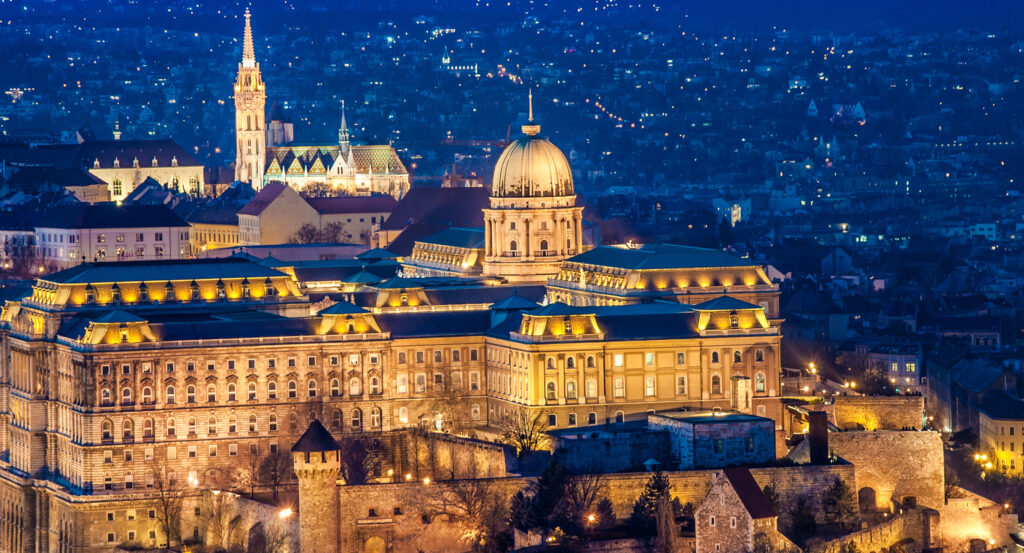
Why Castle Hill matters.
Castle Hill is Budapest's soul rising in stone.
Crowned by the gleaming dome of Buda Castle and cloaked in centuries of legend, this limestone plateau offers one of Europe's most cinematic views: the Danube flowing below, the Chain Bridge arched like a ribbon of light, and Pest glittering across the river in a perfect mirror of the past and present. Walking up Castle Hill feels like ascending through time, medieval ramparts give way to Baroque terraces, cobblestone lanes, and quiet courtyards where every wall has witnessed history's thunder. Yet, despite its grandeur, the hill's beauty is deeply human. Between ornate gates and fortress walls, lilac trees bloom in spring, cafés hum softly in the afternoon light, and violinists play melodies that echo through the arches. From the first golden glow of sunrise to the deep indigo hush of night, Castle Hill stands as the pulse of Buda, steady, watchful, eternal.
What defines Castle Hill.
Few visitors realize that Castle Hill is as much a geological marvel as a historical one.
The hill itself is a natural limestone plateau formed over 15 million years ago, hollowed by caves and thermal springs that still breathe beneath the city's feet. Archaeological excavations reveal that Celts and Romans settled here long before Budapest existed, drawn by its vantage and its warmth. The medieval castle that once crowned the hill was built in the 13th century by King Béla IV, but over the next 700 years, Castle Hill would rise and fall with every shift in empire, Ottoman, Habsburg, Soviet, each leaving its mark in stone and spirit. Beneath its surface lies a labyrinthine cave system that served as wine cellars, air-raid shelters, and even hospitals during wartime. Local legends whisper that the hill hides secret tunnels stretching all the way to the Danube, where Hungarian kings once fled in disguise. Its streets, Tárnok, Fortuna, and Uri, were once home to aristocrats and artisans alike, their colorful façades still preserving the quiet dignity of a bygone age. Today, Castle Hill is part of Budapest's UNESCO World Heritage site, not simply for its architecture, but for what it represents: the endurance of beauty through the storms of history.
How Castle Hill fits.
The best way to experience Castle Hill is to let it unfold at its own rhythm.
Begin your ascent from the Chain Bridge, either on foot or by funicular, pausing often, every step upward reveals a new layer of the city's panorama. Enter through the ornate Habsburg Gate and wander toward the Matthias Fountain, where bronze figures seem to come alive in cascading water. Spend time exploring the courtyards of Buda Castle itself, then venture into the Castle District, a serene neighborhood of pastel houses, Gothic spires, and quiet cafés. Visit Matthias Church for its kaleidoscopic tiles and sacred hush, and step out to the Fisherman's Bastion terrace where Budapest stretches endlessly beneath you. Linger through sunset when the Parliament glows across the river and the castle's walls blaze gold against the evening sky. For a slower pace, visit the Hospital in the Rock Museum or the Labyrinth beneath the hill, where flickering lanterns reveal the city's underworld history. When night falls, stay a little longer, Castle Hill illuminated under the moonlight feels like a dream you never want to wake from. This isn't just Budapest's crown, it's its heartbeat, carved in stone and lit by centuries of grace.
Where your story begins.
Foresyte Travel reveals places that feel extraordinary long before you arrive.
Enjoy editorial crafted for luxury travelers.
Foresyte may earn a commission when you book.





































































































