
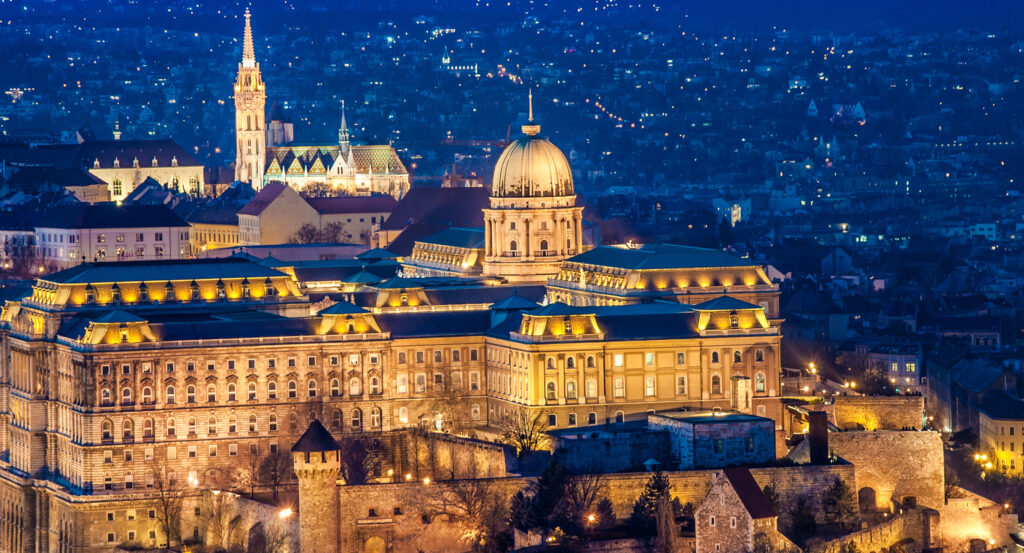
Why Buda Castle matters.
Buda Castle is a royal palace where Castle District's dynastic legacy, centuries of statecraft, fortified hilltop setting, and Hungarian cultural heritage shape one of Europe's most compelling historic complexes.
Set along Szent György tér near Dísz tér and just steps from Matthias Church, the palace unfolds through grand courtyards, ceremonial gateways, vaulted passages, sweeping terraces, museum collections, and commanding views across the Danube toward Pest. Medieval foundations, Baroque wings, reconstructed state rooms, sculpted gardens, and defensive walls reveal nearly eight centuries of rebuilding following invasions, sieges, fires, and political transformation. Rising above Castle Hill, the palace remains the enduring symbol of Hungarian sovereignty, where royal history, archaeology, and national culture converge within Budapest's historic skyline.
What defines Buda Castle.
Buda Castle is best known for serving as the principal royal residence of Hungarian kings since King Béla IV established a fortified palace on Castle Hill following the Mongol invasion during the mid-thirteenth century, initiating a complex that expanded into one of Central Europe's foremost royal seats. King Sigismund of Luxembourg transformed the residence during the late fourteenth and early fifteenth centuries into one of the continent's largest Gothic palaces, while King Matthias Corvinus introduced Renaissance courtyards, royal apartments, libraries, and artistic patronage after Italian craftsmen and architects brought Renaissance culture north of the Alps. Following the Ottoman capture of Buda in 1541, the palace deteriorated during 145 years of occupation before suffering extensive destruction during the Habsburg reconquest in 1686. The Habsburg monarchy subsequently rebuilt the complex in the Baroque style throughout the eighteenth century under architects including Johann Hölbling, Jean Nicolas Jadot, Nikolaus Pacassi, and Franz Anton Hillebrandt, while the immense Neo-Baroque expansion completed between 1890 and 1905 under architects Alajos Hauszmann, Miklós Ybl, and Gyula Kauser created the vast palace recognized today. Severe damage during the Siege of Budapest in 1944-45 destroyed roofs, ceremonial interiors, sculptures, and royal apartments, leading to decades of archaeological excavation and reconstruction that uncovered extensive medieval remains beneath the present palace. Today the UNESCO-listed complex houses the Hungarian National Gallery, the Budapest History Museum, and the National Széchényi Library, preserving centuries of royal, artistic, literary, and archaeological heritage within Hungary's most important historic palace.
The palace grounds preserve physical evidence from nearly every chapter of Hungary's history. Visitors encounter medieval fortifications, Gothic chapels, Renaissance foundations, Baroque courtyards, ceremonial staircases, reconstructed royal halls, archaeological remains, and defensive bastions that collectively document repeated cycles of destruction and renewal across more than seven centuries. The surrounding terraces connect sculpture gardens, historic gates, panoramic overlooks, museums, and excavated palace ruins while ongoing archaeological research continues revealing new insights into the medieval royal residence that once ranked among Europe's most influential courts.
How Buda Castle fits.
Buda Castle works as the centerpiece of an exploration through Castle Hill's royal and cultural heritage.
Begin at Matthias Church, where centuries of coronations and Gothic craftsmanship establish the historic character of Castle Hill before continuing to Buda Castle. Continue to Fisherman's Bastion, whose arcaded terraces frame sweeping views across the Danube and the Hungarian Parliament Building. Conclude at Hospital in the Rock Museum, where subterranean chambers reveal another chapter of Castle Hill's military and twentieth-century history. The progression moves naturally from sacred history to the royal palace before concluding beneath the hill itself, revealing why Buda Castle remains the defining expression of Hungary's royal past.
Where your story begins.
Foresyte Travel reveals places that feel extraordinary long before you arrive.
Enjoy editorial crafted for luxury travelers.
Foresyte may earn a commission when you book.





































































































