
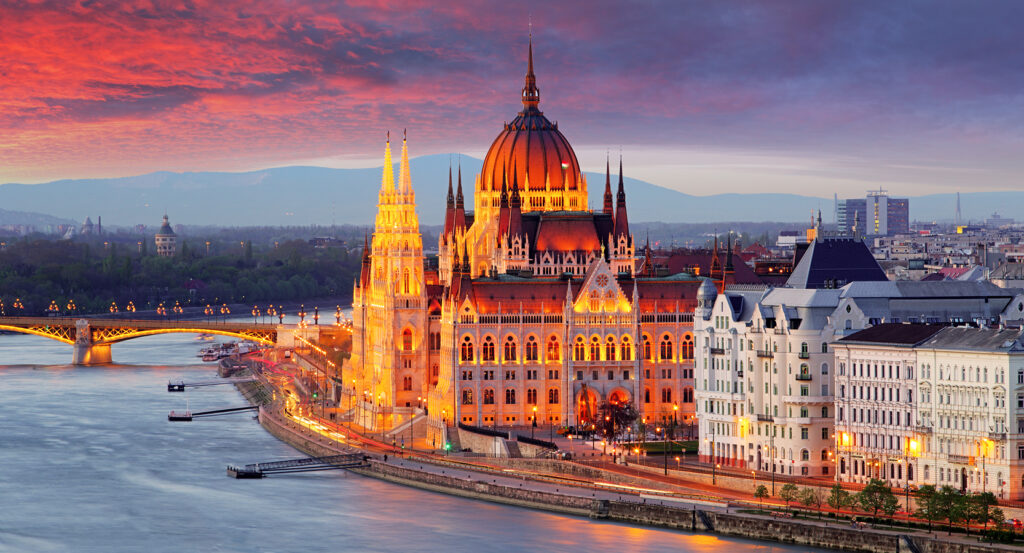
Why Hungarian Parliament Building matters.
Hungarian Parliament Building in Budapest is more than a seat of government, it's a symbol of national pride, resilience, and artistry that rises like a Gothic dream beside the Danube.
Standing as one of Europe's most stunning architectural masterpieces, this riverside monument commands both reverence and admiration. Its intricate neo-Gothic façade, crowned with spires and domes, reflects not just the glory of Hungary's past but also its enduring spirit. Designed by architect Imre Steindl and completed in 1904, the building stretches 900 feet long, making it among the largest parliamentary structures in the world. The symmetrical perfection mirrors the nation's dual-heritage, bridging East and West, monarchy and democracy, history and modernity. Inside, gold leaf, marble, and stained glass envelop every surface, transforming governance into a work of art. From the moment you step through its grand staircase, the scale and detail evoke awe, not unlike walking through a cathedral of statecraft. The central dome, soaring above the Hungarian Holy Crown, glows under the light, symbolizing unity and the sacred authority of the nation's history.
What defines Hungarian Parliament Building.
Though majestic from afar, Parliament's grandeur holds deeper meaning than first meets the eye.
It was constructed as part of Hungary's 1896 millennial celebrations, marking 1,000 years since the founding of the Hungarian state. Three designs were originally submitted in a national competition; the winning neo-Gothic style was chosen to embody the European aspirations of Hungary at the time. Interestingly, the two losing designs were still built, one for the Ministry of Agriculture and one for the Museum of Ethnography, creating a trio of architectural siblings across Kossuth Lajos Square. Over 40 kilograms of gold leaf decorate the interiors, and nearly half a million precious stones and decorative elements were used in its creation. The building's symmetry isn't just aesthetic; it represents the balance of power between the upper and lower houses of parliament, though after the abolition of the upper house in 1945, the design became purely symbolic. Beneath its beauty lies history marked by turbulence, World War II bombings, the 1956 revolution, and the Soviet occupation all left their scars. Yet, the Parliament still stands untouched in dignity, overlooking the Danube like a guardian of freedom.
How Hungarian Parliament Building fits.
To experience Parliament at its best, plan a visit that blends architectural wonder with the rhythm of the city.
Morning tours, available in multiple languages, offer a glimpse into the lavish interior, including the Dome Hall, where the Holy Crown of St. Stephen resides under constant guard. The tour takes you through grand staircases, gilded halls, and the opulent Assembly Room, where every detail tells a story of the nation's evolution. For photographers, the building shines most brilliantly at sunrise, when soft light dances off its white limestone and red-tiled roofs. Yet, the real magic comes at night, when the Parliament glows golden against the Danube's dark waters, reflecting a vision of Budapest that feels almost celestial. A river cruise in the evening offers an unforgettable perspective, the Parliament illuminated like a beacon of democracy and endurance. Combine your visit with a walk across Chain Bridge or up to Buda Castle for panoramic views that tie the city's past and present together. Hungarian Parliament Building isn't just a landmark, it's a story of identity, struggle, and triumph, etched in stone and light, that continues to inspire everyone who stands before it.
Where your story begins.
Foresyte Travel reveals places that feel extraordinary long before you arrive.
Enjoy editorial crafted for luxury travelers.
Foresyte may earn a commission when you book.





































































































