
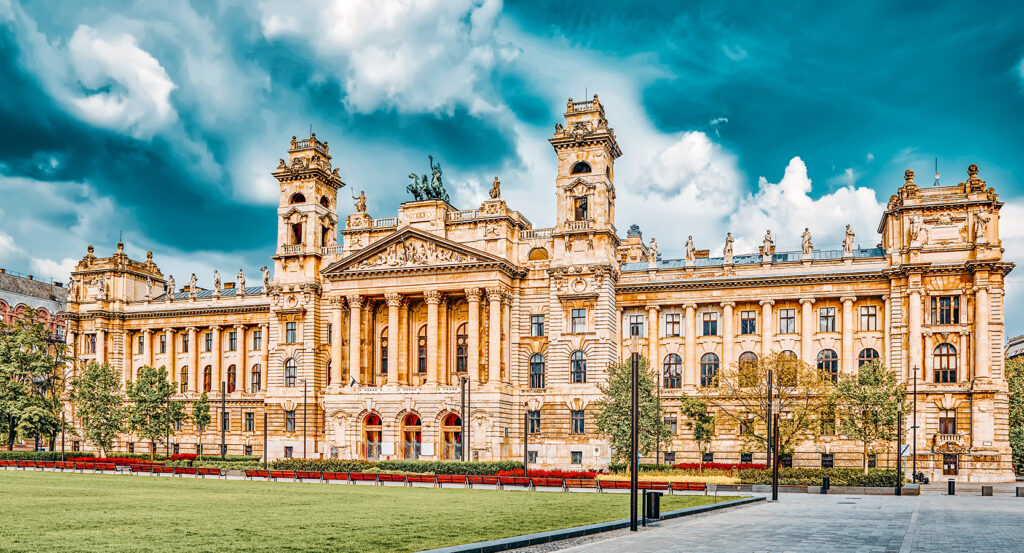
Why Museum of Ethnography matters.
Museum of Ethnography is a cultural institution where Lipótváros's civic ambition, Hungarian folk traditions, global cultures, and contemporary museum design preserve one of Europe's richest ethnographic collections.
Set along Dózsa György út near Ajtósi Dürer sor and just steps from City Park, this striking museum welcomes visitors through expansive exhibition halls, immersive cultural galleries, research collections, panoramic rooftop gardens, and thoughtfully curated displays exploring everyday life across Hungary and the wider world. Every gallery reveals another dimension of human creativity as traditional clothing, ceremonial objects, style architecture, religious artifacts, musical instruments, and handcrafted works document the customs and identities of countless communities. Rising from the edge of Budapest's renewed Museum Quarter, the building itself extends into a publicly accessible landscaped roof that frames broad views across the city while inviting visitors into one of Hungary's leading centers for cultural research and preservation. The experience is defined by cultural discovery, scholarly depth, and an expansive perspective on human societies.
What defines Museum of Ethnography.
Museum of Ethnography is best known for being founded in 1872 as the Ethnographic Department of the Hungarian National Museum before becoming an independent institution in 1947, developing one of Europe's oldest and most significant ethnographic collections with 250,000 ethnographic artifacts, 600,000 photographs, tens of thousands of manuscripts, sound recordings, maps, films, and archival documents representing both Hungarian folk culture and societies across five continents. The museum's early development was shaped by collector and ethnographer János Xántus, whose extensive acquisitions from Asia, North America, and Southeast Asia established the foundation of its international collections, while successive expeditions by Hungarian researchers expanded holdings from Africa, Oceania, South America, and Europe throughout the late nineteenth and twentieth centuries. In 2022 the museum relocated into a purpose-built home designed by Napur Architect Ltd. as part of Budapest's Liget Budapest development, becoming the first building in the world designed specifically as an ethnographic museum during the twenty-first century. The structure spans 34,000 square meters, incorporates exhibition galleries, conservation laboratories, research facilities, education spaces, archives, storage areas, and a publicly accessible rooftop park, while its sweeping curved form was selected through an international architectural competition and later received global recognition including the World's Best Public Building award at the 2022 International Property Awards. Permanent and temporary exhibitions present Hungarian folk traditions alongside global material culture through textiles, ceramics, furniture, ritual objects, agricultural tools, masks, jewelry, transportation, photography, and multimedia interpretation that collectively document the diversity of human civilization.
The museum's collections continue supporting active scholarship alongside public exhibition. Visitors encounter embroidered regional costumes, shepherd carvings, painted furniture, ceremonial dress, musical instruments, religious objects, and domestic interiors documenting centuries of Hungarian rural life alongside collections gathered from Indigenous communities, Asian civilizations, African societies, Pacific cultures, and the Americas. Conservation studios, digitization projects, academic publications, and international research partnerships continually expand understanding of the collection while preserving cultural heritage through one of Central Europe's leading ethnographic institutions.
How Museum of Ethnography fits.
Museum of Ethnography works as part of an exploration through Budapest's Museum Quarter and surrounding cultural institutions.
Begin at House of Music Hungary, where Sou Fujimoto's innovative design and interactive exhibitions establish a contemporary introduction before continuing to Museum of Ethnography. Continue to City Park, whose gardens, promenades, and historic attractions provide a natural transition through one of Budapest's largest public green spaces. Conclude at Museum of Fine Arts, where masterworks spanning antiquity to the modern era provide a fitting finale connecting anthropology, history, and artistic achievement. The progression moves naturally from contemporary cultural interpretation to ethnographic collections before concluding with one of Hungary's foremost art museums, revealing why Museum of Ethnography occupies such an important place within Budapest's cultural landscape.
Where your story begins.
Foresyte Travel reveals places that feel extraordinary long before you arrive.
Enjoy editorial crafted for luxury travelers.
Foresyte may earn a commission when you book.





































































































