
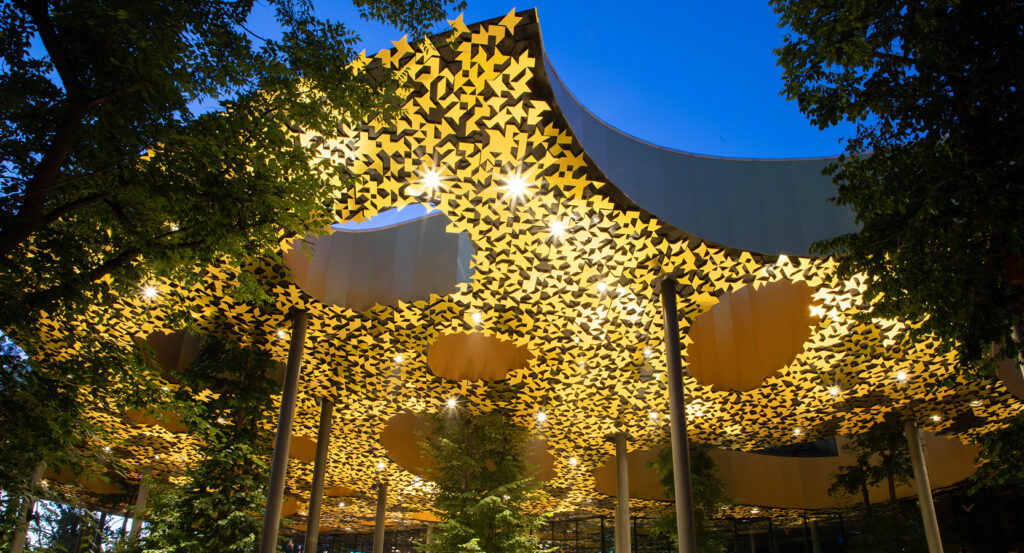
Why City Park matters.
City Park in Budapest is where the city's creative heart beats in open air, a seamless fusion of art, architecture, and nature.
Stretching across Városliget, this radiant cultural corridor ties together Budapest's greatest treasures, from the House of Music Hungary and the Museum of Fine Arts to the renewed Széchenyi Baths and the fairy-tale Vajdahunyad Castle. Walking its tree-lined paths feels like drifting through a living gallery: pianos echo under chestnut canopies, sculptures rise from flowerbeds, and the scent of linden trees mingles with the sounds of laughter and violin strings. Here, every step hums with vitality, morning joggers share space with art students sketching domes, and families linger over ice cream as distant strains of classical music spill from a rehearsal hall. By dusk, the park glows in warm light, reflecting Budapest's timeless balance of elegance and ease. This is not just a park, it's the city's creative sanctuary, where culture doesn't wait behind doors; it dances through the open air.
What defines City Park.
The park is the centerpiece of Budapest's bold Liget Project, a visionary transformation turning City Park into one of Europe's most energetic cultural hubs.
Spanning over 100 hectares, it integrates green renewal with world-class institutions: the House of Hungarian Music, the New National Gallery (soon to open), and the renovated Museum of Ethnography, whose sweeping, grass-covered roof doubles as a walkable parkland. The entire layout was designed to invite flow, a continuous, physical experience rather than a collection of isolated landmarks. The park's designers drew inspiration from Vienna's Ringstrasse and Paris's cultural boulevards, aiming to make art accessible in motion. Beneath the surface, geothermal systems quietly power the lighting and water features, symbolizing Hungary's commitment to sustainable innovation. And while the project sparked debate for its ambition, it has already reshaped the rhythm of the city, making Budapest not only a destination of history but of living culture. Few realize that City Park hosted Europe's first public park concerts as early as the 19th century, or that Liszt himself once performed under its trees. Today, that legacy of music and movement continues, reimagined for a new century.
How City Park fits.
Exploring City Park is best done without itinerary, let your senses be the guide.
Begin near Heroes' Square, where statues of Hungary's founders stand watch, and step into the park's calm embrace. Wander past the glassy curves of the House of Music Hungary, where melodies drift on the breeze, then continue toward the Museum of Ethnography, its rooftop lawn offering panoramic views of the city's evolving skyline. Stop for coffee or local pastries at one of the park cafés, many built into restored pavilions from the 1896 Millennium Exhibition. If time allows, explore the leafy paths leading to Vajdahunyad Castle and the nearby boating lake, where in summer you can paddle beneath Gothic arches and in winter glide across the ice. Stay until twilight, when lamps flicker on, street musicians gather, and the air feels thick with possibility. City Park in Budapest is more than a walkway, it's an experience of renewal, a living discussion between heritage and horizon where art, music, and nature share the same breath.
Where your story begins.
Foresyte Travel reveals places that feel extraordinary long before you arrive.
Enjoy editorial crafted for luxury travelers.
Foresyte may earn a commission when you book.





































































































