
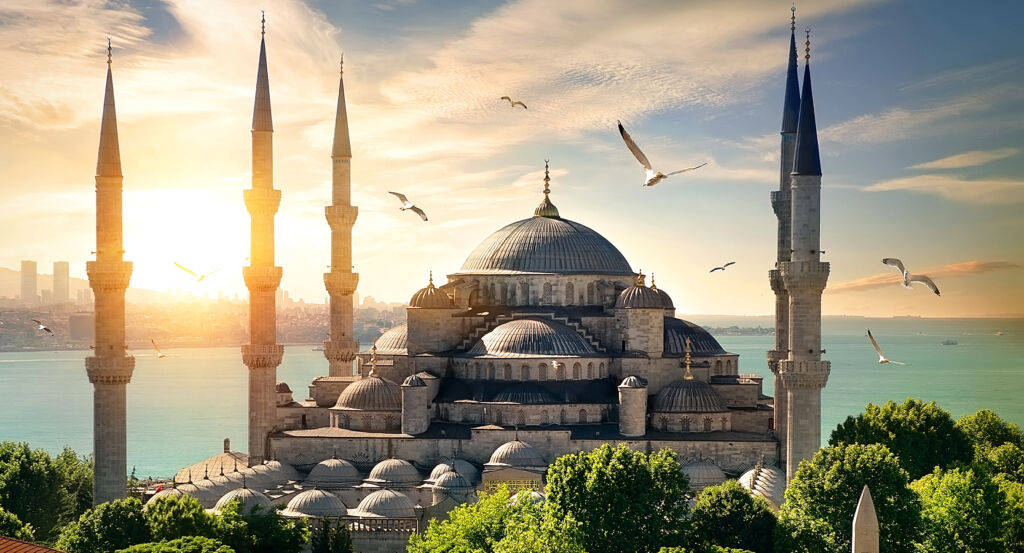
Why Pandeli Restaurant matters.
Pandeli Restaurant is a historic Turkish dining institution where Eminönü's Ottoman commercial heritage meets the culinary legacy of Greek-born Pandeli Çobanoğlu, the cosmopolitan food culture of twentieth-century Istanbul and more than a century of recipes preserved through successive generations of chefs.
Positioned above the entrance to the Spice Bazaar, the restaurant occupies an elevated setting between the waterfront of the Golden Horn, the historic trading streets surrounding Tahtakale and the expansive religious complexes of Istanbul's old commercial center. A narrow staircase rises from the market entrance into a sequence of dining rooms distinguished by luminous turquoise İznik-style tiles, dark blue decorative accents and intimate windows overlooking the surrounding streets. Historic photographs introduce the establishment's celebrated patrons, connecting its interior decoration with the political and cultural figures who shaped modern Turkey. Wooden tables, upholstered seating and traditional furnishings preserve the atmosphere of a longstanding Istanbul restaurant. The principal dining room is complemented by two private rooms, accommodating more secluded gatherings within the historic premises. The result is a distinctive restaurant whose tiled interiors and elevated position above a working Ottoman market preserve an unusually direct connection between Istanbul's commercial history and its culinary traditions.
What defines Pandeli Restaurant.
Pandeli Restaurant is best known for preserving the culinary legacy of Pandeli Çobanoğlu, a Greek-born restaurateur whose cooking became closely associated with the emergence of modern Turkish dining culture. Çobanoğlu developed his professional skills through modest employment in Istanbul's commercial districts, including work as a dishwasher and barber's apprentice. His early culinary enterprise concentrated on familiar preparations such as piyaz, a bean-and-onion salad, and köfte, the seasoned meatballs central to Turkish cooking. These dishes established his reputation among merchants, workers and customers frequenting the markets surrounding the Golden Horn. In 1901, he founded the business that would eventually become one of the city's most enduring restaurants. His professional development coincided with the final decades of the Ottoman Empire, when Istanbul's commercial districts brought together Greek, Armenian, Jewish and Muslim culinary traditions. The establishment subsequently expanded through different premises, gradually attracting an influential clientele associated with the city's political and cultural establishment. Mustafa Kemal Atatürk became one of its celebrated patrons, establishing a connection between the restaurant and the founding generation of the Turkish Republic. Literary figures Ahmet Hamdi Tanpınar and Yahya Kemal Beyatlı also frequented the establishment, linking its dining rooms with influential developments in modern Turkish literature. International visitors included Queen Elizabeth II and Audrey Hepburn, extending its reputation among prominent travelers to Istanbul. The restaurant's history also reflects the political upheavals that transformed the city's minority communities during the twentieth century. Its former premises suffered damage and looting during the anti-Greek violence of September 6-7, 1955, a period of persecution that profoundly affected Istanbul's Greek population. Following those events, the restaurant secured premises within the Spice Bazaar, establishing the location that would become inseparable from its subsequent reputation. By 1957, Pandeli had settled into its elevated dining rooms above the market, beginning a new chapter within one of the Ottoman capital's most significant commercial buildings. Çobanoğlu continued directing the enterprise until his death in 1967, leaving a repertoire of preparations closely associated with his professional achievements. His son Hristo Pandeli subsequently assumed responsibility for the business, working alongside chefs trained within the original establishment. Cemal Biberci and Naşit Aydınhan became important figures in the preservation of its culinary traditions, contributing to the continuity of recipes across successive decades. Abdullah Sait Sevim later emerged as the restaurant's principal kitchen authority, maintaining the cooking methods and preparations inherited from his predecessors. Özay Çınar contributed comparable continuity to the dining room, overseeing hospitality and relationships with generations of regular customers. Financial difficulties forced the restaurant to close in 2016, interrupting a business that had operated through the collapse of an empire, the establishment of a republic and successive periods of political and economic change. The Desert Group acquired the enterprise and reopened it in 2018, restoring its historic premises and reassembling experienced members of the professional team. The restaurant subsequently received MICHELIN Bib Gourmand recognition, acknowledging the quality and value of its traditional Turkish cooking. Its significance rests on the preservation of a culinary institution shaped by Istanbul's multicultural past, the political transformations of modern Turkey and a continuous professional lineage connecting its founder with the contemporary kitchen.
Abdullah Sait Sevim's cooking preserves the established repertoire of Istanbul restaurant cuisine through carefully maintained recipes, traditional ingredients and preparations developed across generations. His approach reflects the relationship between Ottoman palace cooking, the domestic traditions of the city's diverse communities and the substantial dishes associated with its historic commercial restaurants. The menu begins with an extensive selection of olive-oil preparations, introducing vegetables, legumes and aromatic herbs through techniques central to Turkish home cooking. Stuffed vine leaves combine seasoned rice with pine nuts, dried fruit and carefully balanced acidity, producing a familiar preparation whose character depends on the proportions of its filling. Courgette flowers filled with white cheese provide a contrasting expression, their delicate texture complemented by a crisp exterior and a seasoned yogurt accompaniment. The restaurant's most celebrated preparation is kâğıtta levrek, sea bass cooked in paper, a dish closely associated with the founder's culinary legacy. The enclosed preparation preserves moisture and concentrates the fish's natural flavor, establishing a refined interpretation of Istanbul's longstanding seafood traditions. Hünkâr beğendi introduces a richer expression through slow-cooked lamb served over a smooth purée of roasted eggplant enriched with béchamel. Its combination of tender meat, smoky vegetables and concentrated sauce reflects the historical relationship between Ottoman court preparations and the broader development of Turkish restaurant cooking. Eggplant pastry topped with döner provides another distinctive house specialty, bringing together delicate pastry, the sweetness of cooked aubergine and the savory character of seasoned meat. Vişneli tirit extends the repertoire through the relationship between bread, meat and sour cherries, preserving a traditional combination of substantial and acidic flavors. Desserts include almond cookies and oven-baked quince accompanied by syrup and thick cream, concluding the meal through preparations associated with Istanbul's established confectionery traditions. The kitchen's continued reliance on familiar recipes establishes a recognizable culinary progression, beginning with vegetables and cold preparations before developing through seafood, meat and traditional sweets. Pandeli's distinction emerges from the sustained craftsmanship of its professional team, preserving the flavors and techniques of Istanbul's historic restaurant culture within a dining room that has served successive generations of customers.
How Pandeli Restaurant fits.
Pandeli Restaurant works as the dining centerpiece of an exploration connecting the architectural patronage of the Ottoman imperial court, the commercial institutions of Istanbul's historic waterfront and the engineering achievements that transformed movement across the Golden Horn. Its position above the Spice Bazaar places the restaurant within a compact district where expansive religious buildings, merchant establishments and maritime infrastructure preserve successive chapters of the city's commercial development.
Begin at Rüstem Paşa Mosque, the sixteenth-century religious complex commissioned by Grand Vizier Rüstem Paşa, the influential statesman and son-in-law of Sultan Süleyman the Magnificent. Designed by Mimar Sinan, the mosque was developed 1561 and completed through the patronage of Rüstem Paşa's widow, Mihrimah Sultan. Its elevated position above a series of shops and vaulted commercial spaces reflects the integration of religious endowments with the economic life of Ottoman Istanbul. The interior contains an exceptional collection of İznik tiles, including elaborate floral compositions and tulip designs that represent the technical achievements of Ottoman ceramic production. Its compact proportions and richly decorated surfaces establish a striking architectural contrast with the surrounding commercial streets. Continue to Yeni Cami, the imperial mosque overlooking Eminönü Square and the southern approaches to the Galata Bridge. Construction began in 1598 under the patronage of Safiye Sultan, mother of Sultan Mehmed III, with the initial architectural program directed by Davut Ağa. Political changes interrupted the project for decades before Turhan Hatice Sultan, mother of Sultan Mehmed IV, revived construction following the devastating Istanbul fire of 1660. Completed and inaugurated in 1665, the mosque became the centerpiece of a substantial religious complex incorporating a royal pavilion, tombs, fountains and commercial facilities. Its cascading domes, twin minarets and expansive courtyard preserve the architectural ambitions of Ottoman imperial patronage during the seventeenth century. Conclude at Galata Bridge, the historic crossing connecting Eminönü with Karaköy across the Golden Horn. The development of permanent bridges at this location during the nineteenth century transformed commercial movement between Istanbul's historic peninsula and the districts surrounding Galata. Successive structures accommodated increasing pedestrian, carriage and vehicular traffic as the city expanded through the late Ottoman and republican periods. The present bridge opened in 1994, incorporating a movable central section and a lower level occupied by restaurants and other commercial premises. Its pedestrian walkways provide views toward the Süleymaniye Mosque, the waterfront of Karaköy and the dense architectural landscape surrounding the Golden Horn. The progression connects Sinan's architectural achievements with the imperial patronage of the seventeenth century and concludes at a crossing central to Istanbul's commercial development, establishing the broader historical setting surrounding Pandeli Restaurant.
Where your story begins.
Foresyte Travel reveals places that feel extraordinary long before you arrive.
Enjoy editorial crafted for luxury travelers.
Foresyte may earn a commission when you book.





































































































