
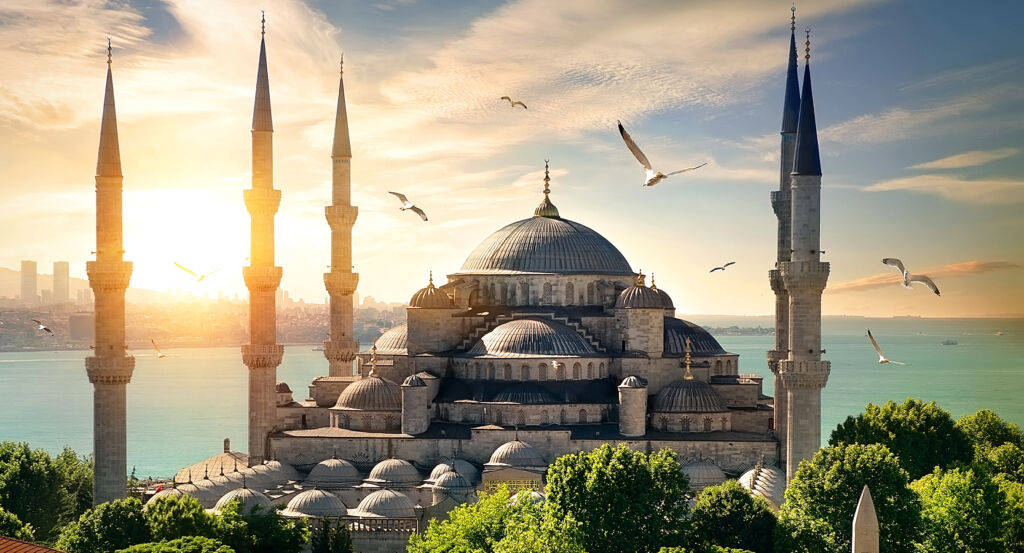
Why Topkapi Palace Museum matters.
Topkapi Palace Museum is a fifteenth-century Ottoman imperial residence where Sultanahmet's Byzantine inheritance meets the dynastic authority of Mehmed II, the administrative institutions of the Ottoman Empire and the courtly traditions that governed Istanbul for nearly four centuries.
Occupying the Sarayburnu promontory above the confluence of the Bosphorus, Golden Horn and Sea of Marmara, the palace extends across a terraced enclosure at the northeastern end of Istanbul's historic peninsula, where successive courtyards connect fortified gateways, ceremonial buildings, gardens and residential pavilions. Stone walls separate the complex from the surrounding urban fabric. Domed chambers, tiled façades and colonnaded porticoes distinguish buildings constructed during successive imperial reigns. Landscaped terraces overlook the waterways that connected the Ottoman capital with its European and Asian territories. The result is a palace complex whose architecture preserves the ceremonial organization, administrative hierarchy and domestic arrangements of the Ottoman court.
What defines Topkapi Palace Museum.
Topkapi Palace Museum is best known as the principal residence and administrative headquarters of the Ottoman sultans following the conquest of Constantinople in 1453. Mehmed II initially occupied the Old Palace in the city's interior before commissioning a new residence on the former Byzantine acropolis. Construction began during the 1460s, establishing a fortified imperial precinct overlooking the principal maritime approaches to the capital. The original complex incorporated residential buildings, administrative chambers, kitchens and enclosed courtyards organized around the requirements of the expanding Ottoman government. Mehmed's architectural program established a sequence of controlled entrances that separated public administration from the private household of the sovereign. The Imperial Gate provided access to the outer precinct, where service buildings and administrative facilities supported palace operations. The Gate of Salutation marked the entrance to the second courtyard, an area associated with the Imperial Council and the management of state affairs. Under Süleyman I, the palace underwent substantial expansion as Ottoman territorial authority extended across southeastern Europe, the eastern Mediterranean and the Middle East. The imperial household grew through the development of specialized court offices, educational institutions and residential quarters. During the sixteenth century, Hürrem Sultan's establishment within the palace contributed to the expansion of the imperial harem and its permanent residential facilities. Successive rulers commissioned additional chambers, ceremonial pavilions and decorative programs associated with dynastic representation. Fires during the seventeenth century damaged portions of the residential complex, prompting reconstruction under later sultans. The palace continued to function as the principal imperial residence until Abdülmecid I transferred the court to Dolmabahçe Palace in 1856. Its older ceremonial buildings retained associations with dynastic traditions and important state possessions. Following the establishment of the Republic of Türkiye in 1923, the complex was converted into a museum in 1924, preserving the architectural and material heritage of the Ottoman court.
Mimar Sinan's architectural contributions to the palace included the substantial reconstruction of its imperial kitchens following a sixteenth-century fire. Their distinctive rows of chimneys rise above vaulted cooking chambers that once supported the preparation of meals for the imperial household and administrative establishment. The kitchens accommodate collections of Chinese porcelain, including celadon and blue-and-white wares acquired through diplomatic exchange and commercial networks. The Imperial Council Chamber occupies the second courtyard, where senior officials assembled to deliberate on matters of government under the authority of the grand vizier. Its decorated interior contains a screened opening associated with the sultan's observation of proceedings. The Gate of Felicity separates this administrative precinct from the third courtyard, which contained the sovereign's private audience and educational institutions. The Audience Chamber provided a controlled setting for diplomatic receptions, connecting court protocol with the political relationships of the empire. The Enderun school trained selected palace servants and officials for positions within the imperial administration. The Treasury preserves objects associated with dynastic wealth, including the Topkapi Dagger, an eighteenth-century jeweled weapon incorporating emeralds and elaborate goldsmithing. The Spoonmaker's Diamond belongs to the palace's collection of precious stones and ceremonial objects. The Chamber of the Sacred Relics contains objects associated with Islamic religious history, preserved within rooms connected with the former private apartments of the sultans. The Harem comprises interconnected residential courtyards, apartments and service chambers associated with the imperial family and its household establishment. The Queen Mother's Apartment preserves the importance of the valide sultan within the court's domestic hierarchy. The Imperial Hall contains a substantial domed interior decorated with tilework and painted ornament, providing a ceremonial gathering space within the residential precinct. The Baghdad Pavilion, commissioned by Murad IV in 1639, incorporates Iznik tiles, stained-glass windows and a domed chamber overlooking the surrounding gardens. These distinct spaces preserve the relationship between political administration, dynastic residence, religious authority and the material culture of Ottoman imperial government.
How Topkapi Palace Museum fits.
Topkapi Palace Museum works as the Ottoman court centerpiece for an Istanbul outing connecting the empire's architectural patronage, archaeological collections and historic waterfront defenses along the eastern peninsula.
Begin at Gülhane Park, the landscaped grounds extending westward from the palace precinct toward the streets of Sirkeci. The park originated within the outer gardens of the Ottoman imperial residence, where wooded areas and cultivated grounds formed part of the sovereign's enclosed estate. Its public history began in 1912, when portions of the former palace gardens opened as a municipal park. Tree-lined avenues, fountains and landscaped paths preserve the relationship between the former royal enclosure and Istanbul's public green spaces. The park also contains the Museum of the History of Science and Technology in Islam, housed within former imperial stables. Continue to Istanbul Archaeological Museums, the museum complex developed during the nineteenth century to accommodate antiquities assembled under Ottoman administration. Osman Hamdi Bey directed its institutional expansion and commissioned Alexandre Vallaury to design the principal neoclassical building. The collections include the Alexander Sarcophagus, discovered at Sidon in 1887, and substantial holdings of ancient sculpture, inscriptions and funerary objects. The adjoining Tiled Kiosk, commissioned by Mehmed II in 1472, preserves an early example of Ottoman architectural decoration incorporating glazed ceramic surfaces. The Museum of the Ancient Orient contains archaeological objects associated with Mesopotamia, Anatolia and neighboring regions. Conclude at Ahırkapı Lighthouse, the coastal navigation structure overlooking the Sea of Marmara near the southeastern edge of the historic peninsula. An earlier lighthouse was established during the reign of Osman III in the eighteenth century to improve maritime navigation along the approaches to Istanbul. The surviving masonry tower dates to the nineteenth century and incorporates a cylindrical shaft rising above its supporting structure. Its position marks the relationship between the city's fortified shoreline and the shipping routes connecting the Bosphorus with the Sea of Marmara. The progression moves from the former imperial gardens through Ottoman archaeological collecting and culminates at the historic coastal lighthouse, connecting Topkapi Palace Museum with the scientific, maritime and public institutions of Istanbul.
Where your story begins.
Foresyte Travel reveals places that feel extraordinary long before you arrive.
Enjoy editorial crafted for luxury travelers.
Foresyte may earn a commission when you book.





































































































