
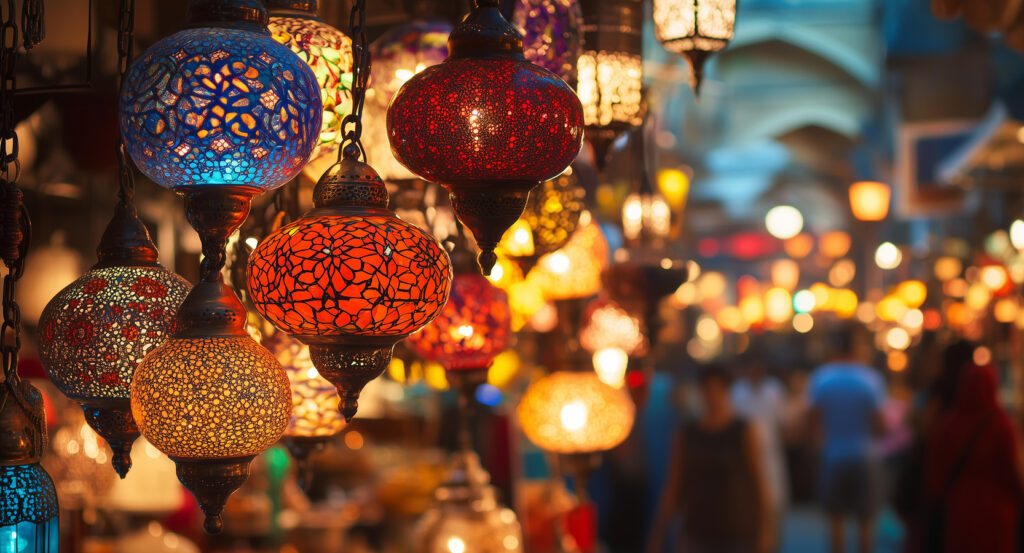
Why Grand Bazaar matters.
Grand Bazaar is a fifteenth-century Ottoman covered market where Beyazıt's mercantile heritage meets the commercial institutions established under Mehmed II, the specialized craft guilds of imperial Istanbul and the trading networks connecting Europe, Asia and the eastern Mediterranean.
Extending across the historic commercial quarter between Beyazıt Square and Nuruosmaniye, the bazaar occupies an enclosed network of vaulted streets on the slopes above the Golden Horn, where masonry gateways connect covered shopping passages with surrounding hans, workshops and neighborhood markets. Its irregular plan incorporates intersecting corridors lined with small commercial premises. Brick vaults, stone arches and plastered masonry distinguish the surviving Ottoman construction. Named gates regulate access from the surrounding streets, preserving entrances associated with particular trading districts. The result is a commercial complex whose architecture preserves the organization of Ottoman urban trade and the concentration of specialized merchants within Istanbul's historic peninsula.
What defines Grand Bazaar.
Grand Bazaar is best known for its extensive network of covered shopping streets and its origins in the commercial foundations established following the Ottoman conquest of Constantinople. Mehmed II initiated the development of the market during the second half of the fifteenth century as part of his program to strengthen the conquered city's economy. The earliest commercial nucleus centered on the Cevahir Bedesteni, a vaulted market building associated with the exchange and safekeeping of valuable merchandise. Its substantial masonry construction provided secure premises for merchants dealing in precious objects, textiles and other goods requiring protection. Revenue generated through commercial foundations supported religious and charitable institutions established under Ottoman patronage. A second covered market, the Sandal Bedesteni, developed nearby and became associated with the trade in fine fabrics. Commercial activity expanded into the streets between these structures as merchants and craftsmen established shops organized around particular products. Ottoman guild institutions regulated aspects of production, apprenticeship, quality and commercial practice within the growing market district. Goldsmiths, textile merchants, leatherworkers and other specialized trades occupied concentrations of premises that shaped the names and functions of individual streets. The bazaar's position within Istanbul's commercial center connected it with caravan routes, maritime imports and wholesale trading establishments. Fires and earthquakes damaged the complex during successive centuries, requiring reconstruction of vaults, shops and circulation routes. The earthquake of 1894 caused substantial destruction and prompted repairs that altered portions of the covered street network. During the twentieth century, changes in manufacturing and retail distribution reshaped the bazaar's commercial activities. Traditional craft businesses continued alongside merchants specializing in jewelry, carpets, ceramics and other goods associated with Istanbul's trading history. Municipal conservation and restoration programs subsequently addressed structural deterioration and the preservation of historic market architecture.
The Cevahir Bedesteni preserves the bazaar's early commercial organization through a rectangular stone enclosure covered by fifteen domes supported on substantial piers. Its interior accommodates merchants dealing in jewelry, antiques and valuable objects, continuing the building's historical association with secure trade. The Sandal Bedesteni contains twenty domes arranged above a separate vaulted hall whose name derives from a woven fabric historically traded there. These two structures establish the architectural foundations around which the wider covered market developed. Kalpakçılar Caddesi forms one of the principal commercial passages, connecting jewelry premises with the market's eastern approaches. Its shopfronts display gold ornaments, precious stones and manufactured jewelry associated with Istanbul's longstanding metalworking trades. The surrounding corridors contain merchants specializing in handwoven carpets, kilims, embroidered textiles and leather goods. Carpet businesses distinguish Anatolian regional weaving traditions through differences in knotting, wool preparation, geometric ornament and vegetable dyes. Ceramic shops contain wares associated with the decorative traditions of İznik and Kütahya, including floral patterns developed during the Ottoman period. The market's vaulted passages incorporate small windows and overhead openings that admit daylight into the interior corridors. Shop entrances open directly onto pedestrian routes, maintaining a commercial arrangement centered on face-to-face transactions and specialized merchandise. The Nuruosmaniye Gate provides an eastern entrance distinguished by Ottoman Baroque architectural details. The Beyazıt Gate connects the western market passages with the adjoining civic precinct. Historic hans surrounding the covered enclosure accommodated merchants, storage rooms and workshops associated with wholesale commerce. The bazaar's surviving organization connects the exchange of valuable goods with the craft production, commercial regulation and architectural infrastructure of Ottoman Istanbul.
How Grand Bazaar fits.
Grand Bazaar works as the Ottoman commerce centerpiece for an Istanbul outing connecting imperial religious patronage, manuscript culture and the historic trading institutions of the city's central market district.
Begin at Beyazıt Mosque, the imperial religious foundation commissioned by Sultan Bayezid II at the beginning of the sixteenth century. Its construction was completed in 1506, establishing one of the principal surviving examples of early classical Ottoman mosque architecture. The prayer hall incorporates a central dome supported by semidomes, and the adjoining courtyard contains marble columns and domed porticoes. The surrounding religious complex historically included educational, charitable and service institutions supported through endowed revenue. Its position beside Beyazıt Square preserves the relationship between imperial religious patronage and the commercial development of the surrounding district. Continue to Sahaflar Çarşısı, the booksellers' market situated near the mosque's courtyard. Its history is associated with Istanbul's manuscript dealers, calligraphers and booksellers, whose trade served scholars, students and religious institutions. The market developed a particular connection with the educational establishments surrounding Beyazıt. Its small shops preserve a concentration of printed books, historical publications and works associated with Turkish literary culture. The courtyard contains a bust of İbrahim Müteferrika, whose eighteenth-century printing activities contributed to the development of Ottoman Turkish publishing. Conclude at Süleymaniye Mosque, the imperial complex commissioned by Sultan Süleyman I and designed by Mimar Sinan. Completed in 1557, the mosque occupies a hill overlooking the Golden Horn and incorporates a central dome, four minarets and an extensive courtyard. Its surrounding külliye included madrasas, a hospital, kitchens and other charitable institutions. The tombs of Süleyman and Hürrem Sultan stand within the adjoining funerary precinct. The complex's scale and endowed institutions preserve the connection between imperial patronage, religious education and the economic organization of the Ottoman capital. The progression moves from early Ottoman mosque construction through the city's bookselling traditions and culminates at Sinan's imperial religious complex, connecting Grand Bazaar with the commercial and institutional foundations of historic Istanbul.
Where your story begins.
Foresyte Travel reveals places that feel extraordinary long before you arrive.
Enjoy editorial crafted for luxury travelers.
Foresyte may earn a commission when you book.





































































































