Why The Ritz-Carlton matters.
The Ritz-Carlton is an elevated hotel where Streeterville's lakefront verticality meets Edward D. Dart's Water Tower Place, a pioneering 1975 mixed-use complex whose reinforced-concrete tower placed luxury lodging high above North Michigan Avenue.
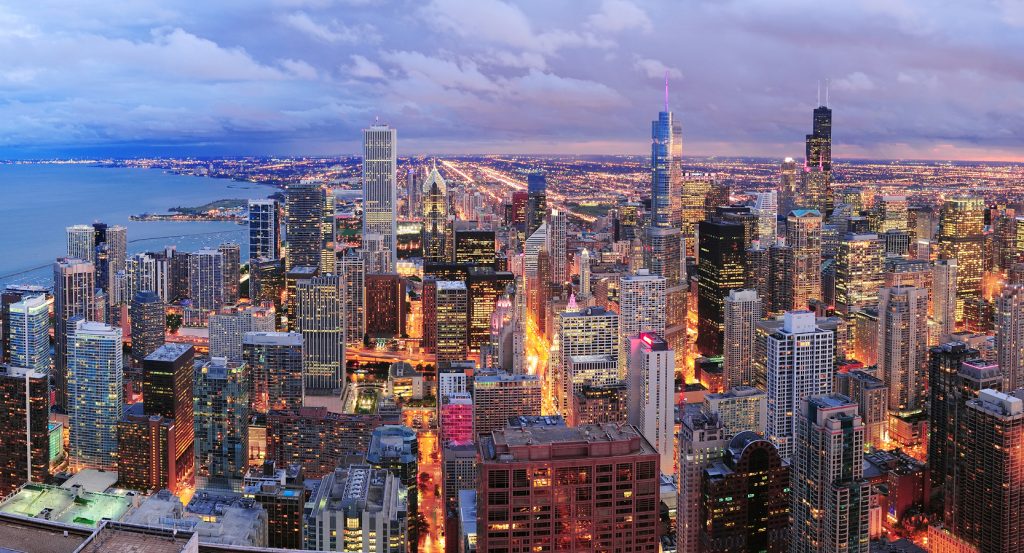
Set along East Pearson Street near North Michigan Avenue and just steps from Jane M. Byrne Plaza, the hotel occupies Streeterville's northwestern edge between the Grand Mile's retail spine, Pearson Street's cultural institutions and the high-rise corridor extending east toward Lake Shore Drive and Lake Michigan. Edward D. Dart shaped the tower as a massive reinforced-concrete slab clad in pale stone, creating a restrained vertical counterpoint to the lower retail podium spreading across the Michigan Avenue frontage. Hotel interiors begin high within the tower, turning arrival into a vertical sequence that culminates in broad windows framing Lake Michigan, surrounding skyscrapers and the dense urban fabric below. The elevated lobby occupies an expansive floor plate above the retail complex, separating the hotel physically from street-level commerce and exploiting the extraordinary height established by the building's mixed-use organization. The result is a hotel whose tower placement, elevated arrival and expansive lake outlooks preserve the dramatic vertical integration that made Water Tower Place a consequential Chicago development.
What defines The Ritz-Carlton.
The Ritz-Carlton is best known for opening in 1975 within Water Tower Place, the ambitious mixed-use complex developed by Philip Morris Klutznick and Thomas J. Klutznick as North Michigan Avenue expanded into a major center of retail, residential and hospitality development. Edward D. Dart of Loebl Schlossman Bennett and Dart served as chief architect, designing a reinforced-concrete tower rising above a multilevel retail podium. The completed skyscraper combined hotel operations, private residences and offices above the shopping complex, creating an unusually extensive vertical concentration of independent urban functions. Its reinforced-concrete construction pushed the material to exceptional height, making the tower the tallest reinforced-concrete building in the world when completed. Water Tower Place altered the commercial geography of North Michigan Avenue by demonstrating that a major enclosed shopping center could succeed within a dense downtown setting, helping extend premium retail activity northward along the corridor. The hotel opened under the Ritz-Carlton name through a licensing arrangement established before creation of the contemporary Ritz-Carlton Hotel Company. Four Seasons Hotels assumed management in 1977, producing the unusual character The Ritz-Carlton Chicago, A Four Seasons Hotel, which endured for nearly four decades. The arrangement left the property carrying the Ritz-Carlton name and lion insignia while operating independently from the Ritz-Carlton organization that emerged during the 1980s. JMB Realty Corporation eventually controlled the hotel through an affiliate and retained Four Seasons as manager through July 31, 2015. Sage Hospitality assumed management on August 1, 2015, and the property simultaneously became a full participant in The Ritz-Carlton system for the first time. That transition united a name carried by the Chicago hotel since 1975 with the international luxury organization that had developed separately during the intervening decades, closing one of the most unusual branding chapters in American hotel history.
BAMO directed the extensive transformation that followed the 2015 operating change, working with Gensler as architect to rebuild principal public areas around Chicago's architectural scale, craftsmanship and relationship with Lake Michigan. The multiyear project represented a $100 million investment and became the property's most extensive physical transformation since its opening. Walnut fins reorganized the twelfth-floor lobby, defining dining and social areas while giving the enormous floor plate a stronger architectural sequence. Lasvit created The Flying Wave for the former location of the lobby fountain, suspending handmade glass elements in an undulating composition derived from the movement of Lake Michigan. Roxy Paine's Mycelium, a branching painted-stainless-steel sculpture, occupies the reception area as another major contemporary artwork integrated directly into the renewed interior. Torali emerged from the reconstruction as the principal restaurant, using marble, brass, pale wood and precise geometric forms to connect Italian modernism with Chicago's design traditions. An adjoining café received mosaic flooring, olive trees and a greenhouse-like composition, establishing a lighter counterpoint to the restaurant and bar. BAMO opened the long event promenade toward the skyline by removing window coverings, introducing mirrored column faces and developing carpeting patterned after rippling lake water. The ballroom was consolidated into a continuous event interior while its original crystal chandelier was cleaned and relamped, preserving one recognizable artifact from the preceding design. The Ritz-Carlton uses walnut, stone, glass, major contemporary artworks and lake-derived forms to reinterpret the immense elevated interiors created within Water Tower Place for a new generation of the hotel.
How The Ritz-Carlton fits.
The Ritz-Carlton works as the anchor for an outing connecting a surviving nineteenth-century waterworks structure, a university arts center shaped by Bauhaus modernism and a historic mansion whose institutional life helped preserve the architectural character of the Gold Coast.
Begin at Chicago Water Tower, completed in 1869 as part of the city's municipal water system and designed by William W. Boyington in castellated Gothic Revival form. The limestone structure enclosed a standpipe regulating pressure from the adjoining pumping works, turning functional infrastructure into one of the young city's most elaborate public buildings. Chicago Water Tower survived the Great Chicago Fire of 1871, giving the structure extraordinary symbolic power as reconstruction transformed the burned district surrounding it. Its survival amid later Michigan Avenue redevelopment left a small nineteenth-century civic building surrounded by the skyscrapers that came to define the corridor. Continue to Arts Club of Chicago, founded in 1916 by a group of Chicago women seeking a permanent institution devoted to contemporary art and intellectual exchange. The organization became an important American platform for modernism, presenting work by Pablo Picasso, Georges Braque, Constantin Brâncuși and other major twentieth-century figures. Ludwig Mies van der Rohe designed its previous interior on East Ontario Street in 1951, creating a celebrated modernist setting that remained central to the institution for decades. John Vinci incorporated Mies's expansive steel staircase into the Arts Club's present building, completed in 1997, preserving a major architectural element across the organization's relocation. Conclude at Graham Foundation for Advanced Studies in the Fine Arts, established in 1956 through a bequest from architect Ernest R. Graham. The institution occupies the Madlener House, completed in 1902 for Albert Fridolin Madlener and his wife, Elsa Seipp Madlener. Richard E. Schmidt and Hugh M. G. Garden designed the residence with Prairie School influences, combining a restrained limestone exterior with carefully proportioned interiors and art-glass detailing. The Graham Foundation acquired the house in 1963 and transformed it into a center for exhibitions, lectures, publications and architectural research, giving the former Gold Coast residence an enduring role in international design culture. The progression moves from Chicago Water Tower's survival through the Great Fire through Arts Club of Chicago's century-long engagement with modern art and culminates at Graham Foundation for Advanced Studies in the Fine Arts, where a Prairie-era residence became a sustained center for architectural ideas.
Where your story begins.
Foresyte Travel reveals places that feel extraordinary long before you arrive.
Enjoy editorial crafted for luxury travelers.
Foresyte may earn a commission when you book.