Why The Arts Club of Chicago matters.
The Arts Club of Chicago is a pioneering modern-art institution where Streeterville's cultural sophistication meets the city's post-Armory Show embrace of the avant-garde, formative exhibitions by twentieth-century masters and an architectural lineage joining Ludwig Mies van der Rohe with John Vinci.
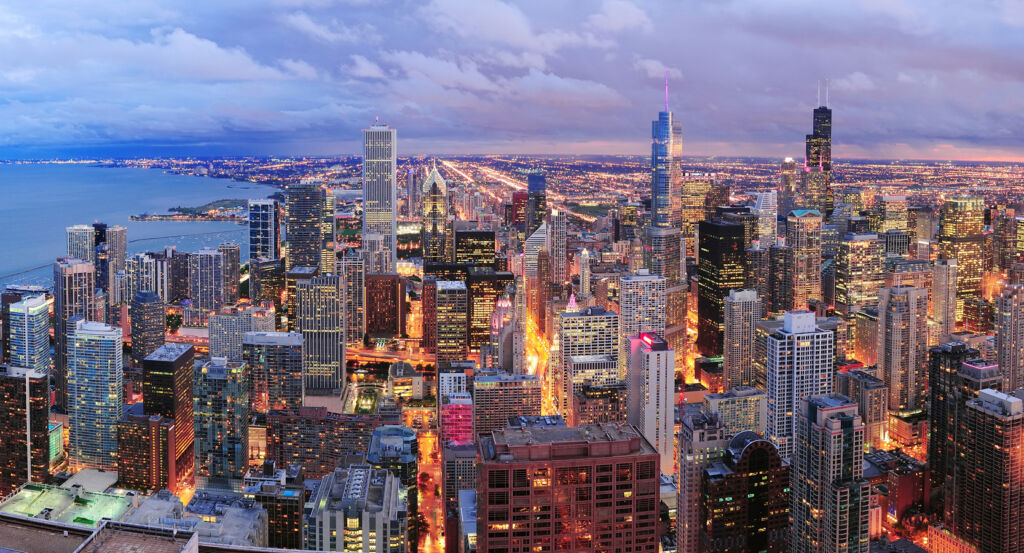
Set along East Ontario Street near North St. Clair Street and just steps from the commercial blocks surrounding Michigan Avenue, the club occupies Streeterville's western interior between the Grand Mile, Northwestern Memorial Hospital's medical campus and the dense residential towers extending east toward Lake Michigan. Norman brick and broad glazed openings give the two-story building a restrained exterior whose proportions deliberately subordinate performance to the art and social activity inside. A garden beside the principal gallery extends exhibitions outdoors, creating another setting for sculpture and artist commissions within the compact urban property. Mies van der Rohe's steel-and-travertine staircase forms the architectural center, connecting public galleries below with the collection, dining and social rooms above. The result is an institution whose purpose-built home turns more than a century of artistic patronage into a physical conversation between preserved modernism and late twentieth-century Chicago architecture.
What defines The Arts Club of Chicago.
The Arts Club of Chicago is best known for giving experimental modern art an unusually early institutional foothold in a city whose hostile response to the 1913 Armory Show exposed the need for sustained engagement with new artistic ideas. Founded on March 22, 1916, the organization defined its purpose around raising artistic standards, maintaining galleries and bringing artists into direct contact with patrons. Rue Winterbotham Carpenter assumed the presidency in 1918 and pushed the young club toward international modernism during a period when few American institutions consistently presented the European avant-garde. Alice Roullier directed the exhibition committee from 1918 into the 1940s and treated contemporary exhibitions as a means of placing Chicago inside artistic developments still unfolding abroad. The club operated a gallery within the Art Institute of Chicago between 1922 and 1927, expanding the reach of a program already becoming unusually adventurous. Constantin Brancusi received a major Arts Club exhibition in January 1927 curated by Marcel Duchamp, bringing twenty bronzes, marbles and stones from a preceding New York presentation into Chicago. Pablo Picasso, Georges Braque, Alexander Calder, Joan Miró, Henri Matisse, Isamu Noguchi, Francis Picabia and other central modernists subsequently entered the club's exhibition history and collection. Elizabeth “Bobsy” Goodspeed led the institution between 1932 and 1940 before Rue Winterbotham Shaw began a presidency lasting until 1979, giving women extraordinary authority over the club's artistic direction across much of the twentieth century. Shaw commissioned Ludwig Mies van der Rohe to design new quarters at 109 East Ontario Street, and his 1951 interior introduced an elegant steel-and-travertine floating staircase that became inseparable from the organization's architectural character. Demolition of those quarters during the 1990s threatened that physical inheritance as the club prepared for another move. A 1995 architectural competition selected John Vinci, a former Mies student, to design the first building created exclusively for The Arts Club. Vinci salvaged the Mies staircase and repositioned it within the new 19,000-square-foot headquarters, which opened in 1997 at 201 East Ontario Street. The intervention preserved a consequential fragment of the 1951 interior without reconstructing the lost rooms around it, allowing the staircase to connect two distinct architectural generations. The Arts Club entered its second century with that relationship intact, continuing a program whose institutional importance lies in sustained contact between Chicago audiences and artists working at the leading edge of their periods.
Alice Roullier's early conviction that Chicago needed direct contact with twentieth-century art also shaped the unusual way the club assembled its permanent collection. Acquisitions grew closely from exhibitions and relationships with artists, making the holdings a cumulative consequence of the institution's programming across successive generations. Georges Braque and Pablo Picasso connect the collection with the dramatic restructuring of pictorial form that transformed European painting during the early twentieth century. Constantin Brancusi carries the sculptural history into a severe reduction of recognizable forms, giving his presence additional significance through Marcel Duchamp's role in bringing his 1927 exhibition to the club. Alexander Calder extends that modernist lineage into sculpture organized around balance and movement, and Joan Miró moves it toward biomorphic abstraction and surrealist invention. Isamu Noguchi brings sculpture into discussion with furniture, gardens and architectural settings through a practice spanning art and design. Henry Moore adds another sculptural branch through the human figure and the relationship between mass, void and landscape. The holdings continued developing after the canonical modernist period through artists including Sigmar Polke, Richard Artschwager, Alex Katz, Peter Doig, Paul Thek, Yayoi Kusama and Suzanne Jackson. That expansion prevents the collection from functioning as a closed survey of early modernism and preserves the founding commitment to art developing within its own period. Second-floor installation gives these works a domestic scale distinct from conventional museum galleries, preserving the relationship between collecting and social exchange that has defined the club since 1916. Temporary exhibitions downstairs continue feeding the same institutional structure through three or four principal presentations annually, joined by performances, lectures, conversations and garden commissions. The Arts Club's enduring artistic character comes from this continuity between exhibition and acquisition, allowing encounters with artists to accumulate gradually into a collection tracing more than a century of changing avant-garde practice.
How The Arts Club of Chicago fits.
The Arts Club of Chicago works as the modernist anchor for an outing connecting Streeterville's Gilded Age collecting culture, Gothic ecclesiastical architecture and Chicago's institutional embrace of postwar contemporary art.
Begin at Richard H. Driehaus Museum, housed within the Nickerson Mansion commissioned in 1879 by banker Samuel Mayo Nickerson and his wife Matilda after their earlier home disappeared in the Great Chicago Fire. Burling and Whitehouse designed the fire-resistant residence, completed in 1883 at a cost of $450,000 and enriched by interiors from R.W. Bates & Co., William August Fiedler and George A. Schastey & Co. The Nickersons filled the house with European paintings, Asian decorative arts and carved jade before donating a substantial portion of their collection to the Art Institute of Chicago in 1900. More than one hundred Chicagoans purchased the threatened mansion in 1919 and donated it to the American College of Surgeons, beginning an early preservation chapter that ultimately led Richard H. Driehaus to acquire the property in 2003 and open his decorative-arts museum there five years later. Continue to Fourth Presbyterian Church, whose congregation formed in 1871 and lost its first home only hours after rededication when the Great Chicago Fire swept through the Near North Side. Growth prompted another move in the early twentieth century, leading the congregation to acquire a site on Lincoln Parkway before Michigan Avenue had been extended north across the river. Ralph Adams Cram designed the sanctuary, Howard Van Doren Shaw developed the surrounding parish buildings, Charles J. Connick created stained glass and Frederick Clay Bartlett directed interior painting and decoration. Dedicated in 1914, the Gothic complex preceded the Michigan Avenue Bridge by six years and subsequently watched the commercial boulevard rise around it. Conclude at Museum of Contemporary Art Chicago, founded in 1967 inside the former Playboy headquarters at 237 East Ontario Street under founding director Jan van der Marck. Its first day included John Cage and Fluxus artists Alison Knowles and Dick Higgins, establishing the interdisciplinary direction that would distinguish its early programming. Dan Flavin received his first solo museum exhibition there, Christo wrapped the building in 1969 and Art by Telephone translated instructions from John Baldessari, Sol LeWitt, Bruce Nauman, Robert Smithson and others into works executed in Chicago. The progression moves from private Gilded Age collecting through a Gothic institution built before the Grand Mile and culminates in the postwar museum culture that gave experimental contemporary art another permanent Chicago platform.
Where your story begins.
Foresyte Travel reveals places that feel extraordinary long before you arrive.
Enjoy editorial crafted for luxury travelers.
Foresyte may earn a commission when you book.