
Why London Eye matters.
London Eye is a soaring observation wheel where South Bank's riverside character meets panoramic urban viewing, lightweight structural engineering and a continuously moving aerial circuit above the Thames.
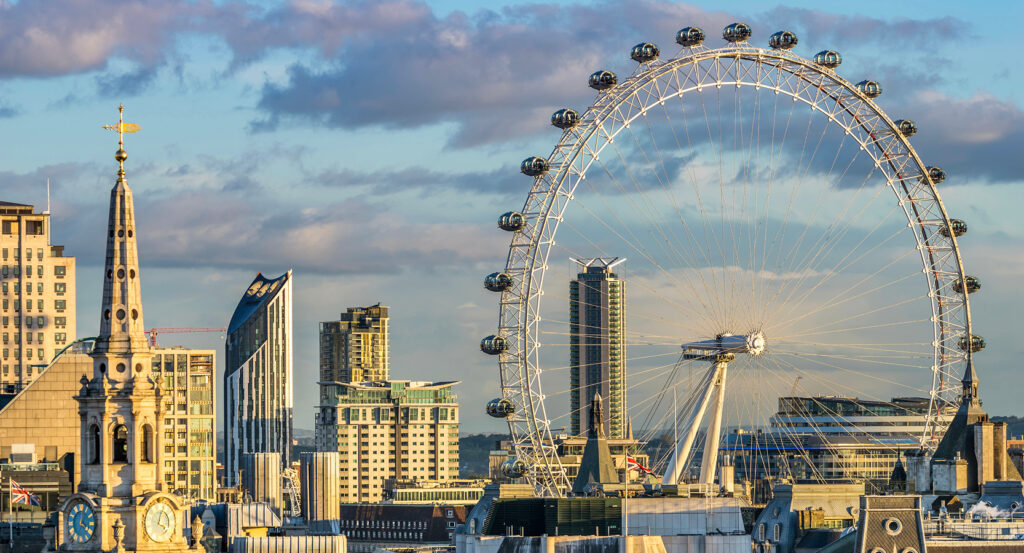
Set along the Queen's Walk near Belvedere Road and just steps from Jubilee Gardens, the wheel occupies the river edge opposite Westminster, with its circular frame rising from an asymmetric support structure that preserves broad sightlines across the water and surrounding skyline. Thirty-two sealed glass capsules travel around the outer circumference, placing passengers beyond the wheel's rim and maintaining outward views as the cabins remain level throughout their ascent and descent. Rotation establishes the primary encounter through gradual elevation, with a complete circuit taking 30 minutes and progressively exposing the spatial relationship between the Thames, Westminster and the dense urban fabric extending across Central London. The cantilevered configuration deepens that encounter through engineering that places the principal supports entirely on the landward side, leaving the wheel visually open toward the river and giving its immense diameter an unusual structural lightness. The result is an observation wheel where continuous motion, externally mounted capsules and an exceptionally exposed riverside position convert Central London's geography into a changing aerial panorama.
What defines London Eye.
London Eye is best known for emerging from David Marks and Julia Barfield's proposal for a millennium structure and becoming a permanent component of London's skyline after beginning as a temporary project. The architects developed the concept in 1993 for a competition organized by The Sunday Times and the Architecture Foundation seeking ideas to commemorate the approaching millennium, yet no competition entry was selected for construction. Marks and Barfield continued developing their wheel independently, establishing the London Eye Company and pursuing the project through a lengthy planning and financing process. Public support expanded after the Evening Standard promoted a Back the Wheel campaign, and British Airways subsequently provided major financial backing that moved the proposal toward realization. Planning permission treated the project as a temporary installation with an initial five-year life, preserving the possibility that the structure would later be dismantled and relocated. The completed wheel reached 135 metres, giving the millennium project a scale capable of changing London's skyline. Tony Blair ceremonially inaugurated the structure on 31 December 1999, but technical issues delayed passenger operation until March 2000. Its sustained popularity overturned the temporary premise behind the original consent, and subsequent approvals secured the wheel's long-term presence on the South Bank.
Construction transformed the conceptual simplicity of a giant wheel into an international engineering operation whose components and assembly demanded specialized techniques. Hollandia supplied the principal steelwork, Poma produced the passenger capsules, Jacobs served as engineer and Mace managed construction, distributing the project across firms with distinct structural and mechanical responsibilities. The rim was assembled horizontally on temporary platforms in the Thames, avoiding the difficulty of constructing the complete circular structure vertically beside the river. Steel cables connected the rim to the central hub through a tension system comparable in principle to an immense bicycle wheel, allowing slender spokes to carry loads without the heavy radial members associated with conventional observation wheels. Locked-coil cables reduced visual mass and wind exposure, and their engineered surface configuration helped control vortex shedding under changing weather conditions. Strand jacks then raised the assembled wheel from its horizontal position over the river toward vertical alignment in a carefully controlled lifting operation. The finished structure depended on the interaction between tensioned spokes, rim, hub, spindle, angled support legs and backstay cables, turning components of immense individual weight into a composition distinguished by visual slenderness. This engineering system established the technical character that separates the London Eye from traditional Ferris-wheel construction and allowed an exceptionally large rotating structure to stand on a constrained Central London riverbank.
How London Eye fits.
London Eye works as the anchor for a daytime exploration through three nearby institutions connecting seventeenth-century plant collecting, the professionalization of nursing and the creation of a national museum during the First World War.
Begin at Garden Museum, housed inside the former church of St. Mary-at-Lambeth, where Rosemary and John Nicholson established the institution in 1977 after campaigning to rescue the abandoned church from demolition. The site reaches deep into Lambeth's history: a church stood there by 1062, the surviving tower dates principally from 1377 and gardener and plant collector John Tradescant the Elder was buried in its churchyard in 1638. Tradescant had settled in Lambeth in 1629 and opened his collection of natural and human-made curiosities to paying members of the public; objects from the collection passed through Elias Ashmole and entered Oxford in 1683 as a foundation of the Ashmolean Museum. Continue to Florence Nightingale Museum, where a collection developed from objects assembled at St. Thomas' Hospital preserves the institutional consequences of Nightingale's reform of nursing. Nightingale helped establish the Nightingale Training School there in 1860 with an initial intake of fifteen probationer nurses, and Matron Dame Alicia Lloyd Still later assembled personal objects connected with Nightingale into a teaching collection known as the Nightingalia. Those holdings appeared in exhibitions marking the Crimean War centenary in 1954, the training school centenary in 1960 and Nightingale's 150th birthday in 1970 before transfer to the Florence Nightingale Museum Trust in 1983 and opening of the museum in 1989. Conclude at IWM London, whose institutional origin dates to 5 March 1917, when the War Cabinet approved creation of a National War Museum during the First World War before participation by Dominion governments prompted adoption of the Imperial War Museum name. George V opened the museum at Crystal Palace in 1920, the collections moved to South Kensington in 1924 and the institution reopened at its present Lambeth Road home on 7 July 1936 within the surviving central portion of the former Bethlem Royal Hospital. The museum closed between 1940 and 1946 after collections were moved away from London, and its remit expanded to encompass the Second World War, extending an institution created amid one conflict into a continuing center for preserving civilian and military experiences of modern warfare. The progression moves from the Tradescants' seventeenth-century culture of collecting through Nightingale's institutional reform of nurse education into a museum founded during global conflict, revealing Lambeth through three organizations that transformed specialized bodies of knowledge into permanent public collections.
Where your story begins.
Foresyte Travel reveals places that feel extraordinary long before you arrive.
Enjoy editorial crafted for luxury travelers.
Foresyte may earn a commission when you book.














































































































