
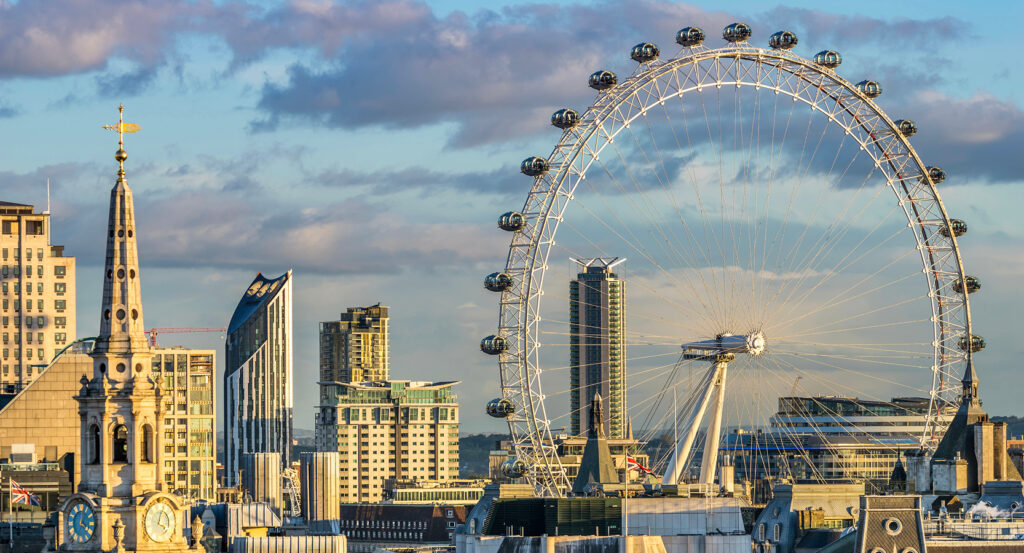
Why The Shard matters.
The Shard is a soaring glass tower where London Bridge's transport-driven character meets Renzo Piano's fractured architecture, extreme verticality and a public viewpoint suspended high above the Thames.
Set along London Bridge Street near St. Thomas Street and just steps from Joiner Street, the tower occupies a tightly constrained site directly above one of London's busiest transport interchanges, rising from dense railway infrastructure and historic Southwark streets into an exceptionally slender skyline presence. Eight inclined glass façades form separate shards that rise at different angles and heights, creating fractures between the planes and leaving the summit visually open as the structure narrows into a cluster of exposed glass forms. Vertical movement establishes the primary encounter as high-speed lifts transfer movement from the compressed streetscape through successive zones of the tower toward viewing levels hundreds of metres above London. The upper galleries introduce a distinct secondary mechanism through uninterrupted panoramas that reorganize the capital around the Thames, exposing the relationship between bridges, rail corridors, historic districts and distant metropolitan centers from a single elevated position. The result is a tower where fractured glass, extreme height, rapid vertical circulation and panoramic exposure convert one of London's densest transport sites into an architectural encounter with the geography of the entire city.
What defines The Shard.
The Shard is best known for Renzo Piano and developer Irvine Sellar's creation of a 309.6-metre tower conceived as a vertical city directly integrated with London Bridge's transport infrastructure. Sellar acquired the 1970s Southwark Towers office building in November 1998 after government policy began encouraging denser development around major transport hubs. Plans for a tower approaching 1,400 feet emerged in April 2000, followed by Sellar's meeting with Piano in Berlin that May, where the architect sketched the germ of the eventual design on the back of a restaurant menu. Piano developed the project around eight sloping glass planes whose form drew inspiration from London church spires and the ship masts visible in Canaletto's eighteenth-century paintings of the Thames. The proposed tower triggered an extended planning process and public inquiry before government approval arrived in November 2003. Financial conditions threatened the project after the global economic crash, but the State of Qatar entered the development as a partner in 2008, securing the capital required for construction. Demolition of Southwark Towers cleared the site, and work on the new structure advanced from 2009 through a building program that ultimately involved 1,450 workers representing 60 countries at its busiest point. The completed tower reached 95 storeys, with level 72 as its highest habitable floor, establishing a vertically stratified building containing offices, restaurants, a hotel, residences and public viewing galleries. Sheikh Hamad Bin Jassem Bin Jabor Al Thani, then Prime Minister and Minister of Foreign Affairs of Qatar, formally inaugurated The Shard on 5 July 2012, completing the twelve-year passage from Piano's Berlin sketch to the finished London skyline.
Engineering the tower on a constrained railway site produced a separate sequence of technical solutions that allowed construction to proceed simultaneously above and below ground. The project employed top-down construction for the first time on a British building of this scale, excavating basement levels as the concrete core rose upward and substantially compressing the construction program. One continuous foundation operation placed 5,400 cubic metres of concrete during a 36-hour period, requiring 700 truck deliveries arriving at intervals of three minutes. Eleven thousand glass panels subsequently enclosed the tower, covering an area equivalent to eight football pitches and forming a double-skin façade whose internal blinds respond automatically to changing light levels. Openings within the fractures between Piano's eight principal glass planes supply natural ventilation to winter gardens incorporated into the office floors. Thirty-six lifts connect the vertically separated uses, with some operating as double-deck units and the fastest travelling at six metres per second. The public galleries occupy the upper portion of the tower 240 metres above street level, placing the accessible summit below the exposed glass and steel spire. Structural and environmental systems serve the same architectural objective: concentrating a dense mixture of metropolitan functions upward without severing the tower from the rail and Underground interchange beneath it.
How The Shard fits.
The Shard works as the anchor for a daytime exploration through three nearby institutions connecting British fashion, museum-scale contemporary art and the preservation of a Royal Navy cruiser whose service extended from World War II into Korea.
Begin at Fashion and Textile Museum, founded by Dame Zandra Rhodes in 2003 to showcase British fashion design and housed in a purpose-designed building by Mexican architect Ricardo Legorreta. Rhodes integrated her design studio and residential accommodation into Legorreta's orange-and-pink composition, then assembled a collection focused on twentieth-century fashion and textiles; Newham College assumed operation in 2007, and the holdings now span work from 1947 onward by designers including Christian Dior, Balenciaga, Biba, Mary Quant and Vivienne Westwood, alongside a temporary exhibition program that has travelled internationally since 2010. Continue to White Cube Bermondsey, opened in 2011 inside a 1970s building redesigned by Casper Mueller Kneer as more than 5,440 square metres of interior gallery space. Three major exhibition areas include the 778-square-metre South Gallery II and the double-height, naturally illuminated 9x9x9 gallery, providing dimensions capable of supporting museum-scale projects; exhibitions by Anselm Kiefer, Mona Hatoum, Antony Gormley, Doris Salcedo, Theaster Gates and Ibrahim Mahama subsequently established the Bermondsey location as White Cube's principal London exhibition complex. Conclude at HMS Belfast, launched by Anne Chamberlain on 17 March 1938 and commissioned into the Royal Navy in August 1939 before a German magnetic mine removed the cruiser from service for three years. Belfast later escorted Arctic convoys, contributed to the December 1943 Battle of North Cape, supported Allied forces during the Normandy landings for five weeks and completed 404 days of active service during the Korean War; Rear Admiral Sir Morgan Morgan-Giles helped create the trust that saved the vessel from disposal, leading to its public opening in London on 21 October 1971 and transfer to Imperial War Museums in 1978. The progression moves from Rhodes and Legorreta's institution for fashion design through the immense exhibition volumes of White Cube Bermondsey into a preserved cruiser carrying the physical traces of Arctic, Normandy and Korean service, extending the surrounding district through design, contemporary art and twentieth-century naval engineering.
Where your story begins.
Foresyte Travel reveals places that feel extraordinary long before you arrive.
Enjoy editorial crafted for luxury travelers.
Foresyte may earn a commission when you book.














































































































