
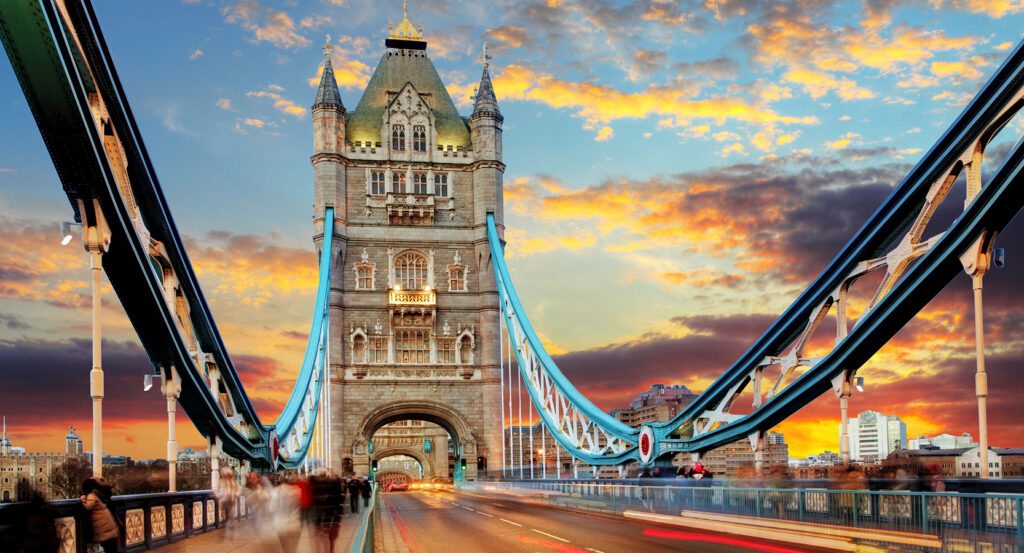
Why Tower Bridge matters.
Tower Bridge is a commanding movable bridge where Tower Hill's medieval riverfront character meets Victorian engineering, Gothic Revival architecture and a working bascule system built to reconcile road traffic with the commercial Thames.
Set across the River Thames near the Tower of London and just steps from the historic Pool of London, the bridge occupies the point where the City's eastern edge reaches toward Bermondsey and the former docklands beyond. Twin stone-clad towers rise above the roadway with steep roofs, turrets and battlemented parapets, framing a central opening whose two leaves divide cleanly above the river channel. Pedestrian movement continues through the towers and upper crossings, where elevated views extend west toward the City skyline and east along the Thames. Below, the roadway sits directly above the movable leaves, making the passage of vessels a visible interruption in the normal movement of pedestrians and traffic across the river. The result is a bridge whose architecture never conceals its engineering purpose, turning the competing demands of land transport and navigation into the defining encounter with London's eastern riverfront.
What defines Tower Bridge.
Tower Bridge is best known for solving a Victorian infrastructure problem created by the rapid expansion of East London without obstructing maritime access to the Pool of London. Pressure for another crossing downstream from London Bridge intensified during the nineteenth century, leading the City of London Corporation to establish the Special Bridge or Subway Committee in 1876 and solicit proposals for a workable solution. More than fifty schemes entered consideration before City Architect Sir Horace Jones joined civil engineer Sir John Wolfe Barry on the bascule proposal selected in 1884. Parliament authorized construction through the Tower Bridge Act the following year, and work began on April 22, 1886 with Barry as chief engineer, Henry Marc Brunel as assistant engineer and Edward Cruttwell as resident engineer. Jones died during the first phase of construction, leaving Barry to direct an undertaking involving five principal contractors and a daily workforce of 432. Foundations descended into the Thames through iron caissons, and more than 11,000 tons of steel formed the structural skeleton before Cornish granite and Portland stone enclosed the towers. Riveting teams drove more than 13 million heated rivets into the structure, binding the structural members into the enormous assembly required to carry both the suspended side spans and movable river crossing. The bascules underwent their first hydraulic movements in spring 1894, and the completed bridge formally opened on June 30 under the ownership of Bridge House Estates, now City Bridge Foundation.
Hydraulic power created a separate technical system that allowed the immense roadway to move with unusual speed for late Victorian infrastructure. The original machinery used coal-fired steam engines to drive pumps that forced water into six accumulators, storing pressure until a bridge lift released that energy into drive engines connected through cogs and racks to the movable leaves. Armstrong Mitchell & Co. supplied hydraulic machinery for the structure, and the preserved steam pumping equipment remains beneath the southern approach. Declining commercial traffic into the Upper Pool eventually reduced the number of lifts from more than six thousand during the bridge's first year to only a few hundred annually by the late 1960s. Modernization began in 1974 with electric pumps and oil hydraulics installed alongside the functioning steam plant so river operations continued during conversion. The new electro-hydraulic system became fully operational in 1976 and has powered the opening mechanism ever since, leaving the Victorian engines as preserved machinery rather than the source of motive power. A further shift occurred when the elevated pedestrian crossings, closed after low use in 1910, reopened as part of the Tower Bridge attraction in 1982 and later received glass-floor sections in 2014. Grade I designation protects both halves of the structure, joining the preserved Victorian machinery, working modern hydraulics and public upper crossings within a bridge that remains operational more than a century after its construction.
How Tower Bridge fits.
Tower Bridge works as the anchor for a Thames route through three nearby sites that move from Norman royal power through the deep religious history of the City's eastern edge and into a twentieth-century warship preserved in the Pool of London.
Begin at Tower of London, where William the Conqueror established the great stone keep after the Norman Conquest as both a defensive fortress and an architectural declaration of royal authority over the capital. Construction of the White Tower unfolded between 1078 and 1100 using Caen stone and English labour, and Henry III and Edward I later surrounded the Norman core with successive defensive walls and towers that developed the complex into England's strongest concentric castle. Royal apartments, the Royal Mint, armouries and a menagerie subsequently accumulated within the fortress, giving the site functions extending far beyond imprisonment and execution. Continue to All Hallows-by-the-Tower, founded by Barking Abbey in 675 and established centuries before the neighbouring royal fortress. The church escaped destruction during the Great Fire of 1666, though bombing during the Second World War heavily damaged a structure whose surviving fabric includes fifteenth-century work; its undercroft preserves fragments of Saxon crosses and a Roman pavement discovered in 1926, extending the site's archaeological history deep beneath the medieval church. A stone altar associated with the Knights Templar and Mount Athlit and a collection of medieval brasses add further layers to a parish church positioned at the eastern threshold of the historic City. Conclude aboard HMS Belfast, launched on St. Patrick's Day in 1938 and commissioned into the Royal Navy shortly before Britain entered the Second World War. A magnetic mine disabled the cruiser early in the conflict, but its return to service led through Arctic convoy duty and the Battle of North Cape to the bombardment supporting the Normandy landings; subsequent deployment during the Korean War added another major combat chapter. The Belfast Trust rescued the ship from disposal and opened it to the public on the Thames in 1971, and Imperial War Museums assumed ownership seven years later, preserving the cruiser within sight of the Victorian crossing upstream. The progression moves from Tower of London's Norman assertion of royal power through All Hallows-by-the-Tower's accumulation of Roman, Saxon and medieval history into HMS Belfast's preserved twentieth-century naval fabric, placing Tower Bridge at the chronological center of a riverfront shaped by nearly a millennium of London history.
Where your story begins.
Foresyte Travel reveals places that feel extraordinary long before you arrive.
Enjoy editorial crafted for luxury travelers.
Foresyte may earn a commission when you book.














































































































