
Why Ninomaru Garden matters.
Ninomaru Garden at Nijō Castle is where Kyoto's power learned how to breathe.
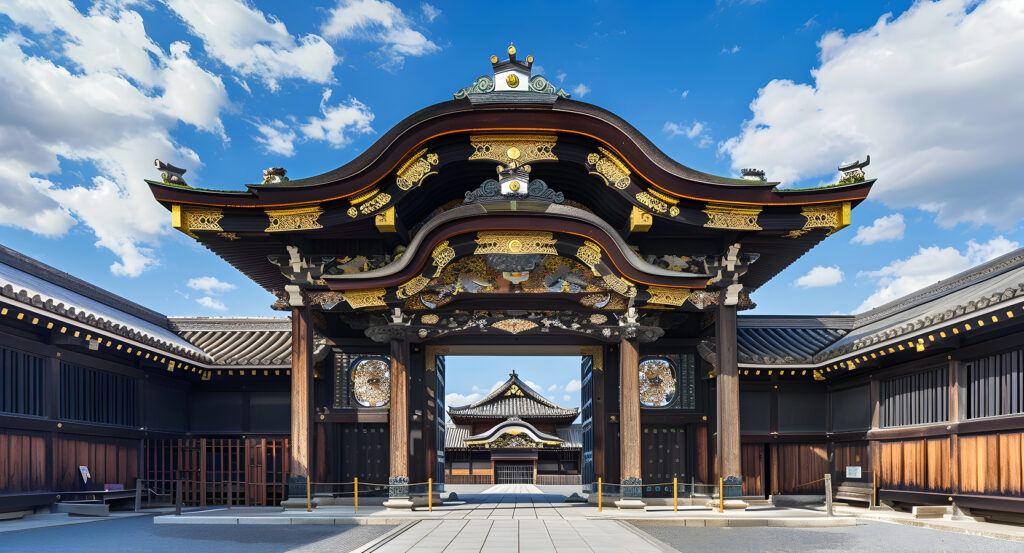
Amid the stone walls and gilded halls, the gardens unfold as a counterpoint, nature's answer to authority, softening the fortress with stillness and grace. Here, beauty is strategy, and every rock, pine, and ripple of water feels intentional. The layout guides your gaze as surely as the shogun once guided his empire, deliberate, fluid, and calm. Step through the Ninomaru Gate, and you enter a landscape designed not for battle, but for balance. Ponds reflect tiled roofs and drifting clouds; stepping stones curve like brushstrokes; and the faint scent of moss lingers in the air like memory. This is where Kyoto's dual nature, discipline and delicacy, finds its perfect harmony. In the golden light of morning or the hush of late afternoon, the gardens hold the same quiet authority as the castle walls: unspoken, unshakable, and profoundly human.
What defines the Nijō Castle Gardens.
Ninomaru Garden was not an afterthought, they were the castle's soul made visible.
Ninomaru Garden, designed in the early 17th century by the renowned tea master and landscape architect Kobori Enshū, remains one of Japan's most refined examples of shoin-zukuri garden design. It captures shakkei, “borrowed scenery”, by framing the distant Higashiyama mountains beyond the castle walls. The composition centers around three islands representing Horai (immortality), Turtle, and Crane, floating within a reflective pond bordered by carefully placed stones. Each element symbolizes longevity, wisdom, and peace, virtues the Tokugawa shoguns wished to project to the imperial court. The Honmaru Garden, later reimagined in the Meiji era by Ogawa Jihei VII, transformed the inner circle into a gentler vision of renewal, fusing imperial aesthetics with Zen-inspired restraint. Together, these gardens chart Japan's passage from feudal command to cultural contemplation. Few visitors realize that Kobori Enshū's original layout also served psychological ends, designed to calm and impress diplomatic guests as they approached the Ninomaru Palace. The sound of water, the sightlines across stone and sky, and the subtle curvature of paths all worked as instruments of persuasion, a landscape that governed. Today, their composition remains unchanged, a rare instance of both political and poetic perfection surviving untouched by time.
How the Nijō Castle Gardens fits.
Ninomaru Garden at Nijō Castle rewards patience more than planning.
Begin your visit after exploring the Ninomaru Palace, when your senses are already tuned to stillness. Step out through the sliding doors into sunlight, and let your pace slow to match the rhythm of the garden. Follow the paths circling the pond, pausing at each bend to notice how the reflections change, clouds drifting, carp gliding, pine needles trembling in the breeze. Each viewpoint feels composed, as if the earth itself were painted. Cross the bridges linking the symbolic islands, and listen for the faint rustle of leaves against stone. Continue on toward the Honmaru Garden, where the geometry loosens and the mood softens; it feels less like a stage for power, more like an exhale after centuries of ceremony. If you can, return near sunset, the low light gilds the water and sets the castle's white walls aglow, while the pines deepen to ink. From the elevated walkway above the moat, the full sweep of the gardens becomes clear, a discussion between symmetry and surrender, crafted in rock, water, and air. Ninomaru Garden at Nijō Castle isn't simply part of the complex; they are its philosophy made tangible. Here, Kyoto reveals its oldest truth: even power, when placed in harmony, becomes peace.
Where your story begins.
Foresyte Travel reveals places that feel extraordinary long before you arrive.
Enjoy editorial crafted for luxury travelers.
Foresyte may earn a commission when you book.

















































































































