
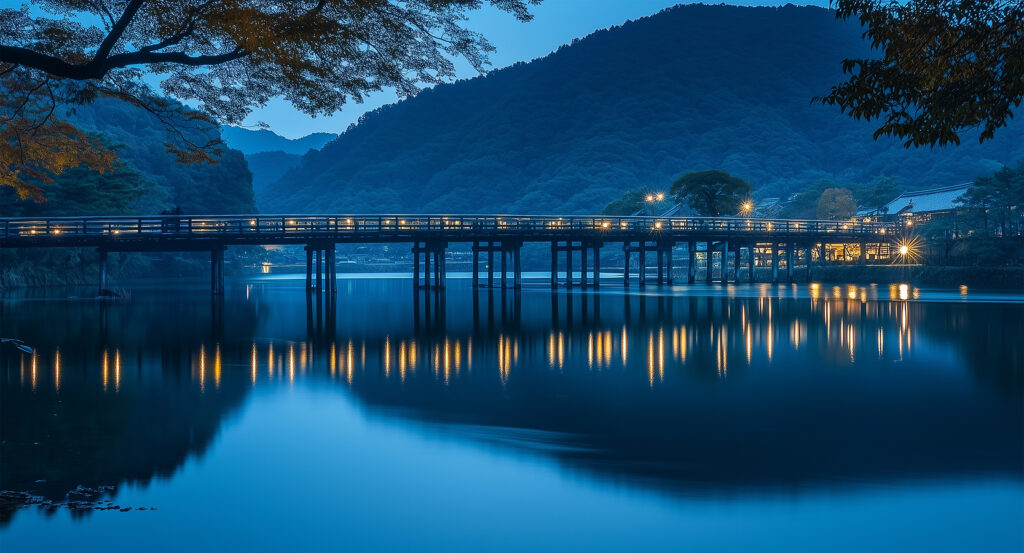
Why Togetsukyō Bridge matters.
Togetsukyō Bridge in Kyoto is a timeless passage between nature, history, and poetry.
Stretching gracefully across the Katsura River in the Arashiyama district, its name means “Moon-Crossing Bridge,” a title bestowed centuries ago when Emperor Kameyama remarked that the moon seemed to glide across its surface. Today, that same quiet magic still lingers. The bridge, first built during the Heian period and later reconstructed in the 1930s, stands as one of Kyoto's most photographed landmarks, a harmony of wood and stone that feels at once eternal and ephemeral. Standing upon it, you're surrounded by the rhythm of Kyoto's seasons: cherry blossoms that blush the air pink in spring, maple leaves that blaze crimson in autumn, and snow-capped mountains that cradle the horizon in winter. Beneath the bridge, the river moves with a meditative calm, dotted with traditional boats drifting beneath its span. Around you, the soft hum of life in Arashiyama unfolds, the distant ring of temple bells, the laughter of visitors, and the gentle clip-clop of rickshaws along the riverbank. The Togetsukyo Bridge isn't just a scenic viewpoint; it's Kyoto distilled into a single experience, beauty, balance, and the quiet passage of time flowing endlessly onward.
What defines Togetsukyō Bridge.
The story of Togetsukyō Bridge is woven from centuries of craftsmanship, resilience, and symbolism.
Originally constructed in the 9th century, the bridge has been rebuilt multiple times due to floods and natural wear, yet it has always returned, embodying the Japanese spirit of ganbaru, persistence through impermanence. The iteration, built in 1934, retains the traditional aesthetic of cypress wood decking supported by reinforced concrete, blending old-world elegance with modern strength. Each design element carries intention: the bridge's subtle curvature mirrors the surrounding mountains, while its unadorned form reflects the Zen ideals of simplicity and restraint. The Katsura River it spans once served as a vital trade route for transporting timber and rice during the Edo period, linking Kyoto to Japan's western provinces. Beyond its practical role, Togetsukyō Bridge has long held deep cultural resonance. It appears in countless ukiyo-e prints, haiku, and films, symbolizing the transient beauty of nature and the flow of life itself. The bridge's proximity to Tenryu-ji Temple, a UNESCO World Heritage site, adds to its spiritual aura. Monks have long walked this path at sunrise, meditating on the river's reflection as a metaphor for enlightenment. Even today, the bridge serves as a gathering point for festivals like Hanatouro, when lanterns illuminate the Arashiyama night in a performance of light and shadow. To walk across Togetsukyō is to step not just through space, but through centuries of artistry, faith, and enduring grace.
How Togetsukyō Bridge fits.
Experiencing Togetsukyō Bridge in Kyoto is best done slowly, not as a photo stop, but as a moment of connection.
Arrive early in the morning, when mist drifts along the river and the crowds have yet to stir. Begin your walk from the northern bank, facing the Arashiyama mountains as the light rises over their slopes. The view from the center of the bridge is nothing short of breathtaking, reflections ripple below, and in every direction, Kyoto reveals its quiet grandeur. Continue toward the southern bank, where small teahouses and souvenir shops invite you to linger. A short stroll brings you to the entrance of Tenryu-ji Temple, whose Zen gardens echo the same harmony that defines the bridge. From there, wander into the famous Arashiyama Bamboo Grove, just ten minutes away, where the whispering bamboo feels like a continuation of the bridge's serenity. If visiting in spring, time your visit for the cherry blossom bloom when the banks of the Katsura River turn into a living canvas of pink and white. Autumn, however, is when the scene reaches its full poetic peak: the surrounding hills ignite with crimson and gold, mirrored perfectly in the water below. For a deeper perspective, take a short boat ride from the nearby pier at sunset, as the sky burns orange and the bridge glows softly against the fading light, it becomes clear why Kyoto has guarded this view for over a millennium. Togetsukyō Bridge isn't just a landmark; it's a living poem, a place where beauty endures, even as everything else drifts gently by.
Where your story begins.
Foresyte Travel reveals places that feel extraordinary long before you arrive.
Enjoy editorial crafted for luxury travelers.
Foresyte may earn a commission when you book.

















































































































