
Why Ryōan-ji matters.
Ryōan-ji in Kyoto is silence made visible, a temple where stillness becomes an art form, and the mind learns to listen to stone and sand.
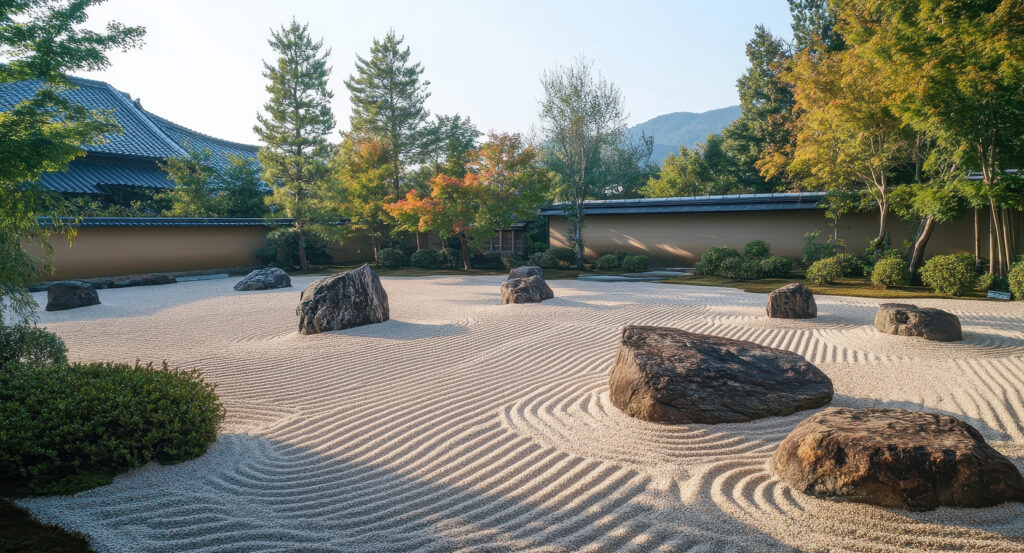
Tucked into the wooded foothills of northwestern Kyoto, this Zen sanctuary radiates a purity so complete that even the breeze seems to move in reverence. Founded in the late 15th century as a temple of the Rinzai Zen sect, Ryōan-ji is most famous for its karesansui, or dry rock garden, a masterpiece of abstraction that has captivated monks, poets, and philosophers for centuries. The garden, deceptively simple, consists of fifteen stones arranged across a bed of perfectly raked white gravel, enclosed by earthen walls stained with the patina of time. Yet no matter where you sit, only fourteen stones are visible, a mystery that invites meditation on perspective and imperfection. The effect is immediate: thoughts slow, breath deepens, and you find yourself gazing not at the garden, but into it, or perhaps, into yourself. Beyond the garden's hush, the temple grounds stretch wide, surrounded by moss-covered paths, bamboo groves, and mirror-like ponds once belonging to an aristocrat's estate. The Kyoyochi Pond, fringed with reeds and maples, reflects the sky so purely it seems to breathe. To walk here is to drift through centuries of contemplation, carried by the rhythm of rustling leaves and distant temple bells.
What defines Ryōan-ji.
Ryōan-ji's famous rock garden is among the most analyzed and misunderstood artworks in the world, yet its mystery is precisely what gives it power.
Created during the Muromachi period (1500), the garden's origins remain uncertain. Some scholars believe it was designed by the painter and monk Sōami, while others attribute it to anonymous temple gardeners who sought to manifest the principles of Zen through form and emptiness. The arrangement of stones has been interpreted in countless ways, as islands floating in a sea, tigers crossing water with their cubs, or mountains rising through clouds. Yet Zen masters insist the garden's true meaning lies beyond representation: it is meant to dissolve meaning altogether, to become a mirror for the observer's mind. The enclosing clay wall, darkened by age and oil, creates an intimacy that focuses the gaze inward, while the gentle asymmetry of the composition expresses wabi-sabi, beauty in impermanence and imperfection. Few realize that Ryōan-ji once served as the estate of the Fujiwara family before becoming a temple in 1450. Fires and wars destroyed much of the original complex, but each restoration honored the temple's spirit of restraint. Today, Ryōan-ji remains one of Kyoto's most profound expressions of Zen, less a monument than a living meditation. Even the raked gravel, maintained daily by monks with silent devotion, becomes part of a ritual that transcends centuries.
How Ryōan-ji fits.
Visiting Ryōan-ji is not about sightseeing, it's about stillness, patience, and presence.
Arrive in the early morning, when the air is cool and the garden lies untouched by footsteps. Enter the Hojo, the temple's main hall, and remove your shoes before stepping onto the wooden veranda that faces the rock garden. Sit cross-legged and allow your gaze to soften, tracing the subtle lines of the raked gravel, each curve and ripple an echo of the monk's breath who shaped it that morning. Don't rush to interpret; simply observe the balance between stone, space, and silence. The longer you sit, the more the garden shifts, its minimalism revealing layers of meaning that words cannot hold. Afterward, wander through the surrounding temple grounds, following mossy paths that circle Kyoyochi Pond. In spring, cherry blossoms scatter across its surface like pale confetti; in autumn, fiery maples frame the reflection of temple eaves. Pause at the tsukubai, a stone water basin inscribed with Zen characters meaning, “I learn only to be content.” Dip your fingers into the cool water and let its simplicity speak. Before leaving, visit the small teahouse nearby, where you can savor a bowl of matcha and feel the quiet linger a little longer. Pair your visit with nearby Kinkaku-ji, just a short walk away, to experience Kyoto's twin expressions of enlightenment, one radiant, one austere. Ryōan-ji is more than a temple, it's an encounter with the essence of Zen itself. To sit before its stones is to touch eternity, not through grandeur, but through emptiness. In its silence, the mind finds its truest sound.
Where your story begins.
Foresyte Travel reveals places that feel extraordinary long before you arrive.
Enjoy editorial crafted for luxury travelers.
Foresyte may earn a commission when you book.

















































































































