Why Ann W. Richards Congress Avenue Bat Bridge matters.
Ann W. Richards Congress Avenue Bat Bridge is a celebrated wildlife attraction where Downtown's riverfront character meets one of the world's largest urban bat colonies, an influential conservation success and the striking seasonal emergence of Mexican free-tailed bats above Lady Bird Lake.
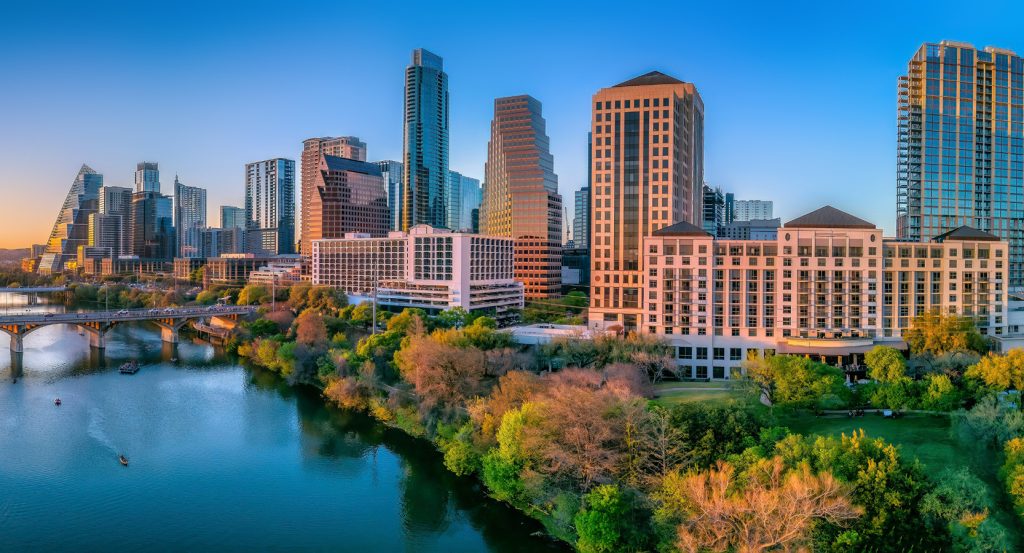
Spanning Lady Bird Lake along Congress Avenue between Downtown and South Congress, the historic concrete bridge connects the city's central business district with its southern neighborhoods, crossing the Colorado River corridor amid waterfront trails, landscaped parkland and prominent views of Austin's skyline. Its broad roadway rests upon a succession of concrete arches, with substantial piers supporting the structure above the water. Pedestrian sidewalks extend along both sides, providing elevated views across the lake and the surrounding waterfront. Beneath the bridge, narrow expansion joints and sheltered concrete cavities create the protected roosting conditions that support its celebrated bat population. The result is a distinctive intersection of historic infrastructure, urban ecology and public recreation that has become one of Austin's most recognizable natural attractions.
What defines Ann W. Richards Congress Avenue Bat Bridge.
Ann W. Richards Congress Avenue Bat Bridge is best known for sheltering a seasonal colony of Mexican free-tailed bats whose evening emergence transforms the downtown waterfront into one of North America's most celebrated urban wildlife spectacles. The crossing originated during Austin's nineteenth-century development, when successive pontoon, wooden and iron bridges connected the commercial center with settlements south of the Colorado River. The present concrete structure opened in 1910, establishing a substantial permanent crossing along the city's principal north-south thoroughfare. Its 910-foot span incorporated a series of concrete arches designed to accommodate transportation across the river. A major rehabilitation completed in 1980 introduced structural modifications that unexpectedly transformed the bridge's ecological importance. Engineers incorporated concrete box beams separated by narrow expansion joints, creating deep cavities that maintained warm, protected conditions suitable for roosting bats. Mexican free-tailed bats began occupying these spaces in substantial numbers during the early 1980s, establishing a maternity colony within the bridge's underside. The growing population initially provoked public concern, with residents expressing fears about disease, safety and the consequences of concentrating hundreds of thousands of bats near downtown. Conservationist Merlin Tuttle relocated Bat Conservation International to Austin in 1986 and organized an extensive public education campaign explaining bat behavior and ecological benefits. The organization worked with civic officials, scientists and community representatives to protect the colony and develop greater public understanding of its importance. Public attitudes gradually changed as the bats became associated with Austin's environmental culture and the city's expanding outdoor recreation traditions. The Austin City Council renamed the crossing in 2006 to honor Ann Richards, the former Texas governor whose political career included service as a Travis County commissioner. The bridge subsequently became an internationally recognized example of urban wildlife conservation, demonstrating how ordinary transportation infrastructure can support a substantial migratory animal population.
Tadarida brasiliensis, commonly called the Mexican free-tailed bat, is a migratory insectivorous species distinguished by its narrow wings, rapid flight and extraordinary ability to exploit aerial insect populations. The Austin colony consists predominantly of females during the spring breeding season, establishing one of the largest urban maternity roosts in the world. Pregnant bats arrive during the warmer months and give birth to pups that remain sheltered inside the bridge until they develop the ability to fly. Colony estimates reach 1.5 million bats during the summer, with 750,000 young raised during the reproductive season. The animals occupy expansion joints measuring three-quarters of an inch to one and one-half inches across, extending deep into the concrete superstructure. These confined spaces provide protection against predators and maintain temperatures favorable for the development of young bats. At dusk, the colony begins its nightly emergence, with successive streams of animals departing beneath the bridge and forming long, dark formations above the water. The bats disperse across surrounding landscapes to hunt moths, beetles and other flying insects, contributing substantial natural pest control to Central Texas ecosystems. Their movements follow seasonal migration patterns connecting Texas with wintering areas farther south in Mexico. The colony's reproductive cycle produces particularly substantial evening flights during late summer, when newly independent juveniles join adult bats in the nightly departure. Emergence timing varies with temperature, rainfall, seasonal conditions and the availability of insects, creating a changing natural performance across the warmer months. The southeastern lakeshore accommodates a dedicated observation area where educational displays introduce the colony's biology and conservation history. Evening gatherings along the bridge and adjoining waterfront have established bat watching as a distinctive Austin tradition, connecting public recreation with the preservation of native wildlife.
How Ann W. Richards Congress Avenue Bat Bridge fits.
Ann W. Richards Congress Avenue Bat Bridge works as the natural anchor for a Central Austin outing connecting the city's waterfront recreation, its celebrated public art and the landscaped civic spaces that define the southern edge of downtown.
Begin at Auditorium Shores, the expansive waterfront park occupying the southern bank of Lady Bird Lake. Its broad lawns extend between Riverside Drive and the water, providing substantial views of Downtown's skyline. The park has served as a major gathering place for concerts, festivals and outdoor recreation, contributing to the city's longstanding association with public music events. The Stevie Ray Vaughan Memorial honors the influential Austin blues guitarist through a bronze sculpture positioned near the waterfront. Its open landscape and adjoining pathways establish a direct connection between Austin's musical heritage and the recreational character of its central lakefront. Continue to Long Center for the Performing Arts, the major cultural institution overlooking the waterfront from the former Palmer Auditorium site. The performing arts complex opened in 2008 and incorporates architectural elements preserved from its predecessor, including a distinctive circular terrace and structural components associated with the earlier building. Its principal performance spaces accommodate opera, ballet, orchestral concerts and theatrical productions. The expansive exterior terrace provides commanding views across the water toward downtown's commercial towers. Its cultural programming contributes to Austin's established performing arts community through major productions and public events. Conclude at Lady Bird Lake Hike-and-Bike Trail, the extensive recreational pathway encircling the central reservoir. The trail extends ten miles through interconnected parkland, waterfront landscapes and established urban neighborhoods. Its paved and natural-surface sections accommodate walking, running and cycling beneath mature trees and along carefully maintained shoreline corridors. Pedestrian bridges and lakeside pathways connect prominent public spaces across the northern and southern banks. The trail's relationship with the Colorado River establishes one of Austin's most important continuous recreational landscapes. The progression moves from Auditorium Shores' open waterfront grounds through Long Center for the Performing Arts' cultural facilities and culminates along Lady Bird Lake Hike-and-Bike Trail, connecting three defining dimensions of Austin's recreational and artistic development.
Where your story begins.
Foresyte Travel reveals places that feel extraordinary long before you arrive.
Enjoy editorial crafted for luxury travelers.
Foresyte may earn a commission when you book.