
Why Coronado matters.
Coronado is a historic coastal community where San Diego Bay's maritime geography meets the architectural ambitions of California's nineteenth-century resort development, the foundations of American naval aviation and a distinctive tradition of seaside residential life.
Situated across San Diego Bay from Downtown, the peninsula occupies a narrow coastal landscape between the Pacific Ocean and the sheltered waters of the harbor, with the Silver Strand extending south toward Imperial Beach and the mainland. Orange Avenue forms its principal commercial corridor, connecting the bayfront with the ocean through a sequence of landscaped blocks, independent businesses and historic civic buildings. Residential streets extend toward broad sandy beaches, their mature trees and garden setbacks preserving the proportions of the original town plan. The San Diego-Coronado Bridge provides a sweeping eastern approach, and the western shoreline opens toward Point Loma across the entrance to San Diego Bay. The result is a compact coastal city whose geographic separation, planned streets and enduring architectural character distinguish it within metropolitan San Diego.
What defines Coronado.
Coronado is best known for its transformation from a sparsely settled coastal peninsula into one of Southern California's earliest planned resort communities, followed by its development into a major center of American naval aviation. The Kumeyaay inhabited the region for generations before American settlement, maintaining fishing communities and gathering resources along the shoreline. The area's nineteenth-century development accelerated as San Diego's commercial expansion and railroad connections attracted investors to the surrounding coast. In November 1885, Elisha Spurr Babcock Jr., Hampton L. Story and their associates purchased 4,000 acres encompassing Coronado and North Island for $110,000. The investors organized the Coronado Beach Company in April 1886, establishing the corporate structure through which they would subdivide the property and construct the infrastructure necessary for a resort settlement. Their plans required substantial investment in transportation, water distribution, electricity and public amenities, creating a coordinated development whose commercial success depended upon attracting both permanent residents and seasonal travelers. The San Diego and Coronado Ferry Company began operations that August, establishing the principal transportation connection across the harbor. A widely publicized land auction attracted thousands of prospective purchasers, and the sale of residential parcels helped finance the community's early construction. Coronado incorporated in December 1890, formalizing its municipal government during a period of rapid regional expansion. Sugar magnate John D. Spreckels subsequently consolidated control of the development company's holdings, extending his influence across the community's transportation services, utilities and recreational infrastructure. His investments supported a growing seasonal population and strengthened the economic relationship between the resort community and San Diego. North Island acquired a separate importance during the early twentieth century as aviation experiments introduced military flying operations to the peninsula. Naval aviator Theodore G. Ellyson began training there in 1911, connecting the site with the formative years of American naval aviation. The Navy commissioned Naval Air Station North Island in 1917, establishing a permanent military presence that would become central to Coronado's economy and institutional character. The filling of the Spanish Bight during the twentieth century joined North Island more completely to the developed peninsula, altering its original coastal geography. The opening of the San Diego-Coronado Bridge in 1969 fundamentally changed regional access, replacing the ferry's historic transportation monopoly with a direct highway connection. Coronado's subsequent development has balanced its military institutions, historic residential districts and visitor economy within the constraints of a geographically limited coastal setting.
Coronado's physical character develops through the relationship between its carefully planned nineteenth-century streets, its residential architecture and the contrasting environments of the Pacific shoreline and San Diego Bay. Orange Avenue establishes the principal organizing axis, with a landscaped median and a succession of small commercial buildings creating a recognizable civic center. The surrounding residential blocks preserve examples of Queen Anne, Craftsman, Mission Revival and Spanish Colonial Revival architecture, recording changes in domestic design across successive periods of the city's development. Broad verandas, projecting bays and ornamental woodwork distinguish surviving Victorian residences, whose construction responded to the expectations of prosperous seasonal households. Craftsman bungalows introduced lower rooflines, substantial porch supports and an emphasis on natural materials during the early twentieth century. Spanish Colonial Revival houses subsequently incorporated stucco walls, red-tiled roofs, enclosed courtyards and arched openings, adapting regional architectural conventions to the city's residential landscape. The generous street planting softens these architectural transitions, with mature trees creating shaded pedestrian routes between residential districts and commercial areas. Coronado's western beaches introduce a different physical environment through extensive stretches of pale sand, low coastal development and unobstructed views across the Pacific. The shoreline's unusually broad profile provides space for walking and recreation, and the presence of mica within the sand contributes to its characteristic shine in direct sunlight. The eastern waterfront follows a more sheltered geography, with marina facilities, public promenades and views toward the Downtown skyline. Glorietta Bay introduces a smaller protected harbor whose calm waters support sailing and other recreational activities. Farther south, the Silver Strand forms a narrow connection between ocean and bay, incorporating coastal dunes, recreational beaches and extensive areas associated with military operations. This geography produces a pronounced contrast between the open Pacific coast and the protected harbor, allowing distinct maritime activities to develop within a relatively small area. Coronado's civic landscape also retains the influence of early resort planning through neighborhood parks, public gathering spaces and a street network designed around pedestrian access. Its architectural character emerges through the preservation of domestic scale, the integration of planted public spaces and the close relationship between residential neighborhoods and the surrounding water.
How Coronado fits.
Coronado works as a coastal destination for an itinerary connecting California's Victorian resort architecture, the preservation of local maritime history and the waterfront transportation networks that shaped San Diego Bay's development.
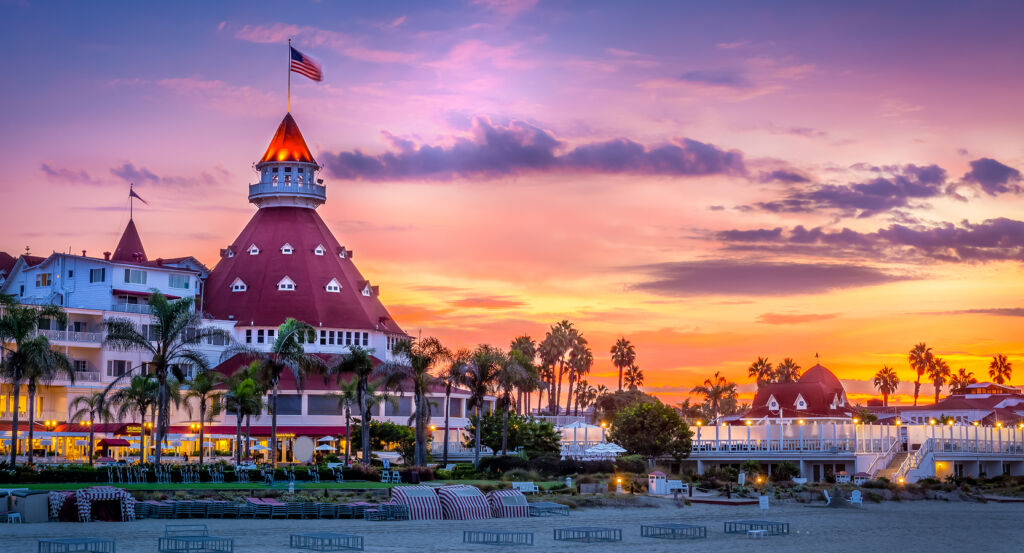
Begin at Hotel del Coronado, the oceanfront resort opened in 1888 under the direction of developers Elisha Babcock Jr. and Hampton Story. Architects James and Merritt Reid developed its distinctive Queen Anne composition, incorporating expansive wooden verandas, projecting gables and the conical red-roofed turret that became a defining feature of the property. Construction required extensive logistical coordination, with materials, skilled workers and industrial equipment brought to a relatively undeveloped coastal site. The resort became associated with prominent political figures, entertainers and wealthy travelers during California's emergence as a national leisure destination. Its designation as a National Historic Landmark in 1977 recognized the architectural and historical significance of the surviving Victorian complex. Continue to Coronado Historical Association and Coronado Museum, whose collections preserve the development of the community through photographs, documents, household objects and material associated with its civic institutions. The association's historical work connects the experiences of early residents with the commercial investments, military developments and architectural changes that shaped the peninsula. Exhibitions examine the evolution of transportation, residential settlement and community life, providing context for the surviving buildings encountered along the surrounding streets. Its location on Orange Avenue places the institution within the commercial district whose development accompanied the community's original subdivision. The museum provides a concentrated account of the people and institutions behind Coronado's physical character. Conclude at Coronado Ferry Landing, the bayfront district overlooking San Diego's downtown waterfront. The original ferry connection began in 1886, establishing the essential link between the developing resort community and the mainland's commercial center. Passenger vessels carried residents, workers, building materials and recreational travelers across the harbor, sustaining Coronado's growth before the construction of a permanent highway crossing. The waterfront subsequently developed into a public destination incorporating pedestrian promenades, shops and dining establishments. Its open views encompass the downtown skyline, harbor traffic and the bridge extending across the southeastern bay. The progression moves from the architectural ambitions of California's resort era through the preservation of Coronado's local history and culminates at the waterfront transportation connection that made the community's early development possible.
Where your story begins.
Foresyte Travel reveals places that feel extraordinary long before you arrive.
Enjoy editorial crafted for luxury travelers.
Foresyte may earn a commission when you book.





































































































