
Why La Jolla Cove matters.
La Jolla Cove is a protected marine sanctuary where La Jolla's sculpted sandstone coastline meets the ecological richness of the Pacific Ocean, the scientific legacy of Scripps Institution of Oceanography and the coastal conservation movement that transformed San Diego's relationship with its marine environment.
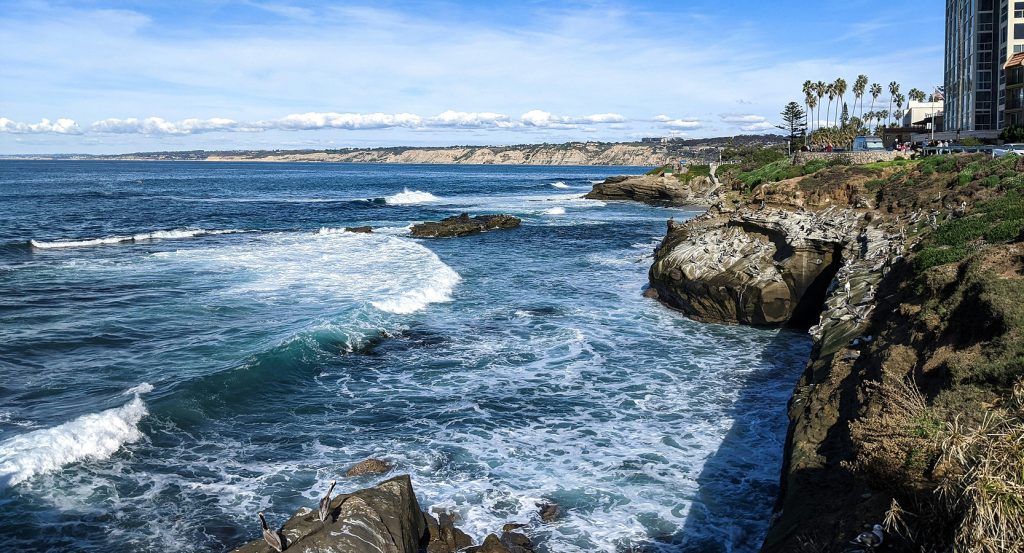
Set beneath Coast Boulevard near the intersection with Girard Avenue and just steps from Ellen Browning Scripps Park, the small crescent-shaped beach occupies a sheltered indentation along La Jolla's northern shoreline, enclosed by sandstone headlands and overlooking the protected waters of the Pacific. Steep stairways descend from the landscaped bluff to a narrow stretch of sand, where wave-cut rock formations and shallow underwater ledges create a distinctive transition between the terrestrial landscape and the marine environment. The surrounding cliffs contain layered sedimentary formations, eroded recesses and natural observation points that reveal the geological processes responsible for shaping this section of the Southern California coast. Above the beach, mature coastal trees, broad lawns and pedestrian overlooks establish a continuous public landscape overlooking the water, with views extending toward the sea caves and the open Pacific horizon. The result is a compact coastal environment whose geological formations, protected marine habitats and relationship with La Jolla's historic public parkland create one of Southern California's most distinctive natural landmarks.
What defines La Jolla Cove.
La Jolla Cove is best known for its exceptionally rich marine environment and its central role in the development of coastal recreation, oceanographic research and marine conservation along the San Diego shoreline. The coastal landscape formed through the erosion of sedimentary rock, with waves progressively shaping the sandstone cliffs, submerged reefs and protected embayment that characterize the present shoreline. Kumeyaay communities occupied the surrounding coastal region for thousands of years, harvesting marine resources from the intertidal environment and maintaining an extensive relationship with the ecosystems of the Pacific coast. During the nineteenth century, La Jolla developed into a small seaside settlement whose sheltered beaches and unusual rock formations attracted visitors from the expanding city of San Diego. The area's first formal subdivision, La Jolla Park, was established in 1887, incorporating public coastal land intended to preserve access to the shoreline. The arrival of improved transportation connections during the 1890s encouraged recreational development, with early bathhouses and seaside accommodations establishing the Cove as a destination for swimming and coastal excursions. In 1894, a bathhouse was constructed near the Cove, introducing facilities that supported the growth of organized beach recreation during La Jolla's early resort period. The development of the surrounding community attracted influential residents, including philanthropist Ellen Browning Scripps, whose investments in public institutions and coastal preservation helped shape the area's civic landscape. The parkland overlooking the Cove received her name on October 18, 1927, commemorating her ninety-first birthday and her contributions to La Jolla's development. During the early twentieth century, swimming, diving and ocean exploration became increasingly important recreational activities along the shoreline, bringing greater attention to the diversity of marine life beneath the surface. Scientific interest in the surrounding coastal waters developed alongside the expansion of Scripps Institution of Oceanography, whose researchers investigated the physical and biological characteristics of the Southern California marine environment. The growing relationship between recreation and scientific investigation established the conditions for a major transformation in the protection of La Jolla's underwater ecosystems.
The San Diego-La Jolla Underwater Park emerged from a conservation movement seeking to protect marine habitats from overfishing and the depletion of vulnerable species along the coast. The state of California established an early marine life refuge near Scripps Institution of Oceanography in 1929, creating one of the state's first protected coastal environments. Additional protections followed in 1957 with the establishment of the San Diego Marine Life Refuge, extending the conservation structure governing the surrounding waters. During the 1960s, divers and marine scientists became increasingly concerned about declining populations of abalone, giant sea bass and other species affected by intensive harvesting. Harold F. Riley of the San Diego Council of Divers joined researchers including Conrad Limbaugh and Jim Stewart in advocating for a protected underwater park that would preserve the area's biological resources. Their efforts culminated in the establishment of the San Diego-La Jolla Underwater Park in 1970, creating a substantial marine conservation area extending offshore from the La Jolla coastline. The adjoining ecological reserve introduced restrictions on the removal of marine organisms, establishing an important precedent for the management of protected marine environments in California. Subsequent boundary adjustments brought the Cove more fully into the conservation system, strengthening protections for the submerged reefs and rocky habitats surrounding the beach. California's Marine Life Protection Act of 1999 subsequently established the structure for a statewide network of marine protected areas, leading to the designation of the Matlahuayl State Marine Reserve and adjoining conservation areas along the La Jolla coastline. These protections preserve an exceptionally diverse underwater environment containing giant kelp, garibaldi, California sheephead, leopard sharks, bat rays, octopuses and numerous species of reef fish. Seasonal oceanographic conditions influence water clarity, currents and the movement of marine wildlife, creating an environment whose ecological character changes throughout the year. California sea lions frequently occupy the nearby rocky shoreline, contributing to the Cove's importance as a location for observing marine mammals in their natural coastal habitat. The protected waters also support snorkeling, swimming and scuba diving, allowing visitors to experience the ecological complexity of the reserve through direct observation. La Jolla Cove occupies an important position in the history of California marine conservation, connecting early coastal recreation with scientific research and the modern protection of underwater ecosystems.
How La Jolla Cove fits.
La Jolla Cove works as the natural centerpiece for an outing connecting the preservation of La Jolla's historic coastal parkland, the geological formations of its sandstone shoreline and the philanthropic investments that established the community's enduring relationship with the Pacific Ocean.
Begin at Ellen Browning Scripps Park, the landscaped coastal reserve whose broad lawns and mature trees occupy the bluff immediately above the sheltered beach. The park developed from land designated for public use during La Jolla's earliest subdivision, preserving a valuable stretch of shoreline as the surrounding settlement expanded. Its distinctive coastal landscape includes Monterey cypress trees shaped by prevailing ocean winds, curving pedestrian paths and historic belvederes positioned along the bluff. The elevated overlooks provide expansive views toward the Pacific and the neighboring rocky headlands, establishing an intimate relationship between the designed public landscape and the natural coastline. The park's historical importance extends into the broader development of La Jolla's civic institutions, reflecting the community's early commitment to public access and coastal preservation. Continue to Sunny Jim Sea Cave, the remarkable geological formation accessible through a historic tunnel excavated into the sandstone cliffs beneath La Jolla's commercial district. German entrepreneur Gustav Schultz developed the tunnel in 1902, creating an unusual passage between the buildings above the shoreline and a natural sea cave at the water's edge. The excavation introduced a steep stairway descending through the rock, allowing visitors to enter a coastal formation previously accessible primarily from the ocean. Author L. Frank Baum gave the cave its familiar name after observing that the outline of its opening resembled Sunny Jim, a character associated with early twentieth-century breakfast cereal advertising. The cave's distinctive entrance, sculpted by marine erosion, provides a dramatic illustration of the geological processes that created La Jolla's network of coastal caverns. Conclude at Children's Pool, the historic seaside enclosure whose curved concrete breakwater represents one of the most consequential coastal engineering projects undertaken during La Jolla's early development. Philanthropist Ellen Browning Scripps financed the project to create a sheltered swimming environment for children along a shoreline exposed to powerful waves and dangerous currents. Engineer Hiram N. Savage and architect William Templeton Johnson developed the structure, which was completed in 1931 and transformed a rocky coastal indentation into a protected beach. Over subsequent decades, the enclosed shoreline became an important resting and breeding habitat for Pacific harbor seals, creating an unusual intersection between recreational infrastructure and marine mammal conservation. The site now serves as a major location for observing harbor seals, with seasonal restrictions protecting the animals during their pupping period. The progression moves from Ellen Browning Scripps Park's historic coastal landscape through Sunny Jim Sea Cave's remarkable sandstone geology and culminates in Children's Pool's transformation from engineered swimming beach to protected marine mammal habitat, revealing the intertwined geological, civic and ecological history of La Jolla's shoreline.
Where your story begins.
Foresyte Travel reveals places that feel extraordinary long before you arrive.
Enjoy editorial crafted for luxury travelers.
Foresyte may earn a commission when you book.





































































































