Why Spanish Steps matters.
In the heart of Rome, Spanish Steps cascade like a marble waterfall, connecting centuries of history, art, and elegance in one graceful sweep.
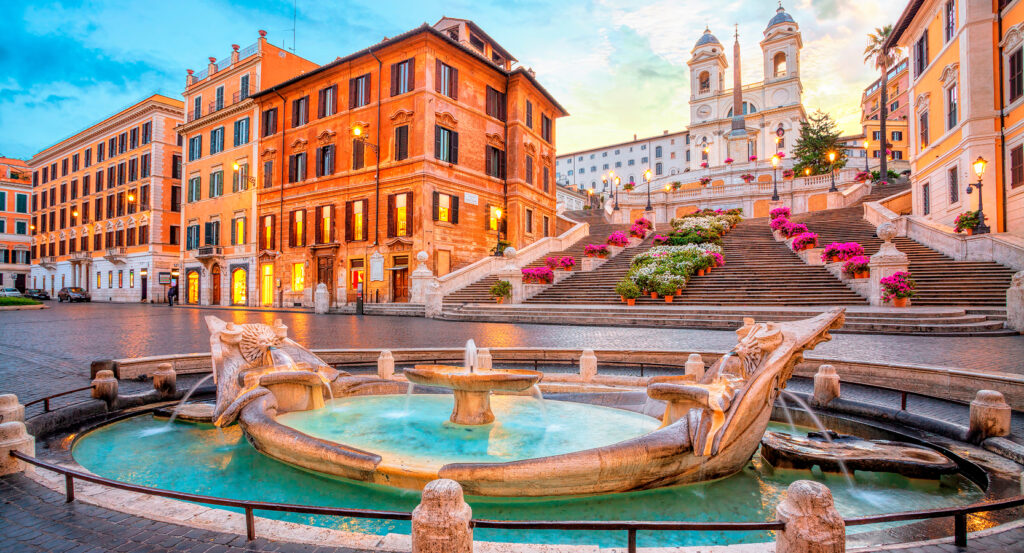
Rising from the thriving Piazza di Spagna to the tranquil Trinità dei Monti church above, this grand staircase of 135 steps has long been more than an architectural landmark, it's a living stage where Rome's timeless rhythm unfolds. Built in the 18th century, the steps were designed to bridge the city's French and Spanish quarters, yet they've become a symbol of Roman beauty itself, a gathering place for lovers, artists, poets, and dreamers. In the golden light of late afternoon, the travertine stone seems to glow from within, while the Fontana della Barcaccia, a charming Baroque fountain shaped like a half-sunken ship, murmurs at its base. Sitting here, you feel Rome in full motion, the hum of conversation, the flash of scooters, the scent of espresso and blooming jasmine. Spanish Steps are not just a destination; they're a performance, where every visitor becomes part of the eternal play that is Rome. Even the quiet moments, a street musician's melody echoing across the piazza, a couple sharing gelato under the fading sun, feel like scenes from a film written by the city itself. Every inch of this place breathes a kind of cinematic poetry that has seduced travelers for centuries, inviting them to slow down and feel time stretch beneath the Roman sky.
What defines Spanish Steps.
While millions stroll them each year, Spanish Steps hold layers of history and meaning often missed by casual visitors.
Commissioned by French diplomat Étienne Gueffier and completed in 1725, the staircase was designed by architect Francesco de Sanctis, who envisioned it as a flowing, theatrical link between the Trinità dei Monti church, built under French patronage, and the Spanish Embassy below, which gave the steps their enduring name. Each curve and terrace was engineered to create harmony between the surrounding Baroque buildings and the natural slope of the hill, turning function into poetry. The steps soon became a hub for artists and intellectuals, the nearby Keats-Shelley House, where poet John Keats spent his final days, now serves as a shrine to Romantic literature and a quiet refuge from the crowds. In the 19th century, painters and writers gathered here to trade ideas, capturing the steps in sketches and verses that spread Rome's allure across Europe. By the mid-20th century, Spanish Steps reached cinematic immortality through films like Roman Holiday, where Audrey Hepburn and Gregory Peck's stolen moments transformed the site into a global emblem of love, freedom, and fleeting beauty. Few realize that eating or drinking on the steps is now prohibited, part of the city's effort to protect their delicate travertine surface, an act both of preservation and reverence. In recent decades, the steps have undergone multiple restorations, most notably in 2015 when Bulgari, whose flagship boutique sits just below, funded a meticulous cleaning that returned their creamy hue to its original glow. Spanish Steps, like Rome itself, endure because they evolve, always ancient, yet somehow eternally new.
How Spanish Steps fits.
Experiencing the Spanish Steps is to experience Rome at its most romantic, where every glance upward feels like a step through time.
Begin your visit in the Piazza di Spagna, framed by the pastel façades of centuries-old palazzi and the gentle burble of the Barcaccia Fountain. From there, take your time ascending, pause midway to turn around and take in the view of Via dei Condotti, the city's most elegant shopping street, where the storefronts of Gucci, Prada, and Bulgari shimmer beneath the afternoon sun. At the top, the Trinità dei Monti church awaits with sweeping views across Rome's rooftops, from the Pincian Hill to St. Peter's Basilica in the distance. Visit at sunrise for serenity, when the steps are bathed in soft gold and the city stirs awake, or at sunset, when the air hums with the sound of footsteps and laughter. Nearby, linger at the Keats-Shelley House, where you can browse manuscripts from Byron and Shelley, or stop for espresso at Caffè Greco, among the oldest cafés in Italy, where generations of writers and artists once sat in quiet reverie. After dark, stroll down Via Margutta, a narrow, ivy-covered lane known for its galleries and artisan workshops, a natural extension of the creative energy that has always surrounded the Steps. As twilight deepens, the marble glows softly in the lamplight, and the square below takes on a dreamlike calm. To stand on the Spanish Steps at that hour is to feel both the grandeur and intimacy of Rome converge, a reminder that beauty here isn't something distant or rare. It's right beneath your feet, waiting to be climbed.
Where your story begins.
Foresyte Travel reveals places that feel extraordinary long before you arrive.
Enjoy editorial crafted for luxury travelers.
Foresyte may earn a commission when you book.