
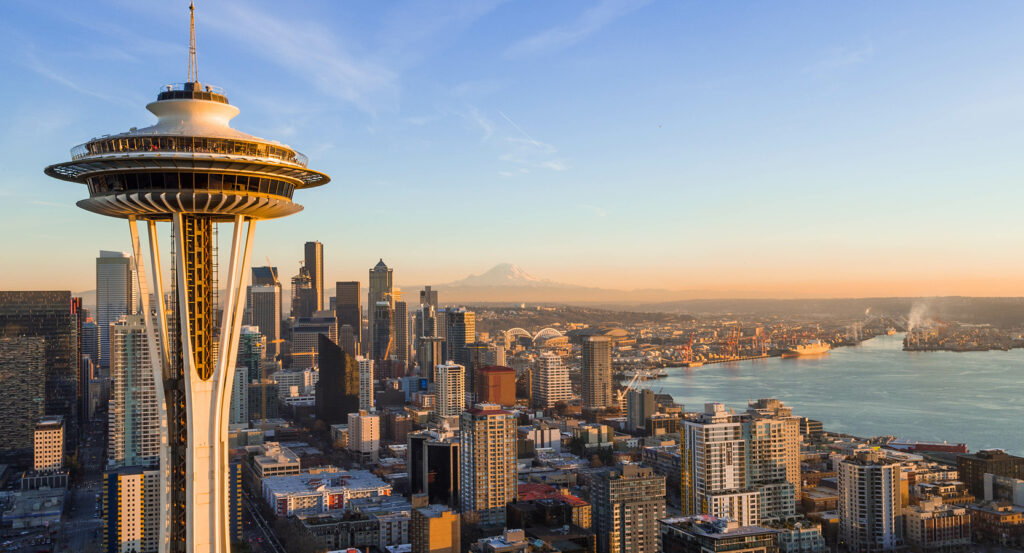
Why Space Needle matters.
Space Needle is a defining Seattle observation tower where Seattle Center's World's Fair heritage meets John Graham Jr.'s futuristic architecture, Pacific Northwest engineering and panoramic views of the city's mountains, waterways and skyline.
Set along Broad Street near Fifth Avenue North and just steps from the landscaped grounds surrounding the International Fountain, the tower occupies the southern portion of Seattle Center, between Lower Queen Anne's residential streets and the commercial corridors extending toward downtown. Three tapering steel legs rise from a substantial concrete foundation to support a saucer-shaped observation structure, creating a silhouette recognizable throughout the Pacific Northwest. A slender central core contains elevators and structural connections beneath the elevated visitor levels. The tower's exterior combines white structural elements, expansive glazing and a narrow spire extending above the roofline. The result is a striking example of midcentury engineering whose sculptural profile gives Seattle's international exposition heritage a permanent presence above the city.
What defines Space Needle.
Space Needle is best known for its creation as the architectural centerpiece of the 1962 Century 21 Exposition, the Seattle World's Fair devoted to science, technology and visions of the future. The project originated with hotel executive Edward E. Carlson, who developed the concept of a prominent observation tower after visiting a telecommunications tower in Stuttgart, Germany. Carlson's early sketches explored a balloon-like structure supported above the city, establishing the conceptual foundation for the eventual design. Architect John Graham Jr. subsequently developed the project with architect Victor Steinbrueck, whose contributions helped refine the distinctive elevated structure. Graham's team transformed the initial concept into a practical tower incorporating an observation deck and rotating restaurant. Private investors, including Howard S. Wright and members of the Pentagram Corporation, financed the project, separating its development from the publicly funded exposition facilities. Construction began in April 1961, leaving an exceptionally compressed schedule before the fair's opening the following spring. The foundation required the excavation of a substantial pit and the placement of 5,850 tons of concrete, creating a counterweight capable of stabilizing the slender structure. Steel fabrication and assembly proceeded rapidly, with construction crews completing the tower in less than a year. Space Needle opened on April 21, 1962, the first day of the exposition, rising 605 feet above the surrounding grounds. Its observation level stood 520 feet above the city, giving fairgoers sweeping views across Puget Sound, Elliott Bay and the surrounding mountain ranges. The tower attracted more than two million visitors during the exposition, becoming one of the fair's most successful attractions. Its architectural form captured the optimism surrounding aerospace engineering and technological progress during the early Space Age. The building subsequently became an enduring symbol of Seattle, connecting the city's international character with a defining achievement of twentieth-century exhibition architecture.
How Space Needle fits.
Space Needle works as the architectural anchor for a Seattle outing connecting a major collection of modern art, the city's experimental music heritage and an important institution devoted to Pacific Northwest scientific discovery.
Begin at Chihuly Garden and Glass, the exhibition complex devoted to the work of Tacoma-born glass artist Dale Chihuly. Opened in 2012, the institution presents a substantial collection of his large-scale glass installations, demonstrating his influential approach to color, organic form and collaborative glassmaking. Its eight interior galleries contain elaborate sculptural compositions inspired by botanical forms, maritime life and abstract natural structures. The Glasshouse features a suspended installation extending 100 feet, with red, orange and yellow glass elements arranged beneath a substantial glass-and-steel roof. An outdoor garden integrates glass sculptures with living plants, establishing striking relationships between manufactured forms and the surrounding landscape. Continue to Museum of Pop Culture, the institution founded by Microsoft cofounder Paul Allen and opened in 2000 as the Experience Music Project. Architect Frank Gehry designed its sculptural building, whose curved metal surfaces draw inspiration from the shapes and visual character of electric guitars. The museum's collections explore popular music, science fiction, fantasy, gaming and contemporary cultural production. Exhibitions devoted to Jimi Hendrix and Nirvana examine Seattle's substantial contributions to American rock music, incorporating instruments, performance artifacts and historical photographs. Its Sound Lab introduces interactive opportunities to experiment with musical instruments and recording technology. Conclude at Pacific Science Center, the educational institution developed for the Century 21 Exposition and subsequently established as a permanent science museum. Architect Minoru Yamasaki designed its original buildings, creating a composition of white concrete arches, reflecting pools and open courtyards. The distinctive Gothic-inspired arches establish one of the most recognizable architectural environments within the surrounding cultural district. Permanent exhibitions explore physics, biology, astronomy and environmental science through interactive demonstrations and educational programming. The institution's planetarium and IMAX theaters extend its scientific mission into astronomy and large-format educational film. The progression moves from Chihuly Garden and Glass's expressive contemporary sculpture through Museum of Pop Culture's exploration of modern cultural creativity and culminates at Pacific Science Center's scientific and architectural heritage, connecting three major institutions within Seattle Center.
Where your story begins.
Foresyte Travel reveals places that feel extraordinary long before you arrive.
Enjoy editorial crafted for luxury travelers.








































































































