Why Chihuly Garden and Glass matters.
Chihuly Garden and Glass is a celebrated glass-art exhibition where Seattle Center's cultural heritage meets Dale Chihuly's revolutionary approach to glassmaking, expansive botanical sculpture and the artistic traditions of the Pacific Northwest.
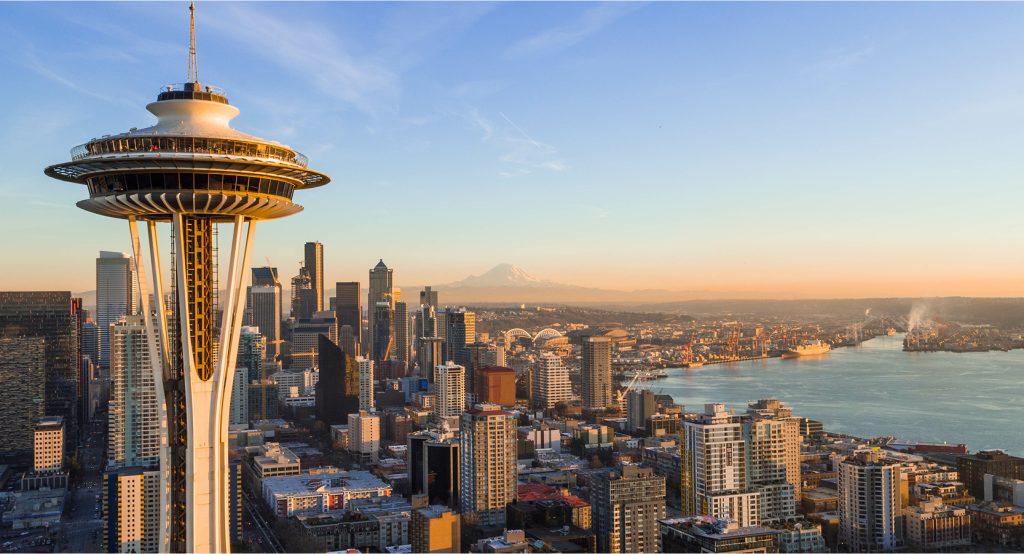
Set along Broad Street near Fifth Avenue North and just steps from the landscaped grounds surrounding the Space Needle, the exhibition occupies a purpose-built complex at the southern edge of Seattle Center, between Lower Queen Anne and the northern reaches of Downtown. Its architecture combines dark gallery interiors, expansive glass walls and a soaring conservatory that establishes a dramatic setting for large-scale sculpture. Eight exhibition galleries lead toward an expansive glasshouse, where suspended installations interact with natural light entering through the steel-framed roof. The adjoining garden integrates carefully arranged plantings with brilliantly colored glass forms, creating striking relationships between living vegetation and sculptural composition. The result is an extraordinary exhibition environment whose architectural restraint and theatrical presentation establish one of Seattle's most distinctive artistic destinations.
What defines Chihuly Garden and Glass.
Chihuly Garden and Glass is best known for presenting the artistic achievements of Dale Chihuly, the Tacoma-born glass artist whose experimental techniques transformed contemporary studio glass into a medium for expansive sculpture. Chihuly was born in 1941 and developed an early interest in glass during his studies in interior design at the University of Washington. He subsequently pursued graduate work at the University of Wisconsin-Madison, studying under Harvey Littleton, a central figure in the American studio glass movement. Chihuly continued his education at the Rhode Island School of Design, where he earned a Master of Fine Arts degree in 1968. A Fulbright Fellowship brought him to the Venini glass factory on Murano, introducing him to the collaborative methods of Venetian glassmaking. That experience shaped his approach to working with teams of highly skilled glassblowers, enabling increasingly ambitious sculptural production. In 1971, Chihuly cofounded Pilchuck Glass School with patrons Anne Gould Hauberg and John H. Hauberg on a wooded property north of Seattle. The institution became an influential international center for glass education, attracting artists who expanded the technical and creative possibilities of the medium. A serious automobile accident in 1976 damaged Chihuly's left eye, altering his physical relationship with the glassblowing process. A subsequent shoulder injury contributed to his transition toward directing teams of artists who executed increasingly complex compositions. His major installations subsequently appeared in museums, gardens and public spaces internationally, including projects incorporating hundreds of individually formed glass elements. Chihuly Garden and Glass opened on May 21, 2012, establishing a permanent Seattle exhibition devoted to his artistic development. The project was developed by the Space Needle Corporation, connecting the artist's international reputation with the city's established cultural district. Its creation brought together major bodies of work within an architectural environment designed specifically for their presentation.
The Glasshouse contains one of the exhibition's most consequential installations, a suspended composition extending 100 feet beneath a substantial glass-and-steel roof. Its red, orange and yellow elements form an elaborate overhead arrangement inspired by Chihuly's interest in botanical structures and organic movement. The surrounding glazing introduces changing daylight, creating shifting relationships between color, transparency and architectural structure. The Northwest Room incorporates objects associated with the artist's extensive collection of Native American baskets, textiles and related material culture, revealing important influences on his sculptural forms. His Basket series emerged through observations of woven containers whose irregular shapes suggested new possibilities for molten glass. The Seaforms series develops delicate, undulating structures inspired by marine life, using translucent surfaces and carefully controlled color to suggest movement beneath water. The Persian Ceiling suspends numerous glass elements above a transparent surface, projecting saturated colors across the surrounding architectural environment. The Mille Fiori installation creates an elaborate artificial garden through upright glass forms resembling reeds, flowers and other botanical structures. The Ikebana and Float Boats combine vessel forms with the influence of Japanese floral arrangement, placing brilliantly colored glass objects within traditional wooden boats. The Chandeliers series demonstrates Chihuly's expansion into large-scale suspended sculpture through dense arrangements of elongated glass elements. The outdoor garden extends these artistic investigations through installations integrated with trees, grasses and flowering plants. Its substantial sculptural forms include towering glass reeds and organic compositions whose colors contrast with the surrounding vegetation. The exhibition's presentation reveals Chihuly's sustained interest in transforming traditional glassblowing techniques into expansive sculptural environments.
How Chihuly Garden and Glass fits.
Chihuly Garden and Glass works as the artistic anchor for a Seattle outing connecting experimental popular culture, the scientific ambitions of the 1962 World's Fair and the city's distinguished public sculpture collections.
Begin at Museum of Pop Culture, the institution founded by Microsoft cofounder Paul Allen and opened in 2000 as the Experience Music Project. Architect Frank Gehry designed its sculptural building, incorporating sweeping metal surfaces whose forms draw inspiration from the visual character of electric guitars. Its collections examine the development of popular music, science fiction, fantasy and contemporary cultural production through instruments, costumes and historical artifacts. Exhibitions devoted to Jimi Hendrix and Nirvana explore Seattle's substantial contributions to American rock music, connecting individual performers with the broader development of influential musical movements. Interactive facilities introduce recording technology and musical performance through hands-on participation. Continue to Pacific Science Center, the educational institution developed for the 1962 Century 21 Exposition and subsequently established as a permanent science museum. Architect Minoru Yamasaki designed its original buildings, creating a distinctive composition of white concrete arches, reflecting pools and open courtyards. The architecture incorporates Gothic-inspired structural forms, establishing a striking relationship between modern engineering and historical design traditions. Permanent exhibitions explore physics, biology, astronomy and environmental science through interactive demonstrations and educational programming. Its planetarium and IMAX theaters extend scientific interpretation through astronomical presentations and large-format educational film. Conclude at Olympic Sculpture Park, the waterfront landscape developed by Seattle Art Museum on a former industrial site overlooking Elliott Bay. Opened in 2007, the park was designed by Weiss/Manfredi Architecture/Landscape/Urbanism, whose Z-shaped landscape connects the surrounding urban grid with the shoreline. The project transformed a contaminated industrial property into a substantial public landscape incorporating native plantings, pedestrian paths and expansive outdoor sculpture. Alexander Calder's Eagle, a striking red steel composition, occupies a prominent position within the park's collection. Richard Serra's Wake introduces another major sculptural work through a series of substantial weathering-steel forms. The park's elevated pathways provide expansive views toward Puget Sound and the Olympic Mountains, connecting contemporary art with Seattle's maritime geography. The progression moves from Museum of Pop Culture's exploration of contemporary cultural creativity through Pacific Science Center's scientific and architectural heritage and culminates at Olympic Sculpture Park's integration of expansive sculpture with the waterfront landscape.
Where your story begins.
Foresyte Travel reveals places that feel extraordinary long before you arrive.
Enjoy editorial crafted for luxury travelers.
Foresyte may earn a commission when you book.