Why Golden Gate Bridge matters.
Golden Gate Bridge is an expansive suspension bridge where the Presidio's military and maritime heritage meets the engineering ambitions of twentieth-century California, the dramatic geography of San Francisco Bay and one of the most consequential achievements in American bridge construction.
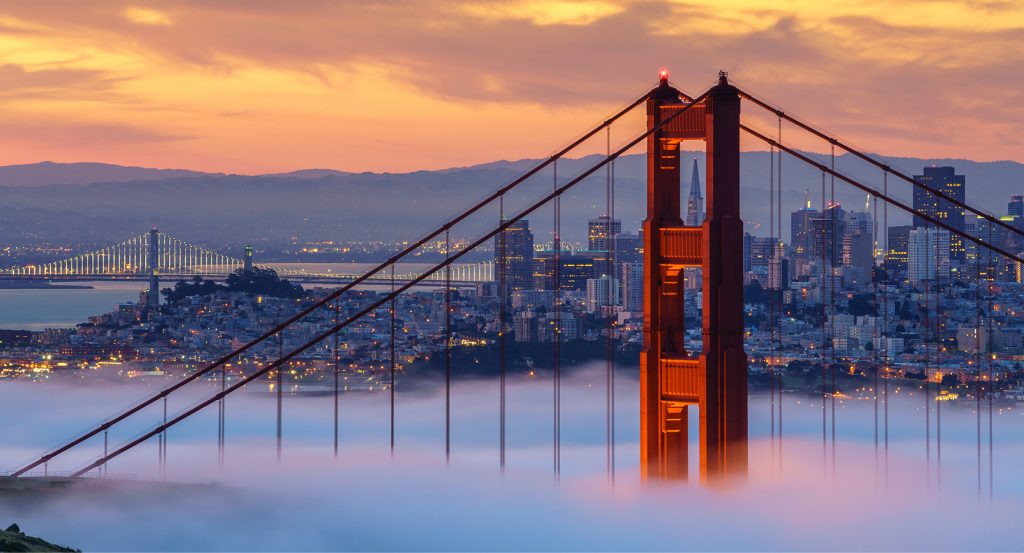
Spanning the Golden Gate strait between the Presidio and the Marin Headlands, the suspension bridge carries U.S. Route 101 across the entrance to San Francisco Bay, connecting the northern edge of the city with Marin County above a deep tidal channel bordered by steep coastal bluffs. Two International Orange towers rise above the roadway, supporting sweeping main cables that descend toward the center of the span. Vertical suspender ropes connect those cables to a slender steel deck, creating the bridge's distinctive profile against the surrounding hills and open Pacific. Massive concrete anchorages secure the suspension system at either end, with pedestrian sidewalks providing elevated views across the water and adjacent coastlines. The result is a commanding feat of structural engineering whose expansive proportions and carefully considered appearance have become inseparable from San Francisco's coastal landscape.
What defines Golden Gate Bridge.
Golden Gate Bridge is best known for its pioneering suspension engineering, International Orange color and transformation of transportation between San Francisco and the communities north of the Golden Gate strait. The waterway acquired its English name in 1846 when explorer and military officer John C. Frémont recognized its significance as the entrance to a major natural harbor. During the nineteenth century, ferry services provided the principal connection between San Francisco and Marin County, requiring passengers and vehicles to cross a channel characterized by powerful tides, frequent fog and difficult maritime conditions. Proposals for a permanent crossing gained momentum during the early twentieth century as automobile ownership expanded and regional transportation demands increased. Engineer Joseph B. Strauss became the project's principal advocate, developing an early design before assembling specialists capable of creating a more sophisticated suspension structure. Consulting engineer Leon Moisseiff contributed the suspension principles that shaped the final design, drawing upon contemporary developments in long-span bridge engineering. Charles Alton Ellis performed extensive structural calculations, translating the proposed configuration into a technically detailed construction program. Architect Irving Morrow refined the bridge's visual character, introducing Art Deco elements and advocating for the distinctive orange finish. Construction began on January 5, 1933, during the Great Depression, creating substantial employment through a project financed by bonds approved by voters in the participating counties. The foundations required difficult work in exposed marine conditions, particularly around the southern tower's construction site. Workers subsequently erected the steel towers, installed the main cables and suspended the roadway above the channel. The bridge opened to pedestrians on May 27, 1937, followed by automobile traffic the next day. Its 4,200-foot main span established a world record for suspension bridges that endured until 1964. The completed crossing fundamentally changed regional transportation, creating a permanent highway connection between San Francisco and Marin County.
Joseph Strauss introduced extensive construction safety measures, including a protective net suspended beneath the developing roadway to catch workers who fell during assembly. The net saved nineteen men, who subsequently became known as the Halfway to Hell Club. Eleven workers nevertheless died during construction, underscoring the dangers associated with building at such an exposed coastal location. Irving Morrow's architectural treatment incorporated stepped tower portals, carefully proportioned lighting fixtures and decorative railings that reinforced the structure's Art Deco character. The International Orange finish was selected for its visibility in fog and its compatibility with the surrounding landscape, establishing a color that became internationally associated with the crossing. Each principal tower rises 746 feet above the water, supporting a suspension system designed to accommodate substantial wind forces and changing traffic loads. The two main cables contain thousands of individual steel wires assembled into enormous bundles capable of carrying the roadway's weight. Their construction employed aerial spinning techniques, with wire transported repeatedly between the anchorages and towers until the required cable dimensions were achieved. The bridge's slender deck and flexible suspension system permit controlled movement under changing environmental conditions. Powerful Pacific winds, salt-laden air and persistent fog create demanding maintenance requirements, making corrosion protection a continuing responsibility. The Golden Gate Bridge, Highway and Transportation District oversees the crossing and its associated regional transportation services. Seismic retrofit projects have strengthened structural components to improve performance during major earthquakes. The bridge also incorporates a movable median barrier, introduced in 2015 to separate opposing traffic and reduce the risk of head-on collisions. A substantial suicide-deterrent net system was completed in 2024 beneath the pedestrian sidewalks, introducing an important additional public safety measure. Its continuing significance rests in the combination of exceptional engineering, architectural coherence and the permanent transportation connection it established across one of California's most demanding waterways.
How Golden Gate Bridge fits.
Golden Gate Bridge works as the architectural anchor for a northern San Francisco outing connecting the city's coastal defenses, its celebrated waterfront landscapes and the natural geography surrounding the entrance to San Francisco Bay.
Begin at Fort Point National Historic Site, the nineteenth-century military fortification positioned beneath the southern approach to the bridge. The United States Army constructed the brick fortress between 1853 and 1861 to defend the entrance to San Francisco Bay during a period of expanding Pacific commerce. Its three-tiered casemates, vaulted masonry passages and carefully arranged gun positions demonstrate the engineering principles of American coastal defense before the Civil War. The fort's location directly beside the tidal channel established commanding fields of fire across the narrow maritime entrance. Its preserved interior spaces and military exhibitions introduce the strategic importance of San Francisco's natural harbor during the nineteenth century. Continue to Crissy Field, the extensive waterfront landscape extending eastward along the northern edge of the Presidio. The site served as a military airfield during the twentieth century before undergoing a major ecological restoration that reintroduced tidal marshes, native vegetation and accessible shoreline recreation. Its broad lawns, sandy beach and pedestrian paths provide substantial views across the bay toward the surrounding hills. The restored wetlands support shorebirds and other wildlife, establishing an important natural habitat within the urban waterfront. Its open landscape provides a distinctive perspective on the relationship between San Francisco's military history and contemporary environmental preservation. Conclude at Battery Spencer, the historic coastal defense installation occupying an elevated position in the Marin Headlands. The battery was constructed during the late nineteenth century as part of the expanding network of fortifications protecting the entrance to San Francisco Bay. Its concrete gun emplacements and surviving military structures occupy a dramatic hillside setting above the northern approach to the strait. The elevated overlook provides extensive views across the suspension towers, Downtown, Alcatraz Island and the surrounding Pacific coastline. Its position introduces the steep coastal geography that shaped the bridge's engineering requirements and the defensive history of the harbor entrance. The progression moves from Fort Point National Historic Site's preserved military architecture through Crissy Field's restored waterfront landscape and culminates at Battery Spencer's commanding coastal overlook, connecting three consequential dimensions of San Francisco's maritime, environmental and engineering heritage.
Where your story begins.
Foresyte Travel reveals places that feel extraordinary long before you arrive.
Enjoy editorial crafted for luxury travelers.
Foresyte may earn a commission when you book.