Why Bennelong matters.
Bennelong is a celebrated contemporary Australian restaurant where Bennelong Point's Aboriginal history and Sydney Harbour's maritime grandeur meet the architectural achievement of the Sydney Opera House and a half-century of influential Australian fine dining.
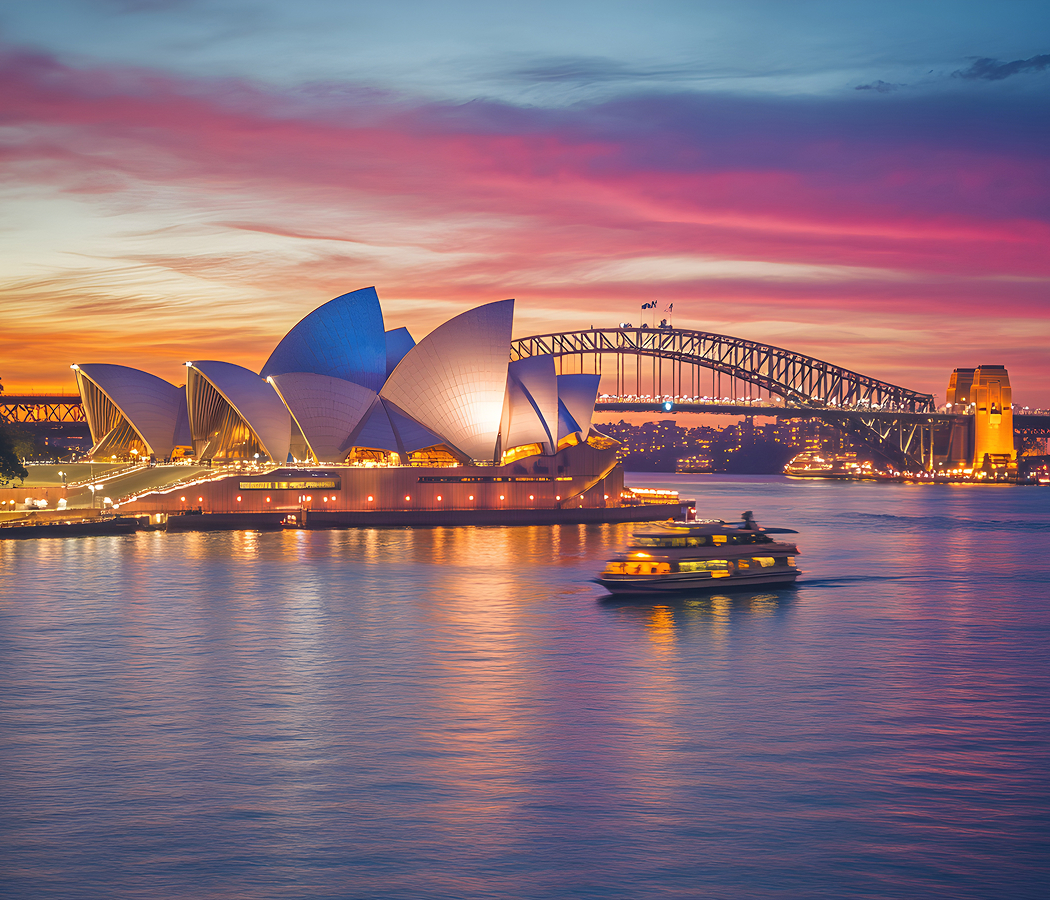
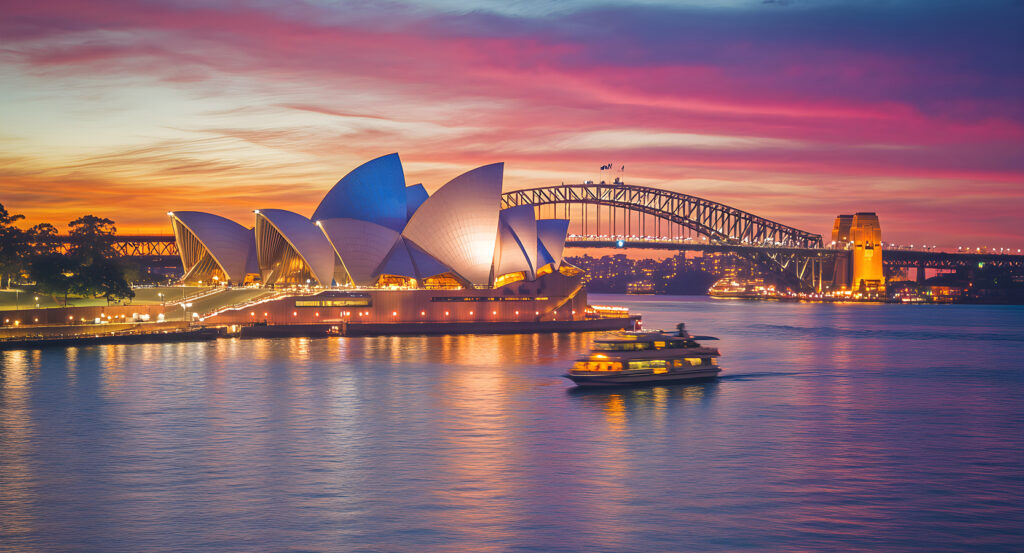
The Sydney Opera House occupies a promontory extending into Sydney Harbour beyond Circular Quay, with Farm Cove and the Royal Botanic Garden to the east, the Sydney Harbour Bridge across the western waterway and the historic streets of The Rocks framing the southern approach. Bennelong occupies the smallest of Jørn Utzon's vaulted shells, where soaring concrete ribs, bronze-framed glass walls and the building's sculptural roof structure establish a cathedral-like interior overlooking the harbour. Tonkin Zulaikha Greer Architects developed the restaurant's contemporary interior, introducing custom polymer-and-brass tables, carefully integrated lighting and furnishings that complement the original architectural surfaces. Three interconnected dining levels accommodate the Main Dining Room, The Counter, The Table, the Dress Circle and Bennelong Bar, with elevated seating providing views through the glazed façade toward Circular Quay. The result is a restaurant whose extraordinary architectural enclosure and panoramic waterfront setting place contemporary Australian dining within one of the twentieth century's most consequential public buildings.
What defines Bennelong.
Bennelong is best known for transforming the Sydney Opera House's restaurant pavilion into a distinguished institution of Australian gastronomy, connecting successive generations of prominent chefs with the architectural and cultural history of Bennelong Point. The promontory takes its name from Woollarawarre Bennelong, a Wangal man whose interactions with Governor Arthur Phillip became central to relations between Aboriginal communities and the British settlement established at Sydney Cove in 1788. Phillip commissioned a brick hut for Bennelong on the point in 1790, creating a significant early site of contact between the colony and the region's Aboriginal inhabitants. The peninsula subsequently became associated with Fort Macquarie, a defensive installation completed in 1821, before the construction of a tram depot transformed its waterfront function. Danish architect Jørn Utzon won the international competition for the Sydney Opera House in 1957, developing a design whose expansive shell structures fundamentally changed the architectural possibilities of the site. Construction began in 1959, and the project subsequently underwent substantial political and technical difficulties that culminated in Utzon's departure in 1966. Australian architect Peter Hall directed the completion of the building's interiors, working with Lionel Todd and David Littlemore to reconcile the architectural scheme with the requirements of a functioning performing arts institution. Queen Elizabeth II formally opened the Sydney Opera House on October 20, 1973, establishing a major new cultural institution whose restaurant pavilion became part of its original public facilities. German-born restaurateur Oliver Shaul operated the first incarnation of Bennelong, beginning a hospitality history subsequently shaped by prominent Australian chefs and restaurateurs. Amanda Bilson and Janni Kyritsis contributed important chapters to the restaurant's development, establishing the pavilion as a destination for ambitious cooking alongside its principal function as a performing arts venue. French-born chef Guillaume Brahimi secured the restaurant contract in 2001, reopening the establishment as Guillaume at Bennelong after extensive refurbishment. Brahimi had trained under Joël Robuchon in Paris before relocating to Australia, bringing a classical French culinary foundation to one of Sydney's most prominent dining rooms. His restaurant earned two chef hats in the Sydney Morning Herald Good Food Guide by 2003 and subsequently achieved three-hat recognition, consolidating its reputation within Australian fine dining. Guillaume at Bennelong concluded service on New Year's Eve 2013, ending a twelve-year period of influential French cooking beneath the Opera House sails. The Fink Group secured the subsequent restaurant tender in November 2014, appointing Peter Gilmore as executive chef and undertaking a comprehensive redevelopment of the pavilion. Gilmore had established an international reputation at Quay through his treatment of Australian produce, close relationships with specialist growers and technically elaborate contemporary cooking. Bennelong reopened on July 1, 2015, introducing a new culinary program dedicated to the diversity of Australian ingredients and a dining format organized across several levels. Executive head chef Rob Cockerill played a central role in the restaurant's development, drawing upon seven years working with Gilmore at Quay and substantial professional experience in Sydney, Far North Queensland and London. The reopening attracted immediate recognition, including three Best New Restaurant awards during its first months of operation. The restaurant subsequently became associated with Australian desserts interpreted through contemporary pastry techniques, particularly its architectural pavlova inspired by the Opera House sails. Gilmore's departure from Sydney brought a significant leadership transition in 2026, when Cockerill assumed responsibility for Bennelong's culinary direction as executive head chef. His appointment followed eleven years at the restaurant, preserving continuity with its established commitment to Australian ingredients and technical cooking. The Good Food Guide awarded Bennelong two chef hats in its 2026 edition, maintaining the restaurant's position among Sydney's prominent fine-dining establishments.
Where your story begins.
Foresyte Travel reveals places that feel extraordinary long before you arrive.
Enjoy editorial crafted for luxury travelers.