
Why Cabrillo National Monument matters.
Cabrillo National Monument is the panorama of San Diego's edge, where exploration, nature, and oceanic drama converge beneath the endless California sky.
Perched on the southern tip of the Point Loma peninsula, the monument stands at the gateway of the Pacific, where on September 28 1542, Juan Rodríguez Cabrillo made the first European landing on what would become the West Coast. Walking onto its grassy bluffs, you're met with sweeping views of San Diego Bay, the city skyline, Coronado Island, and on clear days even Mexico's Coronado Islands beyond the horizon. Tide-pools ripple with marine life at your feet, and winter brings an orchestra of migrating gray whales drifting by the “Whale Watch” overlook. The old Point Loma Lighthouse still stands sentinel, its white tower a symbol of both colonial and maritime legacy. Every trail hums with story, every vista whispers discovery. Cabrillo National Monument isn't simply about the past, it's the present moment stretched wide into view, where land, sea, and sky meet in subtle grandeur.
What defines Cabrillo National Monument.
Behind its wide-open views lies a layered heritage of conquest, defense, ecology, and care that has shaped both San Diego and the coast beyond.
Originally designated in 1913 to honour Cabrillo's landing, the monument preserves more than history, it anchors military remains, natural habitats, and cultural celebration in one place. The trails trace old coastal artillery bunkers and fortifications that guarded the harbor through World Wars, and the ancient lighthouse, built in 1855, decommissioned in 1891, still opens to visitors as a window into maritime life. As tides fall, the intertidal zone reveals a spirited array of sea anemones, octopuses, limpets and starfish, proof that life persists at the interface of rock and water. Native Kumeyaay heritage is central here, too, with ceremonies and storytelling that link ancient stewardship to modern conservation. Even the monument's modern visitor-centre architecture stands as a mid-century expression of place: built in the 1960s under the National Park Service's Mission 66 initiative, it frames the coast with clean lines and clarity. By layering exploration, nature, and memory, Cabrillo National Monument becomes a place where every lookout feels like revelation, every footprint echoes with voyage.
How Cabrillo National Monument fits.
To experience Cabrillo National Monument fully, arrive with both eyes open and heart attuned to horizon, this is a landscape meant to be walked and felt, not just glimpsed.
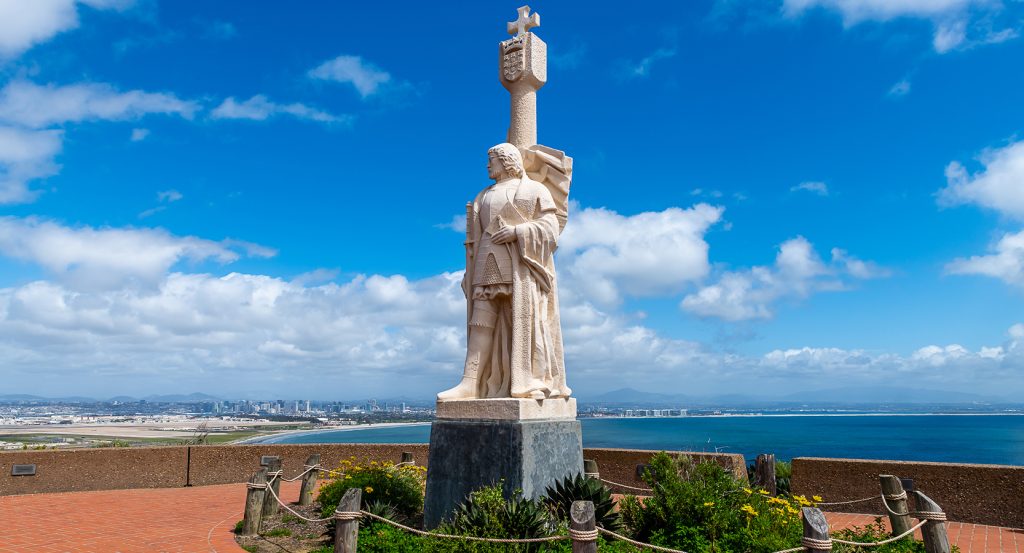
Drive the winding road to the monument's summit and pause at the Visitor Center to pick up tide-pool schedules, whale-watch timing, and ranger-talk listings. Begin on the Bayside Trail or the new Oceanside Trail and hike down toward the tide-pools, go during a negative-tide day, and you'll step into the fragile kingdom of sea stars, hermit crabs and kelp-forest creatures. After the trail, return uphill to the overlook by the old lighthouse, breathe in the salt wind, look beyond the naval base, the waves, the city beyond the bay. Visit in late afternoon when the golden light coats the cliffs and the Pacific stretches like polished glass; in winter, linger at the Whale Watch point and scan the sea for spouts and migration glimpses. End your visit with a quiet moment beside Cabrillo's statue, his gaze fixed on the horizon where discovery once began. Cabrillo National Monument in San Diego isn't just a stop on the map, it's a vantage point for perspective, a place where land ends and possibility begins.
Where your story begins.
Foresyte Travel reveals places that feel extraordinary long before you arrive.
Enjoy editorial crafted for luxury travelers.
Foresyte may earn a commission when you book.





































































































