
Why Pudong matters.
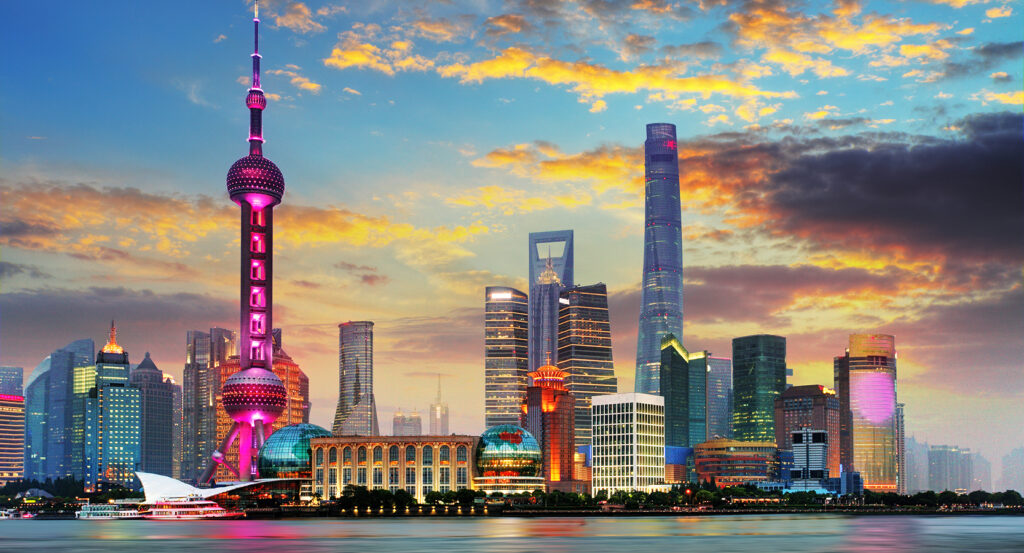
Pudong in Shanghai is the city's vision of the future made real, a shimmering skyline of glass and light that rises where rice paddies once stretched along the Huangpu River.
To stand in Pudong today is to witness one of the most astonishing urban transformations in modern history. Barely three decades ago, this district was little more than industrial outskirts and farmland; now it's the beating heart of Shanghai's global identity, home to the city's tallest towers, grandest boulevards, and most daring architectural experiments. The skyline is instantly recognizable, the needle of the Oriental Pearl Tower, the bottle-opener silhouette of the Shanghai World Financial Center, and the spiraling grace of the Shanghai Tower all pierce the sky like symbols of aspiration. But Pudong is more than its skyscrapers. Beneath the futuristic facades lies a city of contrasts, peaceful riverside parks, luxury malls glowing with digital art, and quiet pockets of tradition hidden among the steel. Strolling along the riverside promenade of Lujiazui feels like walking through a live painting of progress: ferries gliding across the Huangpu, reflections rippling beneath towers that seem to float. Pudong isn't simply a district of Shanghai, it is Shanghai's declaration that the future has arrived.
What defines Pudong.
Behind its glittering skyline lies a story of bold vision, calculated risk, and relentless reinvention.
When China designated Pudong as a Special Economic Zone in 1990, few could have imagined how rapidly it would rise. The government's aim was to create a financial and commercial hub that could rival Hong Kong and Singapore, and in just one generation, they succeeded. Entire neighborhoods were planned from scratch, with international architects invited to design landmarks that would redefine Shanghai's identity. The Oriental Pearl Tower became the district's first icon in 1994, soon followed by the Jin Mao Tower and the Shanghai World Financial Center. Together, they created a skyline that signaled China's reemergence on the global stage. Yet Pudong's story isn't only about architecture, it's about imagination. The once-empty land east of the Huangpu River became a living laboratory for modern urban design: underground shopping streets, automated metros, and eco-friendly green zones now coexist with luxury hotels and business headquarters. Lujiazui, the central business area, holds more than half of Shanghai's tallest buildings, but only a short walk away, Century Park offers 140 hectares of calm, a manmade oasis where locals cycle past lakes and cherry blossoms bloom in spring. Few realize that Pudong's skyline is designed with feng shui in mind: each building's orientation and shape meant to balance elements of water, wind, and light. This quiet attention to harmony gives Pudong its distinct character, futuristic, yes, but still rooted in an ancient respect for balance and flow.
How Pudong fits.
Exploring Pudong is about embracing both its scale and its subtlety, the grand gestures that define Shanghai's image and the quiet spaces that reveal its soul.
Start the visit in Lujiazui, the district's architectural heart, where the trio of Shanghai Tower, Jin Mao Tower, and Shanghai World Financial Center stand shoulder to shoulder in symbolic harmony. Ride the high-speed elevator to the observation deck of the Shanghai Tower, the second-tallest building in the world, for a view that stretches beyond the city's haze to the Yangtze River Delta. From there, descend to ground level and wander along Binjiang Avenue, a riverside promenade offering postcard views of the Bund across the water. Stop for lunch or coffee at one of the sleek riverfront cafés, where locals and travelers mingle beneath the skyline's shimmer. For a dose of culture, visit the Shanghai Science and Technology Museum, an architectural marvel in its own right, or spend an afternoon at Century Park, a lush expanse of green where you can rent bikes, picnic, or drift across the lake on paddleboats. As evening falls, head back to the waterfront to witness the skyline ignite, a synchronized light show where color and reflection dance across the river. To end the night, consider a drink at a rooftop bar high above the clouds; from there, Shanghai feels infinite, suspended between memory and tomorrow. Pudong isn't just the face of modern China, it's a reminder that cities, like dreams, are built by those who dare to imagine them differently.
Where your story begins.
Foresyte Travel reveals places that feel extraordinary long before you arrive.
Enjoy editorial crafted for luxury travelers.
Foresyte may earn a commission when you book.

















































































































