
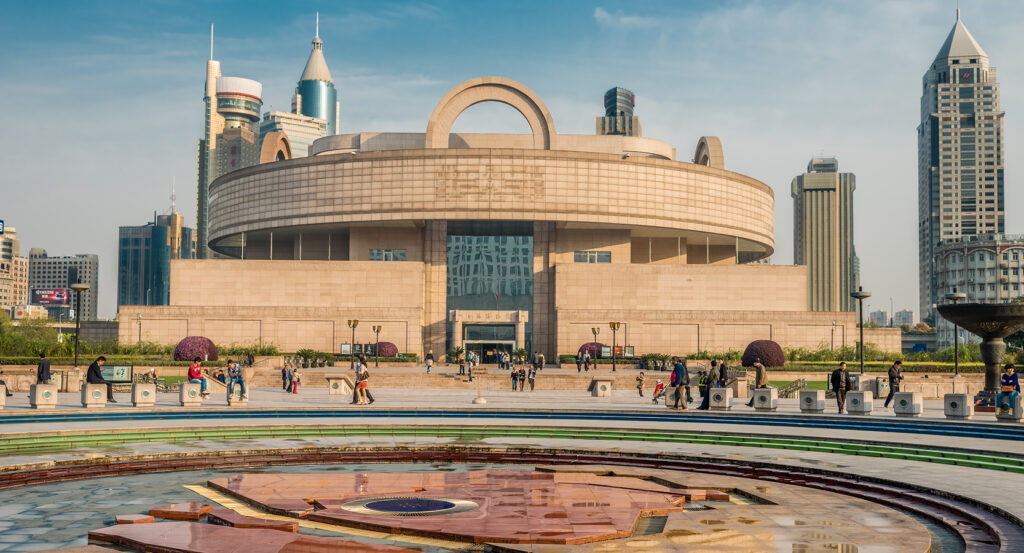
Why Shanghai Museum matters.
In the dynamic heart of Shanghai, China, where glass towers and neon skylines tell the story of modern ambition, Shanghai Museum anchors the city in its ancient soul.
Set in the cultural expanse of People's Square, this world-class museum is a sanctuary of timeless beauty, a temple to Chinese civilization that invites you to slow down and trace the lineage of one of humanity's oldest continuous cultures. The museum's architecture itself is symbolic: a circular roof representing the sky, resting atop a square base symbolizing the earth, a harmony drawn from ancient Chinese cosmology. Step inside, and the frenetic rhythm of Shanghai gives way to quiet reverence. Here, in soft golden light, over 120,000 artifacts unfold like chapters in China's story, each gallery a world unto itself. Bronze vessels from the Shang and Zhou dynasties gleam with age-old mystery; jade carvings whisper of devotion and dynasty; delicate ceramics trace the evolution of form and fire. In the Painting and Calligraphy Gallery, scrolls flow across the walls like rivers of ink and emotion, capturing the spiritual essence of Chinese art, a conversation between brush, breath, and eternity. Shanghai Museum is not just a repository of objects; it's an immersive meditation on the craftsmanship, philosophy, and grace that shaped Chinese character across millennia.
What defines Shanghai Museum.
Shanghai Museum is both a marvel of curation and a symbol of China's cultural renaissance, a place where the country's ancient artistry meets its modern aspirations.
Founded in 1952, the museum was originally housed in a repurposed bank building before moving in 1996 to its current architectural masterpiece designed by Xing Tonghe. The structure itself reflects profound philosophical balance, “round heaven, square earth”, echoing a cosmic order deeply rooted in traditional Chinese thought. Inside, the museum's ten major galleries and three special exhibition halls showcase the evolution of Chinese material culture across 7,000 years, organized not by chronology but by art form, allowing each discipline to tell its own story. The Ancient Bronze Gallery, among the finest in the world, contains ritual vessels used for ancestral offerings, each intricately decorated with taotie masks that merge human and animal symbolism. In the Ceramics Gallery, visitors can trace the journey from Neolithic earthenware to the porcelain perfection of the Ming and Qing dynasties, each piece reflecting a mastery that defined global art and trade. The Jade Gallery glows with translucence, revealing the spiritual power attributed to the stone in Chinese culture, purity, immortality, and moral strength. Yet, beyond these treasures lies something subtler: the museum's commitment to accessibility and education. It was among the first in China to offer free admission, ensuring art and history belong to everyone. Its restoration labs quietly lead international research in conservation science, merging traditional methods with modern technology. What most don't realize is that Shanghai Museum serves as the heart of China's broader cultural ecosystem, a model for dozens of institutions that followed, bridging past and future with elegance and purpose.
How Shanghai Museum fits.
Visiting Shanghai Museum is an essential rite for anyone seeking to understand not just Shanghai, but China itself, a journey into the country's artistic DNA.
Set aside two to three hours, though art lovers could easily spend an entire day exploring its vast collections. Begin in the Bronze Gallery, where the earliest expressions of Chinese civilization gleam under soft lighting, their ritual designs both fierce and serene. Move next to the Sculpture and Ceramics Galleries, where Buddhist stone carvings and Tang dynasty figurines reveal a spiritual evolution carved in clay and marble. The Calligraphy Hall and Painting Gallery demand quiet patience, take time to linger, as these are considered the purest forms of Chinese art, expressing not just image but thought, rhythm, and soul. Don't miss the Furniture Gallery, a local favorite where Ming and Qing hardwood masterpieces embody simplicity and proportion so refined they seem modern even today. After exploring the museum, step outside into People's Square, where the city's pulse beats in perfect contrast to the stillness you've just experienced. Nearby, you can stroll to the Shanghai Grand Theatre or enjoy tea at People's Park Pavilion, reflecting on how seamlessly Shanghai bridges its ancient grace and futuristic ambition. Shanghai Museum isn't just a collection, it's an experience of timeless balance, where every artifact, every brushstroke, and every whisper of jade reminds you that beauty, in China, has always been more than art. It has been a way of life.
Where your story begins.
Foresyte Travel reveals places that feel extraordinary long before you arrive.
Enjoy editorial crafted for luxury travelers.
Foresyte may earn a commission when you book.

















































































































