
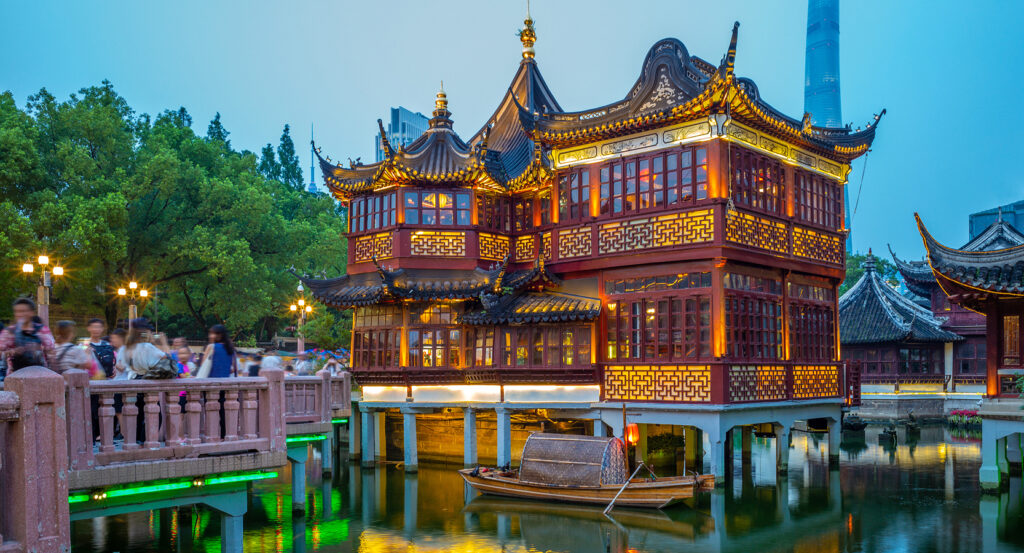
Why Yu Garden matters.
Yu Garden is a Ming-dynasty classical garden where Shanghai Old City's mercantile heritage meets the private garden traditions of Jiangnan, the architectural patronage of the Pan family and the preservation of sixteenth-century Chinese landscape design.
Set along Anren Street near Fuyou Road and a short walk from the City God Temple, the garden occupies an enclosed precinct within Shanghai's former walled city, between the traditional commercial streets surrounding Yuyuan Bazaar and the historic residential blocks extending south toward Fangbang Middle Road. Whitewashed walls and tiled roofs separate its landscaped courtyards from the surrounding commercial district. Ornamental ponds, artificial mountains and covered walkways divide the grounds into interconnected garden chambers. Pavilions and halls overlook compositions of limestone rockery, water and cultivated vegetation. The result is a classical Chinese garden whose enclosed spatial arrangement preserves the domestic architecture and landscape traditions of Ming-dynasty Shanghai.
What defines Yu Garden.
Yu Garden is best known for its Ming-dynasty origins, classical Jiangnan garden architecture and surviving arrangements of pavilions, rockeries, ponds and ornamental courtyards. Its construction began in 1559 under Pan Yunduan, a member of a prosperous Shanghai family whose father, Pan En, held senior positions in the Ming imperial administration. Pan Yunduan conceived the garden as a private retreat intended to provide comfort and enjoyment for his parents. The name Yu derives from a Chinese character associated with pleasure and contentment, expressing the family's intended purpose for the estate. Construction continued over several decades as Pan Yunduan's official career and financial circumstances influenced the pace of development. The garden reached substantial completion in 1577, establishing an elaborate residential landscape within Shanghai's expanding commercial settlement. Its design drew upon the Jiangnan tradition of scholarly gardens, which developed across the prosperous cities of the Lower Yangtze region. The Pan family's investment incorporated architectural craftsmanship, ornamental stonework and carefully arranged garden spaces associated with the cultural aspirations of the Ming elite. Following Pan Yunduan's death, the family's declining fortunes contributed to the deterioration and eventual dispersal of portions of the property. During the eighteenth century, local merchants and community organizations acquired sections of the former estate and undertook restoration projects. The garden became associated with the commercial and religious institutions of the surrounding Old City, extending its significance beyond the original private household. The nineteenth century brought substantial disruption during the Small Swords Society uprising and subsequent military conflicts affecting Shanghai. Buildings and landscape features suffered damage during periods of occupation and urban instability. Further deterioration occurred during the twentieth century as the surrounding city underwent political and economic changes. A major restoration program began in 1956, reconstructing architectural elements and rehabilitating the historic garden landscape. Yu Garden reopened to the public in 1961 and received national cultural heritage protection in 1982, securing its position among Shanghai's principal surviving examples of classical garden architecture.
Pan Yunduan's garden incorporates a sequence of enclosed spaces designed around changing relationships between architecture, water, stone and vegetation. The Sansui Hall complex forms part of the garden's principal architectural arrangement, with timber columns, carved decorative elements and tiled roofs characteristic of traditional Jiangnan construction. Its name refers to auspicious agricultural harvests, connecting the garden's architectural symbolism with prosperity and abundance. The Grand Rockery rises as a substantial composition of yellowstone assembled to create an artificial mountain landscape. Its irregular surfaces, narrow passages and elevated viewing positions establish changing perspectives across the surrounding courtyards. The Exquisite Jade Rock, a porous ornamental stone traditionally associated with the garden's historic collections, stands among the site's most distinctive landscape objects. Its perforated surface demonstrates the aesthetic qualities prized in Chinese scholar's rocks, including irregular form, intricate openings and weathered texture. The surrounding Yuhua Hall provides an architectural setting for viewing the stone. Covered corridors connect the garden's principal chambers, directing movement through alternating enclosed and open spaces. Decorative windows frame selected views of rockeries, ponds and architectural details beyond the garden walls. The Wanhua Chamber incorporates carved timber elements and garden plantings associated with the cultivation of ornamental vegetation. Watercourses and ponds provide visual separation between buildings, extending the apparent depth of the enclosed grounds. Bridges cross the water at carefully selected points, connecting pavilions and walkways through a sequence of changing perspectives. Traditional roof forms incorporate curved eaves, ridge ornaments and dark ceramic tiles associated with southern Chinese architecture. The garden's spatial organization preserves the relationship between domestic retreat, scholarly cultivation and the architectural craftsmanship of the Lower Yangtze region.
How Yu Garden fits.
Yu Garden works as the historical centerpiece for a Shanghai Old City itinerary connecting Ming-dynasty religious institutions, traditional commercial architecture and the transformation of the former walled settlement into a modern urban district.
Begin at City God Temple of Shanghai, the religious complex associated with the protection and spiritual administration of the historic city. Its origins are connected with the Ming dynasty, when the worship of local tutelary deities formed an important part of Chinese urban religious life. The temple developed into a center of community ceremonies, seasonal festivals and devotional activity. Its architectural arrangement incorporates traditional halls, courtyards and timber structures associated with Chinese religious buildings. The surrounding commercial district expanded through the movement of worshippers and merchants, establishing a relationship between religious patronage and local trade. Continue to Yuyuan Bazaar, the commercial district surrounding the historic garden precinct. Its shops and restaurants occupy buildings incorporating traditional Chinese roof forms, decorative timber elements and architectural references to Ming and Qing commercial streets. The district's development reflects Shanghai's long association with regional trade and the commercial activities of the Lower Yangtze region. Merchants sell traditional confectionery, tea, craft objects and regional food specialties within a network of pedestrian passages. The commercial complex connects the historic Old City with the preservation and reconstruction of traditional Chinese retail architecture. Conclude at Dajing Pavilion, the surviving structure associated with Shanghai's former city wall. The original defensive wall was constructed during the Ming dynasty in 1553, responding to coastal raids and the need to protect the growing commercial settlement. Its perimeter enclosed the historic Chinese city before the development of the nineteenth-century foreign settlements. Most of the fortifications were demolished during the early twentieth century as Shanghai expanded beyond the old defensive boundary. The surviving section preserves masonry associated with the city's earlier military infrastructure. The progression moves from religious patronage through traditional commerce and culminates at the former defensive perimeter, connecting Yu Garden with the institutions and urban structures that shaped historic Shanghai.
Where your story begins.
Foresyte Travel reveals places that feel extraordinary long before you arrive.
Enjoy editorial crafted for luxury travelers.
Foresyte may earn a commission when you book.

















































































































