Why Mykonos Town matters.
Mykonos Town is a historic Cycladic enclave where Mykonos's seafaring heritage meets the commercial prosperity of Aegean merchant families, the architectural ingenuity of a densely settled island port and the international cultural prominence that transformed Chora into one of Greece's most recognizable coastal settlements.
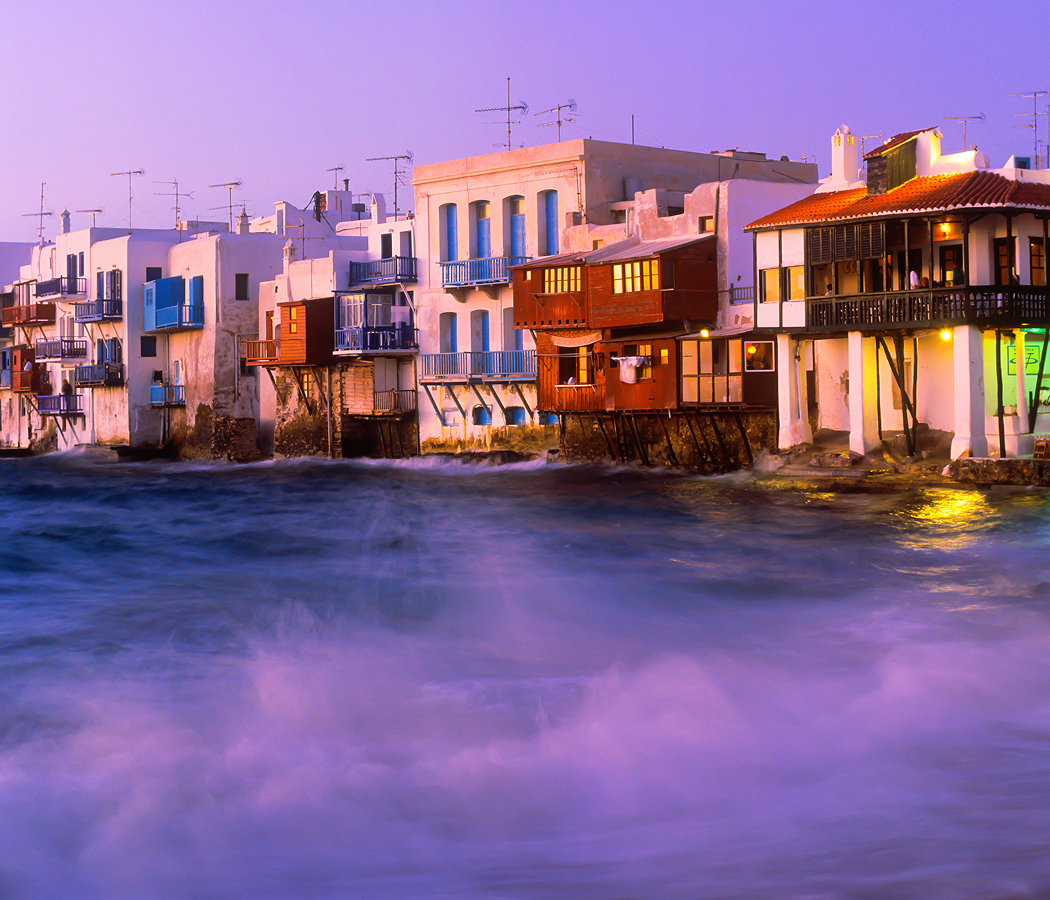
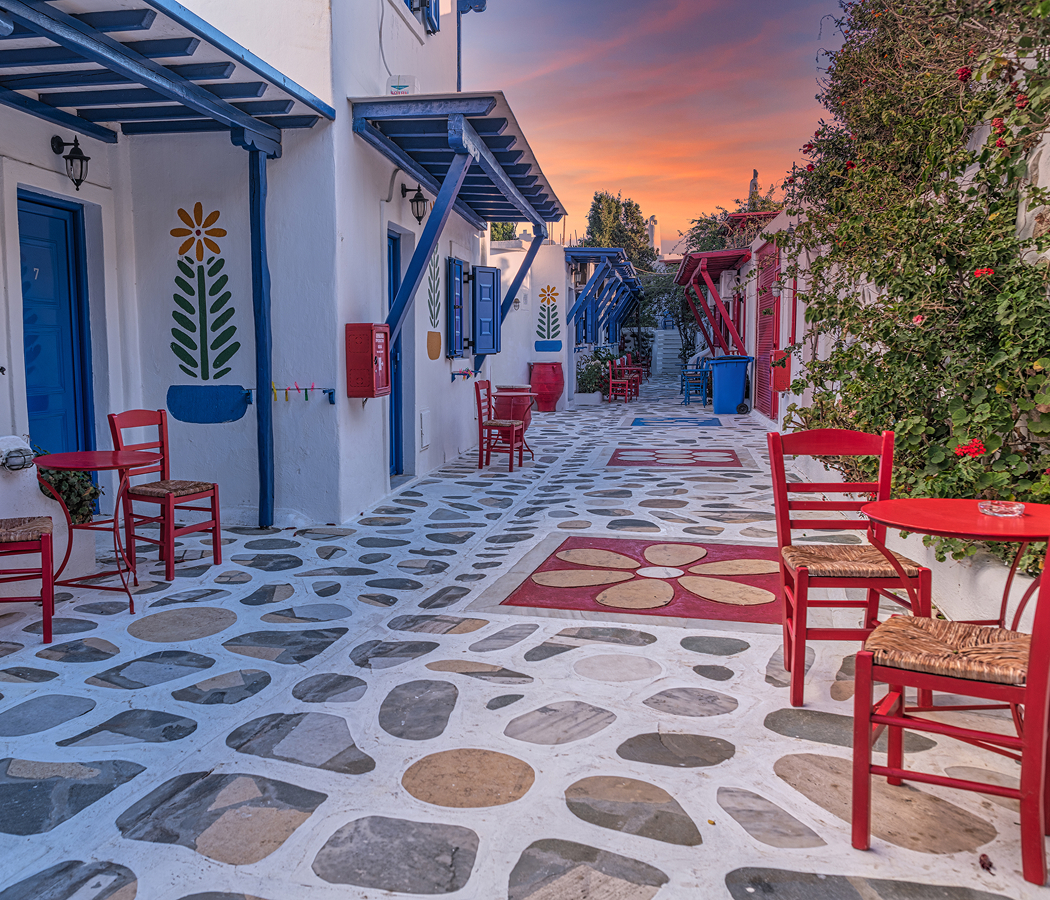
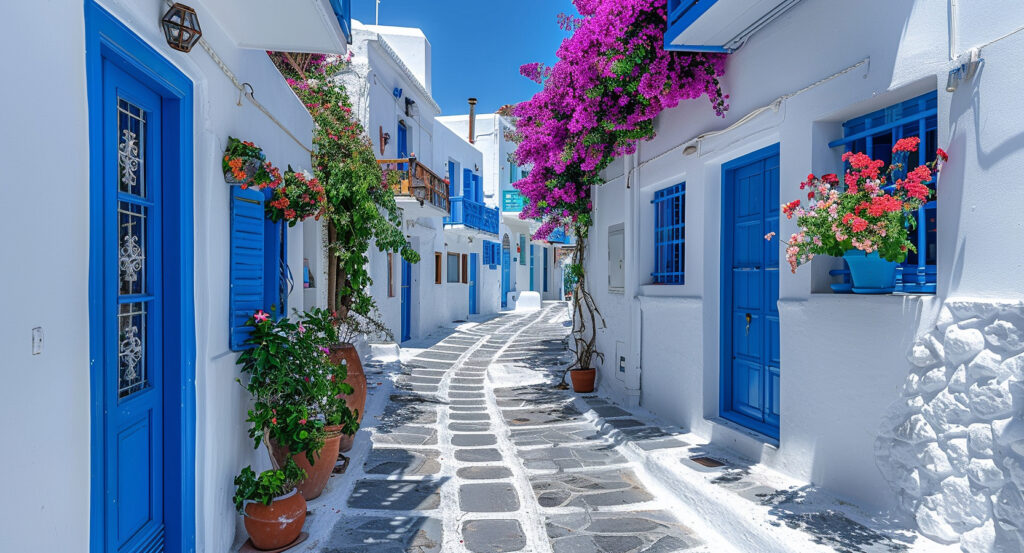
Occupying the island's western shoreline between the Old Port and the exposed headlands of Alefkandra, the historic settlement extends inland through a compact network of pedestrian lanes, with whitewashed houses descending toward sheltered waterfront approaches and closely arranged neighborhoods spreading across the surrounding granite terrain. Two-story residences, painted wooden balconies and small enclosed courtyards create an irregular streetscape shaped by centuries of incremental construction. Narrow passages connect open squares with former commercial premises, family chapels and residential buildings whose exterior staircases accommodate the settlement's restricted building space. The waterfront incorporates sheltered quays and former maritime facilities, preserving the physical relationship between the town and its historical shipping economy. The result is a concentrated coastal settlement whose architecture, circulation and waterfront geography preserve the working foundations of Mykonos's maritime past.
What defines Mykonos Town.
Mykonos Town is best known for its labyrinthine Cycladic architecture and its transformation from a fortified maritime settlement into an internationally prominent center of tourism, commerce and cultural exchange. Archaeological evidence establishes human occupation of Mykonos during prehistoric antiquity, preceding the development of the principal settlement on the island's western coast. Ancient Mykonos maintained close relationships with neighboring Delos, whose religious institutions and commercial activities influenced settlement across the surrounding islands. During the Byzantine period, the island formed part of the eastern Mediterranean's changing administrative and maritime networks. The Fourth Crusade of 1204 disrupted Byzantine authority, allowing Venetian interests and Latin rulers to establish political control across substantial portions of the Cyclades. Mykonos subsequently came under the authority of the Ghisi family, whose rule connected the island with the wider system of Latin maritime possessions in the Aegean. Venetian influence shaped the island's political circumstances during the later medieval period, although local communities retained established religious and commercial practices. Ottoman expansion during the sixteenth century introduced a different political environment, with Mykonos participating in the commercial networks of the eastern Mediterranean. The island's maritime economy expanded during the eighteenth century as Greek shipowners developed extensive trading relationships between the Cyclades, mainland ports and the Ottoman commercial world. Merchant families accumulated wealth through shipping, trade and the transportation of agricultural products, supporting the construction of substantial residences and commercial facilities. The Greek War of Independence beginning in 1821 brought Mykonos into the revolutionary struggle, with local vessels and financial resources contributing to military operations. Manto Mavrogenous, a prominent Mykonian revolutionary, devoted substantial personal wealth to the independence movement and became closely associated with the island's patriotic history. The establishment of the modern Greek state altered the commercial circumstances of the Cyclades, although maritime activity continued to support local livelihoods during the nineteenth century. Steam navigation and changing trading routes subsequently weakened traditional sailing enterprises, contributing to economic difficulties and emigration. During the twentieth century, the development of international tourism introduced new sources of income and employment. Mykonos attracted artists, writers and affluent travelers during the postwar decades, gradually acquiring an international reputation associated with cosmopolitan social life and coastal recreation. The expansion of ferry services, aviation connections and hospitality infrastructure accelerated this transformation, making Chora the principal commercial and cultural center of the island's visitor economy. Its surviving architecture preserves the physical organization of the earlier maritime settlement amid the commercial changes associated with modern tourism.
Manto Mavrogenous Square occupies a prominent position near the waterfront, commemorating the revolutionary figure whose contributions connected Mykonos with the creation of the modern Greek state. The surrounding streets incorporate small commercial buildings, residential entrances and pedestrian passages developed within the settlement's compact historical footprint. Traditional Cycladic construction employs local stone masonry covered with lime plaster, producing protective whitewashed surfaces suited to the island's coastal climate. Flat roofs and restrained exterior openings reduce exposure to strong seasonal winds, and enclosed courtyards provide sheltered domestic spaces within densely arranged building groups. Painted wooden doors, shutters and balcony railings introduce contrasting colors against the pale masonry. Exterior staircases connect upper residential floors with narrow streets, allowing buildings to accommodate limited ground-level space. The settlement's irregular street arrangement developed through successive construction phases, producing short passages, unexpected turns and small open squares between adjoining houses. Religious architecture forms an important component of this urban pattern, with neighborhood chapels occupying compact sites among residential buildings. The Metropolitan Church of Zoodochos Pigi serves as an important Orthodox religious institution, maintaining the relationship between ecclesiastical life and the town's historical community. Commercial streets such as Matogianni developed into prominent shopping corridors, incorporating boutiques, restaurants and small businesses within former residential and mercantile premises. The Old Port continues to organize maritime movement along the northern waterfront, connecting the historic settlement with ferry services and coastal excursions. Small fishing vessels and pleasure boats occupy sheltered waters adjoining the former commercial harbor, preserving the area's association with maritime activity. The town's architectural character also incorporates nineteenth- and twentieth-century modifications associated with changing household requirements and commercial functions. Its dense pedestrian environment encourages movement through interconnected streets and squares, maintaining a scale established before the introduction of modern motor transport. The surviving urban fabric demonstrates the practical adaptations of a Cycladic port community to limited land, persistent winds and the economic opportunities of Mediterranean shipping.
How Mykonos Town fits.
Mykonos Town works as the cultural anchor for an island outing connecting the architectural legacy of maritime merchants, the industrial infrastructure of traditional grain processing and the archaeological history of the Cyclades through three complementary destinations.
Begin at Little Venice, the historic waterfront quarter extending along the western edge of Chora. Its eighteenth- and nineteenth-century houses rise directly above the Aegean, with painted wooden balconies projecting beyond whitewashed stone facades. The district developed through the prosperity of shipowners and merchants whose commercial activities connected Mykonos with ports across the eastern Mediterranean. Narrow lanes preserve the compact residential arrangement of the former maritime neighborhood, opening onto waterside terraces and buildings adapted to the exposed coastline. The western orientation provides extensive views across the sea, establishing a direct connection between the settlement's architecture and its historical maritime environment. Continue to Kato Mili Windmills, the surviving group of traditional grain mills standing on an exposed ridge south of the waterfront. Their cylindrical whitewashed towers and conical roofs preserve the architectural forms associated with wind-powered milling in the Cyclades. Mykonos developed numerous windmills to exploit the island's persistent northerly winds, processing grain transported by merchant vessels and supplying flour for local consumption and regional distribution. The surviving structures demonstrate the practical importance of renewable wind energy within the island's preindustrial economy. Their elevated position provides extensive views across the town and surrounding Aegean, connecting the milling industry with the maritime routes that supplied its raw materials. Conclude at the Archaeological Museum of Mykonos, situated near the Old Port and established in the early twentieth century. Its collections contain pottery, sculpture and funerary objects associated with Mykonos and neighboring Rheneia, an island closely connected with the ancient sanctuary of Delos. A prominent exhibit is a seventh-century BCE relief-decorated storage jar depicting episodes associated with the Trojan War, including the capture of Troy. Additional objects illuminate the commercial exchanges, religious practices and artistic production of ancient Aegean communities. The museum places the island's later maritime development within a longer history of regional navigation and settlement. The progression moves from Little Venice's merchant residences through Kato Mili Windmills' industrial heritage and culminates at the Archaeological Museum of Mykonos's ancient collections, connecting Mykonos Town with the economic and cultural history of the Cyclades.
Where your story begins.
Foresyte Travel reveals places that feel extraordinary long before you arrive.
Enjoy editorial crafted for luxury travelers.
Foresyte may earn a commission when you book.